Wildfire tells you less about General Atomics than about what DIU is buying
The Pentagon's Massed Modular Aircraft requirements specify an airframe meant to be lost in bulk. General Atomics answered with four anti-ship missiles and a 10,000-mile ferry range.
The Product Desk
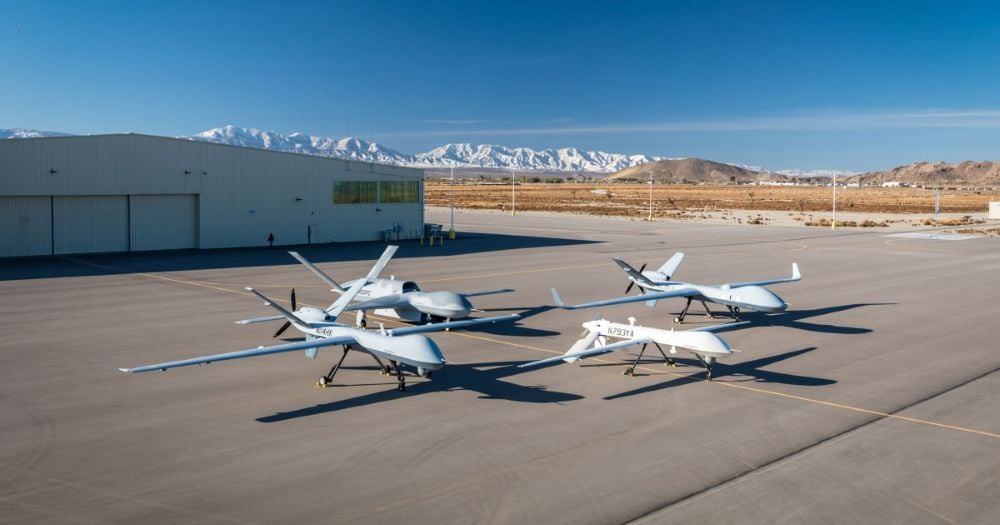
What happened
- Aviation Week reported the Wildfire concept first; The War Zone then reported General Atomics had submitted it to the Pentagon's Massed Modular Aircraft program.
- The Air Force held 165 MQ-9As at the start of fiscal 2026, down from 231 a year earlier, with the type out of production.
- Winning MMA proposals must reach full-scale prototype flight testing within 21 months of award, with initial operating capability targeted for fiscal 2031.
Why it matters
- constraint Writing attrition and multi-aircraft control into the requirement forecloses the exquisite-platform answer: whatever wins has to be affordable enough to lose in numbers, which caps what any bidder...
- exposure With the production line closed and the fleet falling faster than the program can field anything, the medium-altitude surveillance and strike gap lands on combatant commands for most of the rest...
- contradiction DIU describes MMA as cost-effective mass while the leading incumbent answers with cruise missiles and intercontinental transit range, and with no cost target published, nobody outside the...
- decision General Atomics is pushing the buyer toward funding two things rather than one, a near-term replenishment and a 2031 aircraft, which turns a single competition into a budget argument about bridging.
The number that governs how this competition should be read is not the ferry range. It is 135, the MQ-9A count Air Force Lt. Gen. David Tabor gave Congress in May [9], against 231 at the start of fiscal 2025 [8]. That is 96 airframes gone, about 42 percent of the fleet [17], with the MQ-9A out of production [7] and nothing new arriving before the fiscal 2031 initial operating capability that MMA targets [10]. The reporting does not date the May testimony by year, so the slope between those two counts is not fixed [23]. The fiscal 2025 decline on its own was 66 aircraft [18]; at that rate the surviving 135 would be gone in roughly two years, four years short of MMA fielding anything [24].
Set the Defense Innovation Unit's requirement list against that arithmetic and the interesting line is not the range. DIU asks for at least 2,800 pounds of payload, an unrefueled combat radius of at least 2,300 nautical miles, self-deployment of more than 8,000 nautical miles one way, modular payloads including full-motion video, and potentially a single operator controlling multiple aircraft [4]. That last item prices all the others. An aircraft one person flies several of at once is an aircraft the buyer has already decided to lose, which is the premise DIU states outright: the program is built around the expectation of attrition in a high-end fight rather than small numbers of expensive airframes [5].
General Atomics clears the transit bar by 25 percent, with a 10,000-nautical-mile ferry figure [6][20], and that is where the 11,500-mile headline number comes from [15][21]. Ferry range is transit; DIU already separates it from the 2,300-nautical-mile combat radius [4]. Distance is the cheapest thing on the sheet to advertise.
The friction sits between the two descriptions of the same program. DIU wants something cost-effective that can operate in significant numbers and do MQ-9A work [3]. General Atomics proposes up to four AGM-158C anti-ship missiles and semi-autonomous coordination of as many as 100 aircraft [6], explicitly pitching above the baseline [16], while disputing that MMA is a Reaper replacement at all and arguing the services need both a near-term top-up of lost medium-altitude capacity and a separate future aircraft [11]. No unit cost or target quantity appears in the reporting [22]. One hundred coordinated aircraft is about 74 percent of the entire current MQ-9A inventory [19], so the coordination claim only means anything if the coordinated units cost a small fraction of a Reaper, and no fraction has been named.
Wildfire remains a concept with no detailed specifications or images released [13], and spokesman C. Mark Brinkley says the company will pursue it whether or not it wins [12]. Which makes the submission useful mainly as evidence about the customer. The Pentagon is specifying the successor to an aircraft it has been losing in engagements involving Iran and the Houthis [14] as one element of a formation, not as a better single unit [5]. Whether that element can also haul four cruise missiles across an ocean is a question about a vendor's catalogue [6].
What to watch
- Whether DIU publishes a target unit cost or buy quantity for MMA, which is what settles if coordinating 100 aircraft is procurable or decorative.
- Whether the Air Force funds any interim medium-altitude buy before fiscal 2031, or lets the MQ-9A count keep falling.
- Whether General Atomics releases Wildfire specifications and imagery, or the concept stays a paper entry beside its other MMA bidders.
Clarity's read
What the record supports and how the coverage leans. The claims behind it follow.
Reality
- Evidence32
- Adoption12
- Hype gap+46
- Incentives72
- Confidence44
Claim ledger
Ranked by verification strength, evidence, and original report placement.
- [1]
General Atomics unveiled plans for Wildfire, a long-range unmanned aircraft concept positioned as a possible answer to the eventual need for an MQ-9 Reaper successor.
- [2]
Aviation Week was first to report the emergence of the Wildfire concept; The War Zone subsequently reported that General Atomics had submitted the aircraft for the Pentagon's Massed Modular Aircraft (MMA) program.
- [3]
The MMA initiative is led by the Defense Innovation Unit and seeks a cost-effective, theater-range, modular unmanned aircraft that can operate in significant numbers and perform missions currently associated with the MQ-9A Reaper.
- [4]
DIU is seeking an aircraft with at least 2,800 pounds of payload capacity, an unrefueled combat radius of at least 2,300 nautical miles, the ability to self-deploy more than 8,000 nautical miles one way, support for modular payloads including full-motion video sensors, and potentially the ability for a single operator to control multiple aircraft.
- [5]
Rather than relying exclusively on relatively small numbers of expensive, high-value aircraft, the MMA program is designed around the expectation that losses will occur in a high-end conflict.
- [6]
According to The War Zone, General Atomics is exploring a design with a 10,000-nautical-mile ferry range, the potential to carry up to four AGM-158C Long Range Anti-Ship Missiles, and the ability to coordinate swarms of as many as 100 aircraft under semi-autonomous control.
- [7]
The MQ-9A is no longer in production, complicating efforts to replenish the fleet.
- [8]
According to figures cited by The War Zone, the Air Force had 165 MQ-9As at the start of fiscal year 2026, down from 231 at the beginning of fiscal year 2025.
- [9]
By May, Air Force Lt. Gen. David Tabor told Congress that the MQ-9A fleet had fallen to 135 aircraft.
- [10]
MMA proposals are expected to begin full-scale prototype flight testing within 21 months of contract award, and the program targets an initial operating capability in fiscal year 2031.
- [11]
General Atomics has pushed back against describing MMA simply as a Reaper replacement, arguing the U.S. military needs both an immediate solution to replenish lost MALE drone capacity and a longer-term aircraft designed for future conflicts.
- [12]
General Atomics spokesman C. Mark Brinkley told The War Zone that Wildfire is not dependent on winning the MMA program.
- [13]
Detailed specifications and images of Wildfire have not yet been released, and the aircraft remains a concept.
- [14]
The Reaper fleet has suffered significant attrition in operations involving Iran and the Houthis, adding to concerns about the aircraft's vulnerability against a more capable adversary.
- [15]
The published headline on the Wildfire report describes the drone as having an 11,500-mile range and the ability to carry anti-ship missiles.
- [16]
General Atomics is pitching Wildfire as a platform that could go beyond the baseline MMA requirements.
- [17]
The drop from 231 MQ-9As to 135 is 96 aircraft, about 42 percent of the earlier total.
- [18]
The fiscal 2025 decline alone, from 231 to 165, was 66 aircraft, about 29 percent.
- [19]
A 100-aircraft coordinated group equals about 74 percent of the 135-aircraft MQ-9A fleet reported to Congress.
- [20]
A 10,000-nautical-mile ferry range exceeds DIU's stated minimum self-deployment distance of 8,000 nautical miles by 25 percent.
- [21]
The 11,500-mile figure corresponds to the 10,000-nautical-mile ferry range (10,000 x 1.15078 = 11,508 statute miles), not to the combat radius.
- [22]
No unit cost figure or planned buy quantity for MMA appears in the reporting, despite the program being described as cost-effective.
- [23]
The reporting gives the 135-aircraft May figure without specifying its year relative to the fiscal 2026 count of 165, so the elapsed interval between the 231 and 135 counts is not fixed by the source.
- [24]
At the fiscal 2025 loss rate of 66 aircraft a year, the remaining 135 MQ-9As would be exhausted in roughly two years, about four years before the fiscal 2031 MMA initial operating capability.
Get this ledger inside ChatGPT. Ask about any of our stories and the answer brings its figure, each claim’s verdict and the sources. Free, no account.
Sources
1 independent publisher whose own reporting we read for this story.
Topics and entities
Follow any of these and your For You feed starts watching them — no settings page required.
Topics
Entities
- General AtomicsFollow
- AGM-158C LRASMFollow
- U.S. Air ForceFollow
- Massed Modular Aircraft (MMA)Follow
- C. Mark BrinkleyFollow
- Aviation WeekFollow
- MQ-9 ReaperFollow
- The War ZoneFollow
- Defense Innovation UnitFollow
- David TaborFollow
- WildfireFollow