Science1 publisher3 min readPublished
ATLAS measures proton-oxygen collisions more precisely than the shower models differ
The LHC spent part of July 2025 colliding protons with oxygen nuclei to imitate a cosmic ray hitting air, and ATLAS's measurement is now finer than the disagreements among the seven codes used to model showers.
The Scientist · Science desk
What happened
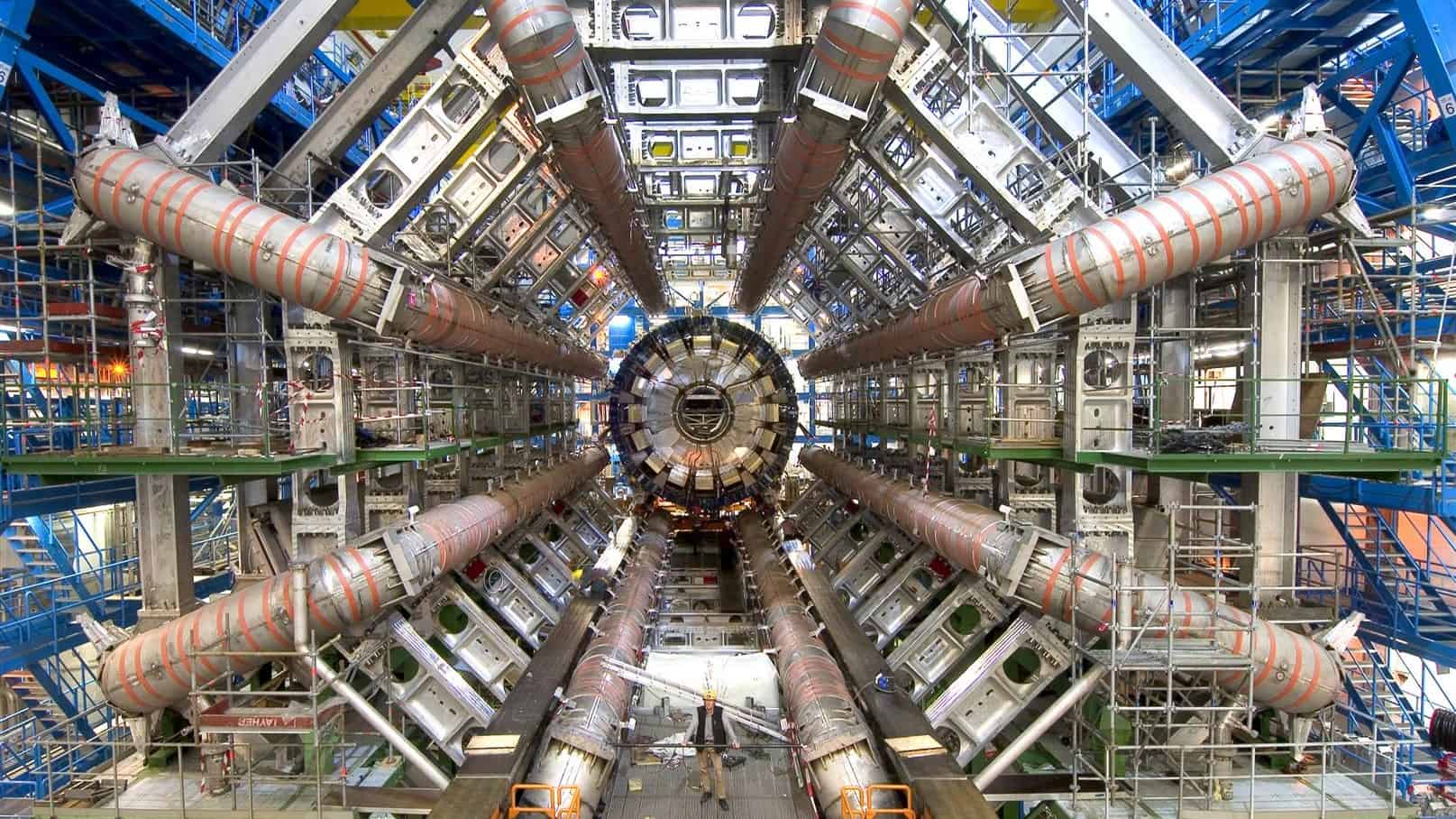
- In July 2025 CERN reconfigured the LHC to collide protons with oxygen nuclei, the protons standing in for cosmic rays and the oxygen for Earth's atmosphere, and ATLAS recorded the charged particles produced.
- ATLAS counted how many particles came out of those collisions, logged their energies and angles, and measured the cross section that fixes how often such collisions happen at all.
- According to lead author Jesse Liu, the measurement is more than ten times more precise than the differences between the existing codes, and none of them reproduces the number of particles created.
Compiled by The ScientistSomething wrong?How this is made
Why it matters
- capability Accelerator data finer than the spread between the codes let model builders test the disagreements one at a time, instead of carrying the spread as a systematic uncertainty on everything downstream.
- constraint Cosmic-ray mass composition inherits whatever the cross section gets wrong, since that number sets how deep in the atmosphere a shower starts.
- decision The groups maintaining these codes now have to pick which observable to fit first, because the one that best matches energies and directions still misses the particle counts.
- precedent Kampert says the cosmic-ray community spent more than a decade asking CERN for measurements like this, and the published result gives the next request a result to point at.
The codes disagree because nobody can calculate these collisions from first principles. The strong nuclear force that governs them is notoriously hard to compute, so the simulations use models informed by accelerator data [27]. Liu said existing models "widely disagree with one another on how these showers form" [26]. Until this run, the LHC's beams had been protons or heavy nuclei such as lead, not the light nitrogen and oxygen nuclei found in air [22].
ATLAS's value for the cross section sits at the low end of the predictions and agrees with two of the seven codes tested [7]. The other five disagree with the data [8]. Karl-Heinz Kampert of the University of Wuppertal, who was not involved in the study, called the cross section "a key parameter" because it determines the average depth at which cosmic rays first interact in the atmosphere [9][21]. That depth, he said, affects "essentially all air-shower measurements that are needed to infer the mass" of the incoming particle [10].
"Our data show that no model correctly describes the number of particles created in these collisions," Liu said [11]. On counts the codes do worse. Some models misjudge the frequency of rare, particle-rich collisions by a factor of ten [12]. A model called Angantyr best reproduces the energies and directions the particles fly out at, and no model describes all the results consistently [13].
Kampert set the comparison at a hundred billion-billion electron volts or more for the most energetic cosmic rays against the million-million electron volts achieved by the LHC [15], a factor of roughly a hundred million [16]. None of the new data touches that gap. "We must extrapolate the known properties of particle interactions at man-made accelerators to those occurring in the upper atmosphere," he said [17]. At the top of the spectrum there is no direct route: about one such particle hits each square kilometre of the Earth's surface per century [18], so a 100 square kilometre array collects about one a year [19]. "The only way to measure them in sufficient numbers is to detect the extensive air showers they produce," Kampert said [20].
Multipurpose detectors like ATLAS and CMS are optimized to track particles flying out at relatively large angles to the beam, Kampert said, and "most of the collision energy remains unseen by ATLAS and CMS" [24][25]. The energy that escapes the measurement is carried by particles at small angles, close to the beam line [30].
The physicsworld account covers counts, energies, angles and the cross section, and does not report a test of muon production in showers or any retuning of a model on the new data [29]. One result does line up with what cosmic-ray observatories already do: the team used its number to infer the cross section for protons colliding with air, a quantity previously measured at such high energies only by those observatories, and it agrees with the earlier air-shower measurements at similar energies [14].
What to watch
- Whether any shower code is retuned on the ATLAS proton-oxygen data, and whether mass-composition results from air-shower arrays move when it is.
- A measurement of the forward region, where Kampert says most of the collision energy goes unseen by ATLAS and CMS.
- Whether CERN schedules further light-ion running, including the nitrogen nuclei that also make up air.