ScienceNot yet confirmed elsewhere1 publisher2 min readPublished
Most distant fast radio burst yet comes from a dwarf galaxy 1,000 times less massive than expected
Astronomers led by Manisha Caleb report FRB 20240304B, the most distant fast radio burst yet, emitted about 3 billion years after the Big Bang. Its host is a dwarf galaxy 1,000 times less massive than expected, and the team favors a magnetar as the source.
The Scientist · Science desk
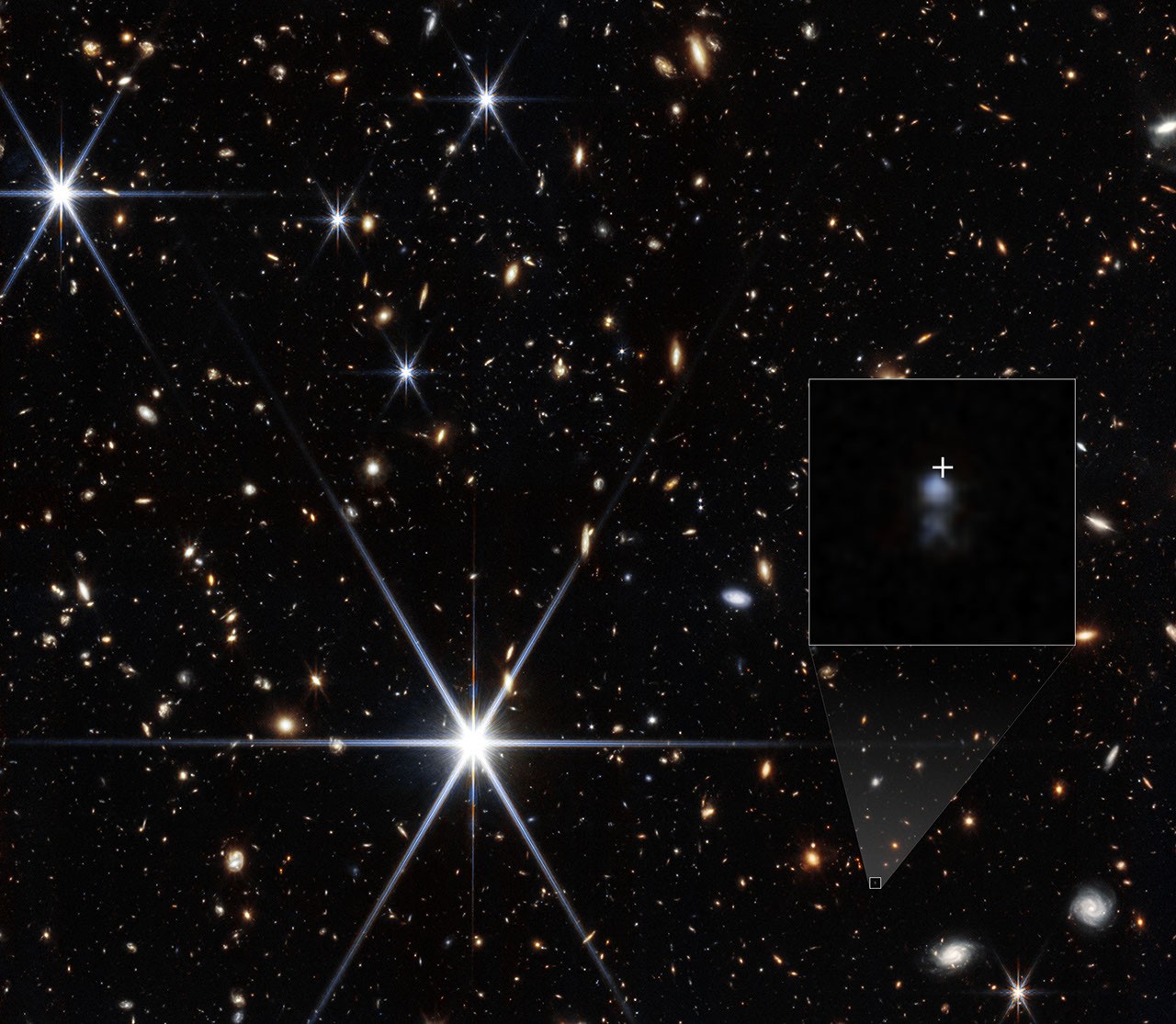
Key figures: about 90 percent of the host galaxy's stellar mass formed in the past 30 million years; the burst comes from cosmic noon, 3 billion years after the Big Bang; Prochaska says theorists have devised nearly 100 FRB models.
| Figure | Value | Note | Claim |
|---|---|---|---|
| Host's stellar mass formed in past 30 million years | 90 percent, about | 10 | |
| Burst era, after Big Bang | 3 billion years | 5 | |
| Prochaska: FRB models | 100 models, nearly | 14 |
What happened
- MeerKAT, a 64-antenna radio telescope in South Africa, identified the burst in March 2024.
- Two ultra-sensitive ground telescopes were then pointed at the same patch of sky and found no host galaxy at all.
- The team then called in JWST, and its infrared sensitivity located the faint host that the ground instruments had missed.
- The burst comes from cosmic noon, an era when star formation across the Universe was at its peak.
- The work is published in Science and draws on multiple observatories in an international collaboration.
Why it matters
- constraint A young host can remove one origin channel for one burst. Every other proposed model still needs a burst or a host that speaks against it.
- capability Host searches for distant bursts that stop at ground-based depth can record 'no host' for a burst that has one, as happened here before JWST looked.
- precedent Any further burst traced to a young host at this epoch would be read against this one, and the timing argument would then rest on more than a single galaxy.
The timing is what carries the inference. About 90 percent of the host galaxy's stellar mass formed in the past 30 million years [10]. Neutron stars orbit each other for billions of years before they collide [12], so a merger is a poor fit for a galaxy that young. A magnetar needs only millions of years to take shape and give up its magnetic energy, and that holds especially in a metal-poor galaxy that breeds massive stars [13].
The host was a surprise on size as well. "We thought it would be a big, nicely formed galaxy with lots of stars, and instead it was a little dwarf galaxy, although it was actively forming stars," said Caleb, a radio astronomer and astrophysicist at the University of Sydney and lead author of the study [17][3].
In our view, the young host is good evidence against a merger origin for this burst and weaker evidence for a magnetar. The thing this doesn't tell you is whether magnetars produce most bursts or whether this galaxy is unusual. ScienceAlert's account of the Science paper does not say how many other bursts have been traced to galaxies at this distance [4], and a sample of one has nothing to be compared against.
J. Xavier Prochaska, an astronomer and astrophysicist at the University of California, Santa Cruz, was asked why the bursts have resisted identification [20]. He said that "the energies involved are modest. They are extreme for radio wave emission, but nothing like the energy in a supernova or gamma-ray burst" [18]. Theorists have devised nearly 100 models to generate them [14]. "We observationalists can only kill models, never prove them. So, when you have 100 to kill, it takes a fair bit of time," Prochaska said [15].
Caleb described where that leaves the field: "We have theories for what objects produce them, but we don't have conclusive proof" [16].
What to watch
- Whether other cosmic-noon bursts located with JWST also sit in young, low-mass galaxies, which would turn this one case into a pattern.
- Whether host measurements like this rule out any of the other proposed models, or only the merger channel.
- The Science paper itself, for the burst's distance measurement and the uncertainty on the host's mass and age; ScienceAlert's summary gives round numbers.
Clarity's read
What the record supports and how the coverage leans. The claims behind it follow.
Reality
- Evidence62
- Adoption
- Insufficient
- Hype gap+12
- Incentives
- Insufficient
- Confidence60
Claim ledger
Ranked by verification strength, evidence, and original report placement.
- [1]
Astronomers have reported FRB 20240304B as the most distant fast radio burst yet.
- [3]
Manisha Caleb, lead author of the study, is a radio astronomer and astrophysicist at the University of Sydney.
- [4]
The study is published in the journal Science and is the work of a large international collaboration that used multiple observatories.
- [5]
The burst comes from cosmic noon, an era only 3 billion years after the Big Bang when Universal star formation was at its peak.
- [6]
The astronomers identified the FRB in March 2024 using MeerKAT, a 64-antenna radio telescope in South Africa.
- [7]
Two ultra-sensitive ground telescopes pointed at the corresponding patch of sky found no host galaxy.
- [8]
The team called in JWST and its infrared sensitivity, which located the host galaxy.
- [9]
The host dwarf galaxy is 1,000 times less massive than expected.
- [10]
About 90 percent of the host galaxy's stellar mass formed in the past 30 million years.
- [11]
The host galaxy's properties helped the astronomers favor a magnetar as the potential source of the burst.
- [12]
Neutron stars dance around each other for billions of years before colliding, so a neutron star merger would not make sense in a young galaxy.
- [13]
Magnetars can form and release their magnetic energy in just millions of years, especially in a metal-poor galaxy that breeds massive stars.
- [14]
Theorists have devised nearly 100 models to generate fast radio bursts.
- [15]
"We observationalists can only kill models, never prove them. So, when you have 100 to kill, it takes a fair bit of time."
- [16]
"We have theories for what objects produce them, but we don't have conclusive proof."
- [17]
"We thought it would be a big, nicely formed galaxy with lots of stars, and instead it was a little dwarf galaxy, although it was actively forming stars,"
- [18]
"the energies involved are modest. They are extreme for radio wave emission, but nothing like the energy in a supernova or gamma-ray burst"
ReportedSupportedSource: J. Xavier Prochaska, University of California, Santa Cruz, to ScienceAlertView cited source - [19]
Fast radio bursts were discovered in 2007 and their origins have been difficult to pin down for nearly two decades.
- [20]
J. Xavier Prochaska is an astronomer and astrophysicist at the University of California, Santa Cruz, and spoke to ScienceAlert about why fast radio bursts have been hard to identify.
Sources
1 independent publisher whose own reporting we read for this story.
Topics and entities
Follow any of these and your For You feed starts watching them — no settings page required.
Topics
- Fast Radio BurstsFollow
- Radio AstronomyFollow
- MagnetarsFollow