Science3 publishers3 min readPublished
MeerKAT pins repeating radio bursts to the giant planet Beta Pictoris b
The team used distant quasars as fixed reference points to separate the planet's signal from its star's, then read a magnetic field of at least 1,250 gauss off the emission. The preprint has not been peer reviewed.
The Scientist · Science desk
What happened
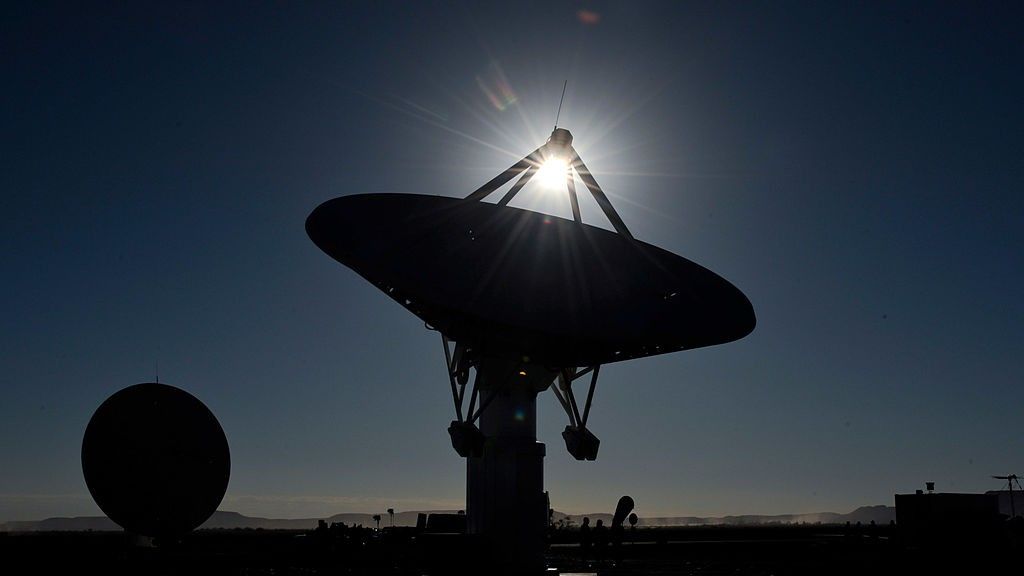
- A team led by Kevin Ortiz Ceballos at the Center for Astrophysics, Harvard and Smithsonian, used South Africa's MeerKAT array to pick up faint, repeating radio bursts from the Beta Pictoris system.
- Beta Pictoris b is a gas giant 64 light-years from Earth with a mass roughly ten times Jupiter's, according to NASA.
- The paper was submitted to arXiv on September 15 and has not yet been through peer review.
Compiled by The ScientistSomething wrong?How this is made
Why it matters
- capability Interior models of giant planets have had solar system fields and theory to work with; a measured field for a young ten-Jupiter-mass object gives them an external number to be tested against.
- constraint The technique landed on the easiest available target, a young massive planet with an exceptionally strong field, so the smaller worlds where magnetic shielding decides whether an atmosphere survives are still out of reach at this sensitivity.
- contradiction The authors report a first direct detection of auroral radio emission, while Callingham, who was not involved, will go no further than probably auroral until someone sees the emission pulse with the planet's spin.
- precedent Radio technosignature searches now have a documented natural planetary emitter to exclude, plus two concrete tests that did the excluding here: astrometric localization against fixed quasars, and circular polarization.
Localizing the source has been the hurdle for this kind of work. Earlier radio detections from exoplanetary systems could not be traced to the planet rather than the star [5]. The group handled it with astrometry. They compared their MeerKAT images against the precise positions of extremely distant background quasars, which act as fixed markers, and used them to plot where the star and the planet should sit. The radio signal lined up with Beta Pictoris b [7]. "We can rule out the star, and ... we can say that it's from this one particular planet," Yvette Cendes of the University of Oregon, a member of the team, said [8].
The second line of evidence is polarization. Auroral radio emission is circularly polarized, meaning the orientation of the waves rotates in a circle, and that is what the researchers saw from Beta Pictoris b [9]. The emission comes from charged particles circling in the planet's magnetic field and exciting molecules in its atmosphere [10].
From those measurements the team derived a field of at least 1,250 gauss at the region where the radio waves are produced [13]. Earth's field is about 0.5 gauss and Jupiter's about 4.3 [14], which puts the planet's value at roughly 290 times Jupiter's [15] and about 2,500 times Earth's [16]. "This constitutes the first direct measurement of magnetic field strength for an exoplanet," the authors wrote [12].
The figure is a lower bound at one location, not a global surface field [13]. It is also close to what theory expected: the authors say it matches predictions for the fields generated by young, massive giant planets [17], and at ten Jupiter masses this object sits near the brown dwarf regime, where observed auroras already imply fields of thousands of gauss [18]. "It's an incredibly, incredibly strong magnetic field, much stronger than anything in our solar system," Cendes said [19].
Joe Callingham of the University of Amsterdam, who was not involved, told Science News that clinching the aurora interpretation would take seeing the radio waves pulsate in time, since the aurora should rotate in and out of view as the planet spins, roughly once every eight hours [22]. "So TBD, but, compelling," he said. "It's probably auroral" [23].
The SETI question is the one readers reach for first, and the team knows it. "When people see 'radio signal from an exoplanet,' they think aliens," Cendes said [31]. Live Science notes that technosignatures are a key focus of the search for extraterrestrial intelligence, and that radio signals can be emitted by natural sources too [26]. Suzanne Aigrain, an astrophysics professor at Oxford who was not involved in the study [34], named two: "There are two natural processes that can produce radio emission in exoplanets," she said, listing magnetic reconnection between a close-orbiting planet's field and its star's, and aurorae driven by stellar particles hitting the upper atmosphere [24]. She said the second is what the authors believe they detected [25], and added: "this is definitely not aliens!" [27].
What the measurement is actually for is interior physics. Aigrain said magnetic field measurements matter because how magnetospheres are generated, and what sets their strength, is not fully understood [35]. A field also shields an atmosphere: "On Earth, for example, the magnetic field has played a key role in retaining the atmosphere and shielding life on the planet from harmful high-energy radiation," she said [28]. "The planet in this paper is quite massive and has a thick atmosphere, so even without a strong magnetic field it could probably hold on to its atmosphere, and it is not expected to host life," she said [29].
What to watch
- Peer review of the arXiv preprint, and whether the at-least-1,250-gauss lower bound survives into a published version.
- The Square Kilometre Array, for which MeerKAT is a pathfinder, is expected online in the next few years; Aigrain says it will be significantly more powerful and open up many more systems.
- An independent detection of the same bursts, localized to the planet by another array.