ScienceReports disagree3 publishers3 min readPublished
Fourteen shark teeth place a nutrient-rich Cretaceous shelf under Egypt's Western Desert
The Abu-Tartur assemblage now runs to seven lamniform species. The phosphate bed that preserved them is a condensed section, which is why the authors read productivity out of it rather than a living community.
The Scientist · Science desk
What happened
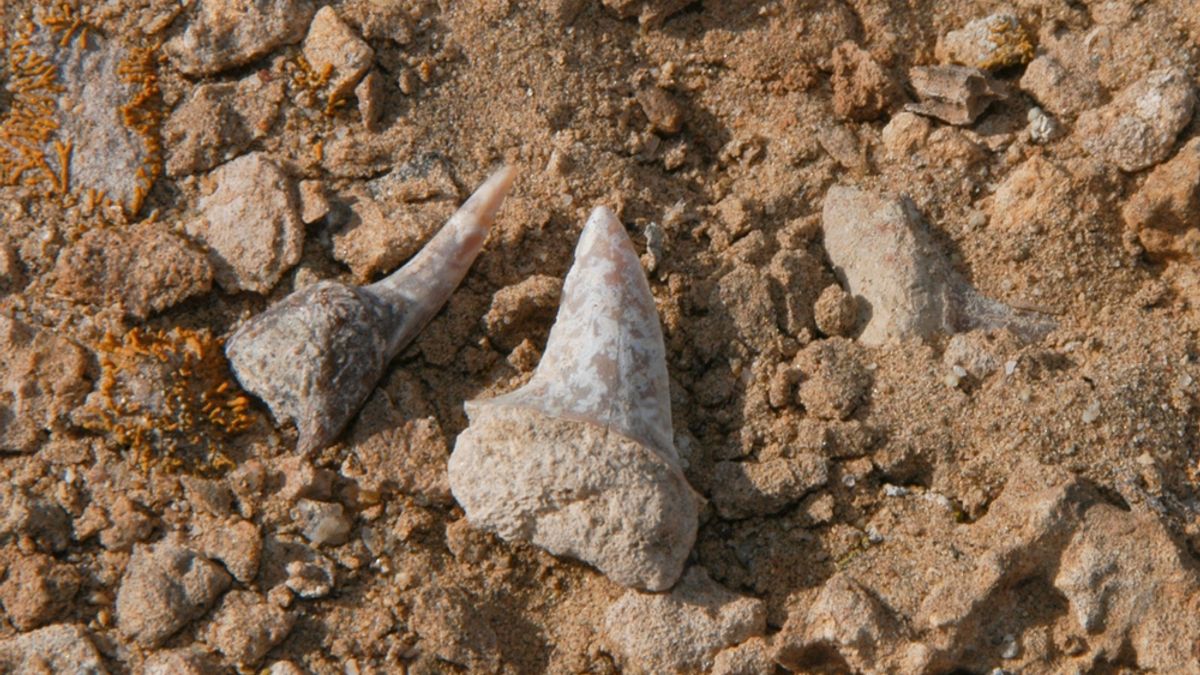
- Fourteen fossil shark teeth surface-collected from a phosphate bed in the Abu-Tartur mine area between 2020 and 2022 were attributed to at least five extinct lamniform species.
- Added to two mackerel shark species the same team had already identified at the site, the tally for the Abu-Tartur region now reaches seven.
- Two of the newly identified species, Serratolamna serrata and Squalicorax bassanii, had not previously been reported anywhere in Egypt.
- One specimen is assigned to Scapanorhynchus raphiodon, a goblin shark relative with no prior record anywhere in Africa, and possibly the youngest known occurrence of the species.
Why it matters
- constraint Time-averaging caps what the site can contribute to palaeoclimate work: it bounds how productive the shelf was, but it cannot hand modellers a dated community, so it enters as a setting rather than a time series.
- exposure The fossil archive and the ore body are the same rock, since the plateau holds one of Egypt's largest phosphate reserves, so whoever works the phosphate also governs access to what is left to collect.
- contradiction Only the phys.org account carried the authors' caveat that the possible youngest-appearance record awaits more specimens, so readers of the other two write-ups would weight a single tooth more heavily than the study does.
- capability Because the teeth were picked off the surface rather than excavated, the method is cheap enough to repeat across other phosphate beds in the Duwi Formation, and the team says it intends to keep looking.
Phosphorite is what you get when the sea floor almost stops receiving sediment but keeps receiving dead organisms. Phosphate in the water column drives phytoplankton productivity, and phytoplankton is the base of the whole marine food web, according to a Springer Nature source cited by Discover Magazine [20]. At Abu-Tartur, organic-rich sediment accumulated under Late Cretaceous marine conditions and hardened into thick phosphorite beds [13]. The result is rock that is unusually rich in fossils and unusually poor in time, and the authors say so in plain terms: a condensed section formed during phases of low sedimentation but high biogenic input, yielding time-averaged accumulations that integrate taxa from multiple ecological niches [9].
That single sentence governs how much weight the assemblage can carry. Fourteen teeth across at least five species works out to a mean of 2.8 teeth per species [22]. That is a presence list rather than an abundance structure, so it says which predators were present without saying which one was common, and it leaves open who actually overlapped in life. Discover Magazine dates the relevant interval to roughly 100.5 to 66 million years ago [17], a window 34.5 million years wide [24], and the bed does not resolve within it. Live Science's report is explicit that the remains may simply have been jumbled into the same sediment over time [12].
What the bed does support is a setting. The authors describe a nutrient-enriched, high-productivity ecosystem along a phosphogenic shelf margin, most likely developed during a transgressive systems tract [10]. Read carefully, it is a statement about sea level and nutrient supply rather than a measured temperature. First author Tarek Yassin of Cairo University told Live Science the area was once a sea with conditions suitable for flourishing marine life, including favourable temperatures, sunlight and appropriate oxygen levels [19]; those conditions are inferred from the animals present, since the teeth were identified by comparing shapes and features against published records and museum specimens [18]. The temperature figure in this story comes from elsewhere, from the Natural History Museum in London, which puts Cretaceous sea level up to 558 feet, or 170 metres, above today's [16].
The taxonomic headline deserves the same discipline. The Scapanorhynchus raphiodon identification rests on one specimen, and the authors themselves note that its apparent status as the youngest known appearance of the species awaits confirmation from more material and further taxonomic work [7]. The sea these animals lived in closed by about 50 million years ago, when Gondwanan fragments collided with Eurasia and raised the mountain belt running from the Alps to the Himalayas, according to Britannica as cited by Discover [21]. That collision is why the shelf is now a plateau you can walk across.
What to watch
- More Scapanorhynchus raphiodon material, which is what the authors say the youngest-appearance claim requires before it stands.
- Whether follow-up collecting logs teeth bed by bed instead of off the surface, which is the only way this deposit gains time resolution.
- Any geochemical or isotope work on the same phosphorite, which would put a measured temperature where the fauna currently supplies an inference.
Clarity's read
What the record supports and how the coverage leans. The claims behind it follow.
Reality
- Evidence62
- Adoption20
- Hype gap+18
- Incentives40
- Confidence71
Perspective Coverage
3 publishers- Builder
- Builder 38%
- Operator
- Operator 34%
- Investor
- Investor 28%
Claim ledger
Ranked by verification strength, evidence, and original report placement.
- [1]
Fourteen fossilized shark teeth were surface-collected from a phosphate bed in the Abu-Tartur mine area of Egypt's Western Desert between 2020 and 2022, and were attributed to at least five additional extinct lamniform shark species.
- [2]
The researchers detailed the discovery in a study published Aug. 18 in the journal Cretaceous Research.
- [3]
The study is Yassin, T., Carrillo-Briceno, J. D., Kindlimann, R., Ibrahim, A., & AbdelGawad, M. K., "Egyptian shark graveyard: New Late Cretaceous Lamniform shark Assemblage from Duwi Formation of Abu-Tartur Area, Southwestern desert, Egypt," Cretaceous Research, DOI 10.1016/j.cretres.2026.106476.
- [4]
The same team had previously discovered several fossilized teeth from two types of lamniform sharks, also known as mackerel sharks, in the area.
- [5]
Two of the species, Serratolamna serrata and Squalicorax bassanii, had never been reported in Egypt before.
- [6]
One specimen is attributed to Scapanorhynchus raphiodon, an ancient relative of today's goblin shark, which had never been reported anywhere in Africa before.
- [7]
The find may also be the youngest known appearance of Scapanorhynchus raphiodon in the fossil record, but that apparent record still needs confirmation from more specimens and future taxonomic work.
- [8]
The new material was a surface collection of 14 fossil shark teeth from a phosphate bed in the Abu-Tartur mine area.
- [9]
The study authors write that the phosphatic nature of the deposit demonstrates a condensed section, formed during phases of low sedimentation but high biogenic input, resulting in time-averaged fossil accumulations that integrate taxa from multiple ecological niches.
ReportedSupportedSource: Yassin et al., Cretaceous Research, quoted by phys.org3 sources— create a free account to open them - [10]
The authors describe the assemblage as highlighting a nutrient-enriched, high-productivity marine ecosystem along a phosphogenic shelf margin, most likely developed during a transgressive systems tract in the Late Cretaceous.
ReportedSupportedSource: Yassin et al., Cretaceous Research, quoted by phys.org3 sources— create a free account to open them - [11]
The study authors note that the phosphate bed may have mixed remains accumulated over time from different habitats rather than capturing one short period in the ecosystem.
- [12]
Live Science reports that the discovery does not necessarily mean these sharks coexisted; their remains may have become jumbled together in the same sediment over time, the study authors noted.
- [13]
The Abu-Tartur Plateau holds one of the largest phosphate reserves in Egypt, and its phosphate resulted from ancient Late Cretaceous marine conditions in which organic-rich sediments accumulated and transformed into thick phosphorite beds.
- [14]
Fossils from the Duwi Formation, which stretches across Egypt and includes the Abu-Tartur Plateau, had already indicated a rich marine ecosystem with fish, sea turtles and marine reptiles.
- [15]
The five newly identified species bring the total number of shark species known from the Abu-Tartur region to seven.
- [16]
During the Cretaceous (145 million to 66 million years ago) temperatures on Earth were generally warmer than today, with sea levels up to 558 feet (170 meters) higher than now, according to the Natural History Museum in London.
ReportedSupportedSource: Natural History Museum, London, cited by Live Science2 sources— create a free account to open them - [17]
Discover Magazine dates the submerged North African interval represented by the site to around 100.5 million to 66 million years ago.
- [18]
The researchers identified the teeth by comparing their shapes and features with published records and museum specimens.
- [19]
Study first author Tarek Yassin, a paleontologist at Cairo University, told Live Science the study provides evidence the area now occupied by the plateau was once a sea with flourishing marine life and environmental conditions suitable for it, including favourable temperatures, sunlight and appropriate oxygen levels.
ReportedSupportedSource: Tarek Yassin, Cairo University, to Live Science1 source— create a free account to open them - [20]
Oceanic phosphate levels are known to drive the productivity of phytoplankton, the food source that acts as the pillar for the whole marine biosphere, according to Springer Nature as cited by Discover Magazine.
ReportedSupportedSource: Springer Nature, cited by Discover Magazine1 source— create a free account to open them - [21]
The Tethys Sea closed by around 50 million years ago when continental fragments of Gondwana collided with the Eurasian landmass, forming major mountain ranges from the Alps to the Himalayas, according to Britannica as cited by Discover Magazine.
ReportedSupportedSource: Britannica, cited by Discover Magazine1 source— create a free account to open them - [22]
Fourteen teeth attributed to at least five species is a mean of 2.8 teeth per species.
- [23]
The team plans to continue its research in the Abu-Tartur Plateau and explore the surrounding area, with Yassin saying they believe there is still much more to discover.
- [24]
The interval Discover Magazine gives for the site spans 34.5 million years.
- [25]
The new teeth ranged from needle-like to triangular and serrated, and their coloration varied from dark brown to yellow.
Sources
3 independent publishers whose own reporting we read for this story.
- discovermagazine.comShark Graveyard in Egypt Reveals Five Extinct Shark Species From a Colorful Collection of Teeth
1 article · August 26, 2026
- livescience.comAncient shark 'graveyard' uncovered in Egyptian desert
1 article · August 27, 2026
- phys.orgEgypt's deserts were once home to a diverse shark community
1 article · August 25, 2026
Topics and entities
Follow any of these and your For You feed starts watching them — no settings page required.
Topics
- Taphonomy and condensed sectionsFollow
- Vertebrate PaleontologyFollow
- Phosphorite geologyFollow
- Late Cretaceous marine ecosystemsFollow
- Science CommunicationFollow
- Shark evolutionFollow
- Egypt's fossil recordFollow
Entities
- Cairo UniversityFollow
- Abu-Tartur PlateauFollow
- Tethys SeaFollow
- Rene KindlimannFollow
- Jorge D. Carrillo-BricenoFollow
- Duwi FormationFollow
- M. K. AbdelGawadFollow
- Scapanorhynchus raphiodonFollow
- Serratolamna serrataFollow
- Squalicorax bassaniiFollow
- Goblin shark (Mitsukurina owstoni)Follow
- Natural History Museum, LondonFollow
- Cretaceous ResearchFollow
- Tarek YassinFollow