Duct tape on a door's exterior cut flood leakage by 97% to 98% in Hull lab tests
Correctly applied exterior duct tape cut water leakage through household doors by 97% to 98% in University of Hull lab tests. The researchers say it cannot stop water coming through walls, floors or drains.
The Scientist · Science desk
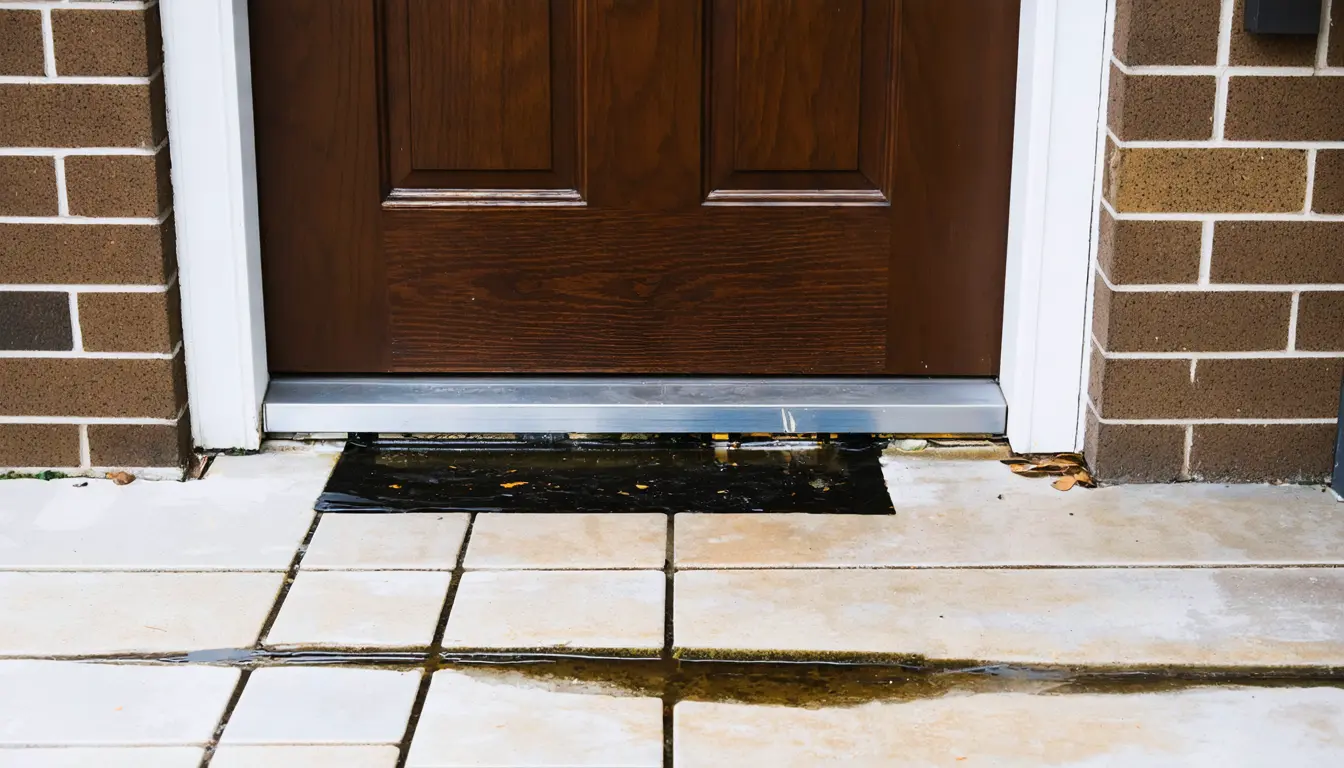
Key figures: sandbags at their most effective cut door leakage by 70% against an unprotected door; correctly applied exterior duct tape cut it by 97% to 98%; test water depth rose to a maximum of 60 cm.
| Figure | Value | Note | Claim |
|---|---|---|---|
| Sandbags' leakage cut, at their most effective | 70% | 8 | |
| Exterior duct tape leakage cut, at least | 97% | up to 98% | 1 |
| Maximum test water depth | 60 cm | 3 |
What happened
- Water depth rose in 5 cm steps to a maximum of 60 cm, and leakage was captured in a sealed enclosure behind each door and measured continuously.
- Sandbags cut leakage by 70% at their best, and their performance varied with water depth.
- Specialized sealing tapes achieved even greater reductions in leakage than duct tape did.
Why it matters
- What it limits constraint A household gets the lab figure only if its door, frame, surfaces and seal resemble the test conditions, and the source says the result depends on all of them.
- Who's exposed exposure Taping a door leaves walls, floors and drains open as routes for water, and properties at significant flood risk still need professionally assessed protection.
- Who has to decide decision A household that already keeps a flood kit has a cheap item to add: a roll at 10 pounds or less, with no sandbag haulage or contaminated-bag disposal.
Read the result as a residual. A 97% to 98% cut leaves 2% to 3% of the unprotected leak still coming through [16]. Sandbags, at their most effective, left 30% [17]. Set the sandbags' best case against the tape range and the sandbags let through roughly 10 to 15 times as much water [18]. That comparison is rough, because sandbag performance varied with water depth [8] and the tape result is reported as a single span [1].
Unprotected doors often leaked thousands of litres an hour at 60 cm [6]. If "thousands" means 2,000 at the low end, a 2% to 3% residual is 40 to 60 litres an hour [19]. The team pumped out whatever reached its sealed enclosure [3], and a home with a taped door would still have water to remove.
The design controls for the person holding the tape. The same person applied it in every test, to minimize bias, and each door took about 10 to 20 minutes [5]. The doors were modern wooden, uPVC and composite units installed by trade professionals [2]. For the sandbag runs, the team stacked 54 bags with plastic sheeting between them and the door [4].
The author is one of the Hull researchers, describing the team's own tests in The Conversation, which Phys.org republished [13]. The account does not give the number of doors tested, how long each test ran, whether the water carried current or debris, or how a first-time applicator would fare. In our view the design is sound for comparing materials on a door, and thin as a basis for promising anything about a particular house.
The 2025 FloodReady Review called for practical, affordable measures that help households prepare [12]. Tape fits that description at the doorway.
The Hull author wrote: "A £10 roll of duct tape cannot stop a flood." [15]
What to watch
- Whether the Hull team publishes door counts, repeat runs and test durations, or a peer-reviewed paper behind the 97% to 98% figure.
- Tests of tape on older doors and frames, and with moving water or debris.
- Whether UK household flood guidance adds temporary door sealing after the FloodReady Review.
Clarity's read
What the record supports and how the coverage leans. The claims behind it follow.
Reality
- Evidence50
- Adoption
- Not scored
- Hype gap+10
- Incentives
- Not scored
- Confidence55
Claim ledger
Ranked by verification strength, evidence, and original report placement.
- [1]
In controlled tests, correctly applied duct tape on the outside of a household door reduced water leakage by 97% to 98%.
- [2]
The laboratory tested modern wooden, uPVC and composite household doors installed by trade professionals.
- [3]
Leaked water was captured in a sealed enclosure behind the door as water depth increased in 5 cm increments to a maximum of 60 cm; leaked water was pumped out and the rate of leakage measured continuously.
- [4]
For sandbag tests, the team stacked 54 sandbags with plastic sheeting between the door and the sandbags.
- [5]
The same person applied the tape for all tests to minimize bias, and it took about 10 to 20 minutes to apply the tape to each door.
- [6]
For unprotected doors, leakage often reached thousands of liters per hour at a water depth of 60 cm.
- [7]
Specialized sealing tapes achieved even greater reductions in leakage than duct tape.
- [8]
Sandbags provided less effective protection against leakage through the tested doorways than the tape-based methods; their performance varied with water depth, and at their most effective they reduced leakage by only 70% compared with an unprotected door at the same depth.
- [9]
A household may already have duct tape or be able to buy a roll for 10 pounds or less.
- [10]
Duct tape is not a substitute for professionally designed flood doors, barriers or a property-specific flood resilience plan; it cannot guarantee a dry home or prevent water entering through other routes, including walls, floors and drains.
- [11]
Effectiveness depends on the condition of the door and frame, the surfaces to which the tape is applied, the quality of the seal and flood conditions.
- [12]
The U.K. government's 2025 FloodReady Review called for practical, affordable measures that help households understand their risks and prepare for flooding.
- [13]
The article's author describes tests that 'colleagues and I conducted at the University of Hull'; the piece was republished by Phys.org from The Conversation.
- [14]
Sandbags are heavy to transport, labor-intensive to deploy and difficult to dispose of after contact with contaminated floodwater, and people do not keep a supply ready.
- [15]
"A £10 roll of duct tape cannot stop a flood."
- [16]
With a 97% to 98% reduction, 2% to 3% of the unprotected leakage remains with duct tape applied.
- [17]
With sandbags at their most effective (70% reduction), at least 30% of the unprotected leakage remains.
- [18]
The sandbags' best-case residual (30%) is roughly 10 to 15 times the tape residual (2% to 3%).
- [19]
If 'thousands of liters per hour' means 2,000 L/h at the low end, a 2% to 3% residual is 40 to 60 liters per hour at 60 cm depth.
Get this ledger inside ChatGPT. Ask about any of our stories and the answer brings its figure, each claim’s verdict and the sources. Free, no account.
Sources
1 independent publisher whose own reporting we read for this story.
- phys.orgDuct tape kept out more floodwater than sandbags in laboratory tests
1 article · October 16, 2026
Topics and entities
Follow any of these and your For You feed starts watching them — no settings page required.
Entities
- University of HullFollow
- The ConversationFollow
- Phys.orgFollow