Most dried essential-oil cockroach treatments killed under 10% of insects in Kentucky tests, researchers report
University of Kentucky researchers found essential-oil cockroach sprays killed over 96% on direct contact, but most dried residues killed under 10%. The Scientific Reports study aged residues on ceramic tile and pine wood for up to a month.
The Scientist · Science desk
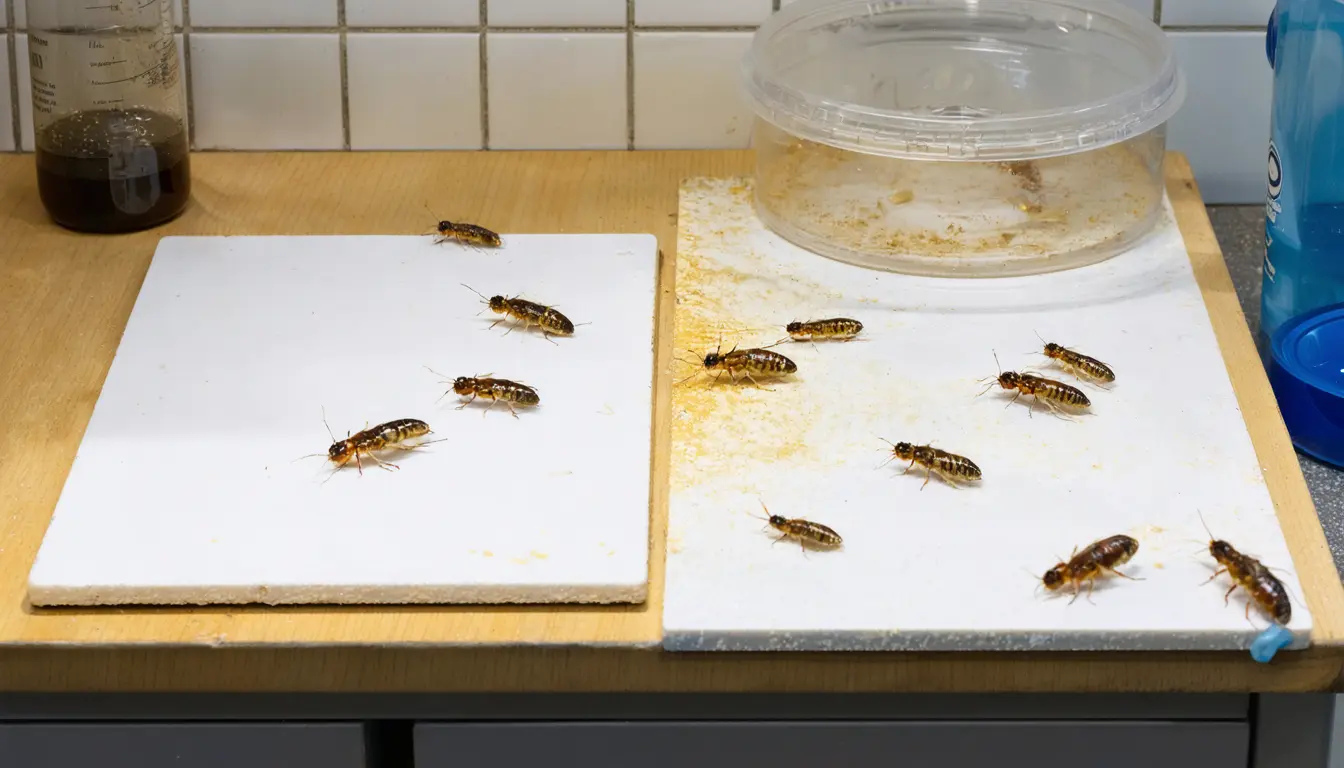
Key figures: the best dried-residue result killed 78% of cockroaches, well below the 90% performance level in EPA federal guidance for effectiveness claims. Sprayed directly, more than 96% died.
| Figure | Value | Note | Claim |
|---|---|---|---|
| Best dried-residue result, cockroaches killed | 78% | 6 | |
| EPA performance level | 90% | 6 | |
| Direct-spray deaths | 96% more than | 3 |
What happened
- The team tested four commercial essential-oil products on a laboratory population sensitive to insecticides and on a home-collected population that is highly resistant.
- The best aged-residue result reached 78%, below the 90% performance level in EPA federal guidance for pesticide effectiveness claims.
- Video tracking showed fresh residues repelled cockroaches from treated tiles, but most of that effect was gone within 24 hours.
Why it matters
- Who's exposed exposure Low-income households, where German cockroaches are common and professional control can be hard to afford, may spend limited money on a spray that leaves them exposed to asthma-linked allergens.
- What it limits constraint Many essential-oil insecticides are exempt from standard EPA registration, and Jackson says that can mean less scrutiny of what the label promises.
- Who has to decide decision Both researchers point anyone facing a German cockroach infestation to insecticidal baits, the standard approach for several decades, over essential-oil or conventional sprays.
The products pass one test and fail the other because the two tests ask different questions. A direct spray shows whether a product kills an insect it lands on. An aged residue shows whether the dried film kills an insect that crosses it later [4]. That second case matches the pest. German cockroaches hide behind refrigerators, in walls and in cabinets, move mainly at night and spend much of their lives out of sight [12].
Zachary DeVries, the Kentucky entomology professor on the study, described the field problem this way: "You see one, and there are 20 more somewhere else." [17]
On the direct sprays, lead author Daniela Jackson said: "They died immediately." She added: "If the study had stopped there, the products would have looked highly effective." [8]
The residue test, if anything, flatters the products. "Those numbers may still give the products too much credit," DeVries said [9]. The test kept each cockroach on a treated surface for four hours, and in a home a cockroach would probably move on from any one spot well before that [10]. Essential oils evaporate quickly, and the Phys.org write-up says that helps explain the gap between the direct-spray and residual results [11].
The Phys.org account describes insects on tile and pine wood. It does not report how an infested home responds, and it does not report sample sizes, product names or results by population. So the conclusion that sprays leave the hidden population alone is an inference from residue kill.
In our view the inference is sound. Most aged residues killed under 10% of insects held on them for four hours [5][10], and an insect passing through on its way back to a wall void would be exposed for less time. It applies to the products as tested.
Jackson put the labelling problem in one line: "A container can promise to kill cockroaches even when users must find and soak each insect." [13]
What to watch
- A trial in occupied, infested homes that counts surviving cockroaches after essential-oil sprays would test the inference drawn here from residue kill.
- The full Scientific Reports paper, for the sample sizes, product-level results and per-population mortality.
- Any change in how the EPA scrutinizes effectiveness claims on exempt minimum-risk products.
Clarity's read
What the record supports and how the coverage leans. The claims behind it follow.
Reality
- Evidence68
- Adoption
- Not scored
- Hype gap−10
- Incentives
- Not scored
- Confidence65
Claim ledger
Ranked by verification strength, evidence, and original report placement.
- [1]
Researchers at the University of Kentucky's Martin-Gatton College of Agriculture, Food, and Environment tested four commercial essential oil-based cockroach-control products in a Scientific Reports study.
- [2]
The researchers used a laboratory cockroach population that is sensitive to insecticides and a home-collected population that is highly resistant to insecticides.
- [3]
When the products were sprayed directly on cockroaches, more than 96% died within seven days, and nearly every test reached 100% mortality.
- [4]
The researchers applied three of the products to ceramic tile and pine wood, then aged the residues for 24 hours, one week or one month, to test what happens when hidden insects cross treated areas after the sprays dry.
- [5]
Nearly every residual treatment killed fewer than half of the cockroaches, and most killed fewer than 10%.
- [6]
The best residual result reached 78%, well below the 90% performance level described in EPA federal guidance for pesticide effectiveness claims.
- [7]
Video tracking experiments showed that fresh residues caused cockroaches to avoid treated tiles, but most of that repellent effect disappeared within 24 hours, coinciding with decreases in efficacy in later aging trials.
- [8]
"They died immediately," said lead author Daniela Jackson, a 2025 UK graduate now with the University of Pittsburgh Medical Center. "If the study had stopped there, the products would have looked highly effective."
- [9]
"Those numbers may still give the products too much credit," said Zachary DeVries, UK associate professor of entomology.
- [10]
In the residual tests, cockroaches were forced to remain on the treated surfaces for four hours, far longer than they would likely stay in one place inside a home, DeVries said.
- [11]
Essential oils evaporate quickly, which helps explain the divide between the direct-spray and residual results along with the decline in repellency after only 24 hours of aging.
- [12]
German cockroaches live in narrow spaces people cannot easily reach, such as behind refrigerators, inside walls and in cabinets; the pest moves mainly at night and spends much of its life hidden.
- [13]
"A container can promise to kill cockroaches even when users must find and soak each insect," Jackson said.
- [14]
Jackson said many essential oil-based insecticides qualify as minimum-risk pesticides and are exempt from the EPA's standard registration process, and that effectiveness claims may receive less scrutiny.
- [15]
German cockroaches are common in low-income housing, where professional pest control may be difficult to afford; DeVries said families can spend limited money on a product that leaves them exposed to cockroach allergens linked to asthma and other health concerns.
- [16]
For a German cockroach infestation, both DeVries and Jackson recommend insecticidal baits rather than essential oil or conventional sprays; cockroaches eat the bait and ingest the insecticide, a method that has been the standard approach for several decades.
- [17]
"You see one, and there are 20 more somewhere else," said DeVries.
Get this ledger inside ChatGPT. Ask about any of our stories and the answer brings its figure, each claim’s verdict and the sources. Free, no account.
Sources
1 independent publisher whose own reporting we read for this story.
- phys.orgEssential oil sprays kill cockroaches on contact but offer little lasting control
1 article · October 16, 2026
Topics and entities
Follow any of these and your For You feed starts watching them — no settings page required.
Entities
- University of KentuckyFollow
- US Environmental Protection AgencyFollow
- Scientific ReportsFollow
- Phys.orgFollow
- Daniela JacksonFollow
- Zachary DeVriesFollow