ScienceNot yet confirmed elsewhere1 publisher2 min readPublished
Roman fort near Frenni Fawr gives the Magnus Maximus legend a site to test
Oxford's Mark Merrony has found a Roman fort about 2 miles from Frenni Fawr, where the Mabinogion pitches Magnus Maximus's camp. The legend now has a physical site to test, though a fort shows that soldiers were there and cannot by itself place the emperor.
The Scientist · Science desk
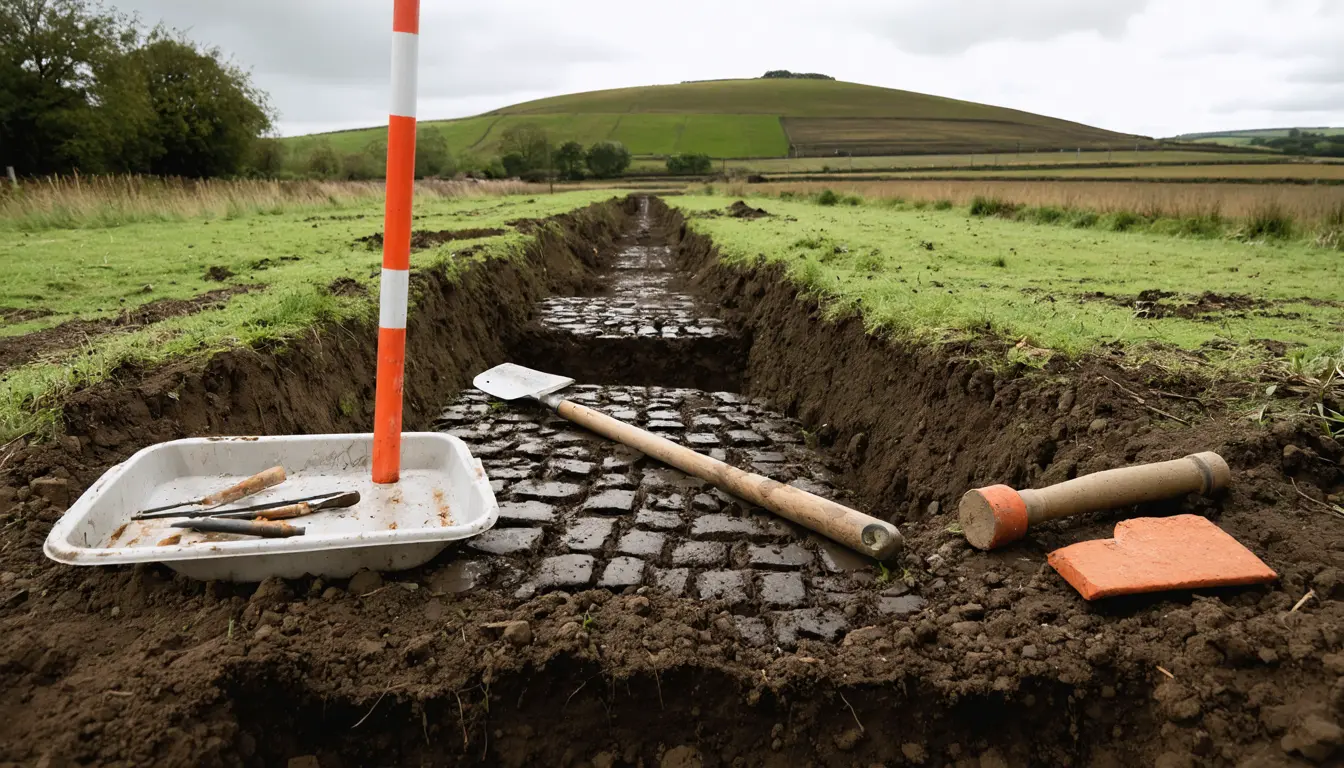
Four figures: the fort lies about 2 miles (3.5km) south-west of the summit of Frenni Fawr, likely held about 500 troops, measures 180 by 150 metres, and two coins dating from the late 4th century were found at the site.
| Figure | Value | Note | Claim |
|---|---|---|---|
| Distance from Frenni Fawr summit | 3.5 km | about 2 miles, south-west of the summit | 1 |
| Troops the fort likely held | 500 troops | estimate: about 500 | 11 |
| Fort length | 180 metres | fort measures 180 by 150 metres | 10 |
| Late-4th-century coins found | 2 coins | 7 |
What happened
- Satellite imagery showed an outline in an overgrown field, and a Roman tile Merrony spotted soon after his visit was the first of many.
- A geophysical survey confirmed a rectangular building in the middle of the enclosure and a larger one immediately south of it.
- The dig has produced an unusual iron stylus, many pottery shards, large quantities of Roman tile, compacted clay floors and preserved wagon ruts.
- The fort measures 180 by 150 metres and sits on a slope with a commanding view of the surrounding landscape.
Why it matters
- contradiction The Guardian's headline says the fort "could prove" the emperor's camp is real, while Merrony's own wording is that a fortified auxiliary fort "may help unlock" the mystery of the legend.
- precedent Merrony identified a Roman road on the southern shoulder of the Preselis in 2022. With the fort, he now has two sites in the same hills to set against the assumption that the Romans did not venture far into Wales.
- cost The open questions about dating and context will be answered by further trenches. The Guardian names Oxford University and crowdfunding as the support for that work, and the dig just finished is one of several planned.
Merrony's reasoning is conditional. "If Magnus Maximus was there, there must have been an army there," he said [17]. According to the Guardian, he is excited that this landscape holds the only Roman military site close to where the Mabinogion places the emperor [20]. A fort answers the question of whether soldiers were in the area. Whether Maximus was among them is a separate question.
Location is a second gap. In The Dream of Macsen Wledig the emperor pitches his camp on Frenni Fawr, the 395-metre easternmost peak of the Preseli Hills [16]. The fort lies south-west of that summit [1], on a slope with a commanding view [10]. The Guardian says no Roman camp or fort had been found on the summit or below it before this one [2].
The method is the reassuring part. A satellite outline is a hypothesis. A surface tile, a geophysical survey and a dig each tested it, and the Guardian says the excavation confirmed Merrony's theory of the site and its significance [23].
Coins are a thinner kind of evidence. Merrony said his brother Nick had jokingly asked him, before the dig, to find a couple of coins to prove the Magnus Maximus theory [8]. Nick, Merrony said, "came back and said 'well, are these any good?'" [9]. The Guardian places Maximus's rule of Britain in the fourth century [15], so coins from its closing decades are in the right period. A coin can only be lost after it is minted, so two of them say the site was in use then or later. In our view they do not identify who was in command, and Merrony himself says only that they "may be linked to the tale of Macsen Wledig" [14]. The Guardian's account does not say where in the site the coins lay or how they were dated.
The Guardian also reports that the find upends the assumption that the local Indigenous Celtic tribe had been at peace with the Roman invaders [12]. That goes further than the finds it lists, which record occupation of a fort the report says was likely to have held about 500 troops [11].
What to watch
- The Antiqvvs write-up: whether it states where the two coins were found and how they were dated.
- The further planned excavations: whether they date the fort's occupation independently of the coins.
- Any evidence from the later seasons of conflict with the local tribe, which the Guardian's claim of overturned assumptions would need.
Clarity's read
What the record supports and how the coverage leans. The claims behind it follow.
Reality
- Evidence40
- Adoption
- Insufficient
- Hype gap+30
- Incentives35
- Confidence40
Claim ledger
Ranked by verification strength, evidence, and original report placement.
- [1]
Merrony discovered the fort in 2024, about 2 miles (3.5km) south-west of the summit of Frenni Fawr.
- [2]
There had been no archaeological evidence for a Roman marching camp or fort on the summit of Frenni Fawr or below it until now.
- [3]
Satellite imagery showed a convincing outline in an overgrown field, and shortly after visiting it Merrony noticed a Roman tile, which turned out to be the first of many.
- [4]
A geophysical survey confirmed a rectangular building in the middle of the enclosure and a larger rectangular building immediately to the south.
- [5]
Merrony said the arrangement of the two buildings is consistent with the placement of a headquarters building orientated east and thereby 'facing the enemy', and a commander's house.
- [6]
Finds at the site so far include an unusual iron stylus, many pottery shards, large quantities of Roman tiles and extensive compacted clay floors, and rut marks left by wagons have been preserved.
- [7]
Merrony's brother Nick found two coins dating from the late 4th century at the site.
- [8]
Merrony said that before the dig his brother Nick had jokingly asked him to find a couple of coins to prove the Magnus Maximus theory.
- [9]
Merrony said Nick "came back and said 'well, are these any good?'"
- [10]
The fort measures 180 by 150 metres and is on a slope with a commanding view of the surrounding landscape.
- [11]
The fort is likely to have held about 500 troops.
- [12]
The discovery overturns assumptions that the area's Indigenous Celtic tribe was on peaceful terms with the Roman invaders.
- [13]
Merrony identified a Roman road along the southern shoulder of the Preselis in 2022, challenging assumptions that the Romans did not venture far into Wales.
- [14]
Merrony said it is fascinating to consider that the two coins "may be linked to the tale of Macsen Wledig".
- [15]
Magnus Maximus was the Roman emperor who ruled Britain in the fourth century.
- [16]
In The Dream of Macsen Wledig, medieval storytellers described how Maximus on his military manoeuvres pitched his camp at Frenni Fawr, the 395-metre (1,300ft) easternmost peak of the Preseli Hills.
ReportedContestedSource: The Guardian, summarising the Mabinogion tale2 sources— create a free account to open themView cited source - [17]
"If Magnus Maximus was there, there must have been an army there," Merrony said.
ReportedContestedSource: Mark Merrony, quoted by The Guardian2 sources— create a free account to open themView cited source - [18]
The Guardian's headline says the Roman fort found in Wales "could prove myth of emperor's camp is real".
ReportedContestedSource: The Guardian headline2 sources— create a free account to open themView cited source - [19]
Merrony said the presence of a heavily fortified Roman auxiliary fort "may help unlock the mystery of a Mabinogion legend that has endured for nearly 1,700 years".
ReportedContestedSource: Mark Merrony, quoted by The Guardian2 sources— create a free account to open themView cited source - [20]
Merrony expressed excitement that this landscape held the only Roman military site close to where the Mabinogion places the emperor.
ReportedContestedSource: The Guardian, describing Merrony2 sources— create a free account to open themView cited source - [21]
With financial support from Oxford University and crowdfunding, one of several planned excavations has just finished.
- [22]
Merrony's research will appear in Antiqvvs, a quarterly magazine dedicated to archaeology, ancient art and history.
- [23]
The excavation that has just finished confirmed Merrony's theory of the site and its significance.
Sources
1 independent publisher whose own reporting we read for this story.
- theguardian.comRoman fort found in Wales could prove myth of emperor’s camp is real
1 article · October 12, 2026
Topics and entities
Follow any of these and your For You feed starts watching them — no settings page required.