Science1 publisherNot yet confirmed elsewhere2 min readPublished
Concordia prints impact-absorbing test parts from simulated moon soil and recycled PEKK
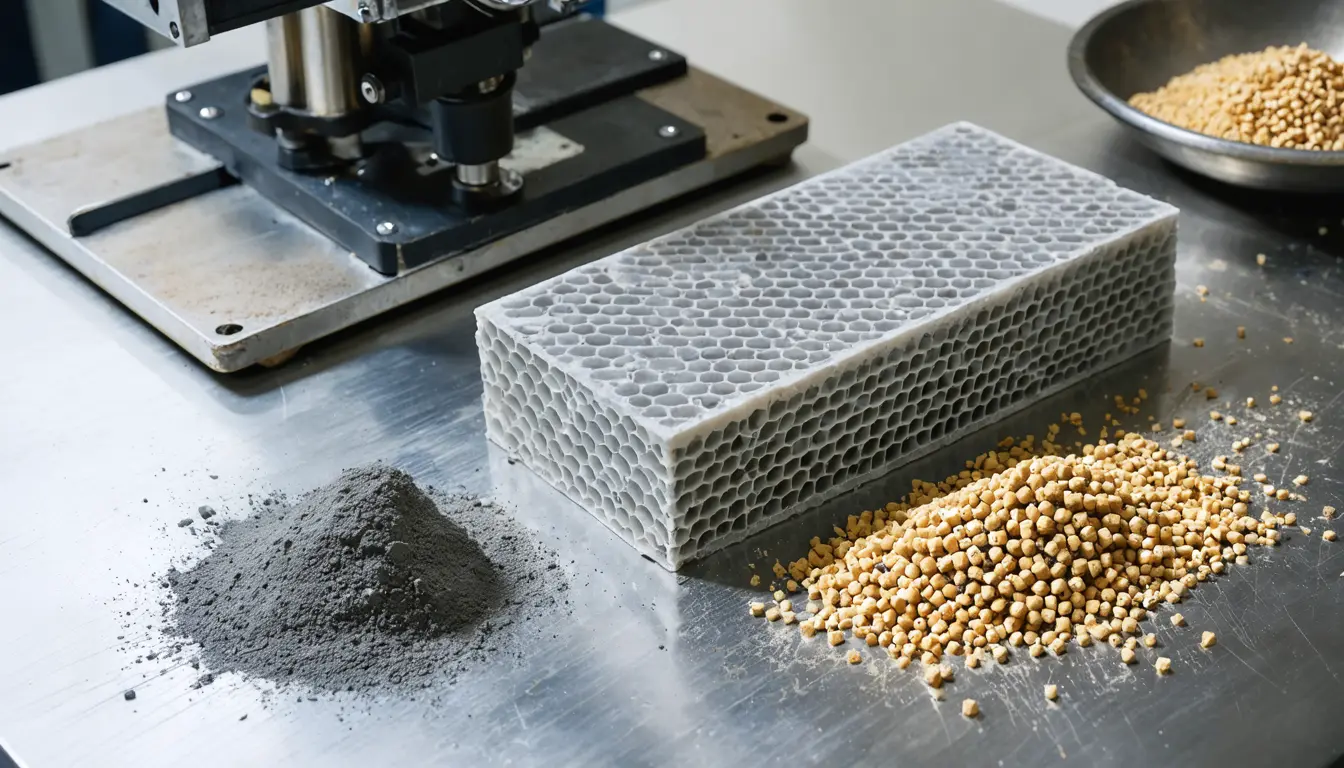
Concordia engineers 3D-printed impact-absorbing structures from lunar soil simulant and PEKK plastic recycled three times without significant degradation. It is an early lab step toward making lander parts on the moon from local dust and reused polymer.
The Scientist · Science desk
Drafted by a language model from the sources cited here and checked against its claim ledger before publication. How we use AISend a correction
What happened
- Scrap PEKK was shredded, milled into powder, heat-dried and mixed with a commercially available regolith simulant, then made into printer filament.
- The simulant lowered the temperature at which PEKK crystallized and reduced shrinkage and warping during heat treatment.
- Internal porosity was higher than in plain PEKK and made the composite more brittle, though the recycled plastic itself showed no degradation.
- Besides the impact-absorbing structures, the team printed a wrench from the same composite.
- Farshad Malekpour, a 2026 master's graduate, and professor Mehdi Hojjati published the study in Composites Part B: Engineering.
Compiled by The ScientistSomething wrong?How this is made
Why it matters
- constraint A composite that grew more brittle is a poor match for a structure designed to bend and bounce back, so using it as a landing absorber depends on getting the porosity down first.
- capability Prints that warp less and heat-treat at a lower temperature need less finishing work, and the researchers note the moon offers little to no post-processing equipment.
- decision Mission planners could count a spent absorber as stock for later prints, though the evidence so far covers only three recycling rounds.
The economics start with the launch bill. By some estimates, moving one kilogram from Earth to the moon costs more than $1 million [14]. Regolith, the sharp rocky shards and dust covering the surface, has long been the abundant ingredient planners want to print with [1]. The other half of this composite is a different kind of resource. The researchers describe PEKK as a high-performance, space-grade polymer, and they present the work as a route to efficient use of scarce materials in space [15][13].
In my view the recycling result is the firmer of the two findings. The PEKK in the demonstrations had already served as a sacrificial structure before it was reprocessed [7]. Those parts are built to absorb energy and deform under load. They are not meant to stay in service as permanent structure [2]. The researchers say the study is among the first to close that loop, recycling a space-grade polymer and combining it with lunar regolith [15].
The thing the published summary doesn't tell you is the regolith share of the mix, or how much energy a printed absorber took up. The first figure sets how many launched kilograms the local dust could replace. The second would show whether the composite absorbs a hit as well as plain PEKK.
The test conditions are also some distance from a landing. The team measured how the material responded to heat, stretching, bending and compression, and heat-treated some samples [10]. The sponge-like structures were used to gauge how the composite withstands stresses similar to those a lunar module's landing mechanism absorbs on impact [3][9]. The regolith was a commercially available simulant [8]. A simulant result shows how the polymer handles a manufactured stand-in for moon dust. Testing with real lunar material would be a separate experiment. The researchers call the technology still very new [13].
What to watch
- Published energy-absorption figures for the regolith-PEKK structures set against plain PEKK, which would show whether the added brittleness costs the part its function.
- Recycling runs beyond three rounds, and any processing change that cuts the composite's internal porosity.
- Tests using returned lunar samples in place of commercial simulant.