Science3 publishersIndependently confirmed2 min readPublished
CT scans reassign a crocodile skull recovered in Egypt in the 1920s to a new gavial species
Paul Burke's team used CT scans to name Herugavialis cairensis, a new gavial, from Egyptian fossils filed as Tomistoma since the 1920s. The reread adds a species to the Mediterranean's fossil crocodile record, which the authors tie to past changes in climate and sea level.
The Scientist · Science desk
Drafted by a language model from the sources cited here and checked against its claim ledger before publication. How we use AISend a correction
What happened
- The fossils, a nearly complete skull among them, come from Egypt's Mokattam Formation, which phys.org describes as the same rock used to build the Great Sphinx.
- At least two other gavial species lived alongside Herugavialis in the shallow seas that covered much of the region.
- Only two gavials survive, Gavialis gangeticus and Tomistoma schlegelii, both in fresh water on the Indian subcontinent and in Southeast Asia.
- Gavial fossils span more than 100 million years and a near-global range, and many of those species lived in shallow marine settings.
Compiled by The ScientistSomething wrong?How this is made
Why it matters
- contradiction PopSci puts Herugavialis in Egypt "when the Great Sphinx was built 4,500 years ago," yet its rock is about 10,000 times older than the monument, so the Sphinx link is the stone and the name.
- constraint The group's ancient range stays where the fossil record already had it; what Herugavialis adds is one more species in the Mediterranean diversity series the authors set against climate.
- precedent A skull sat in the wrong genus for a century on outward resemblance, so other early Egyptian crocodile identifications made by eye are candidates for the same CT re-examination.
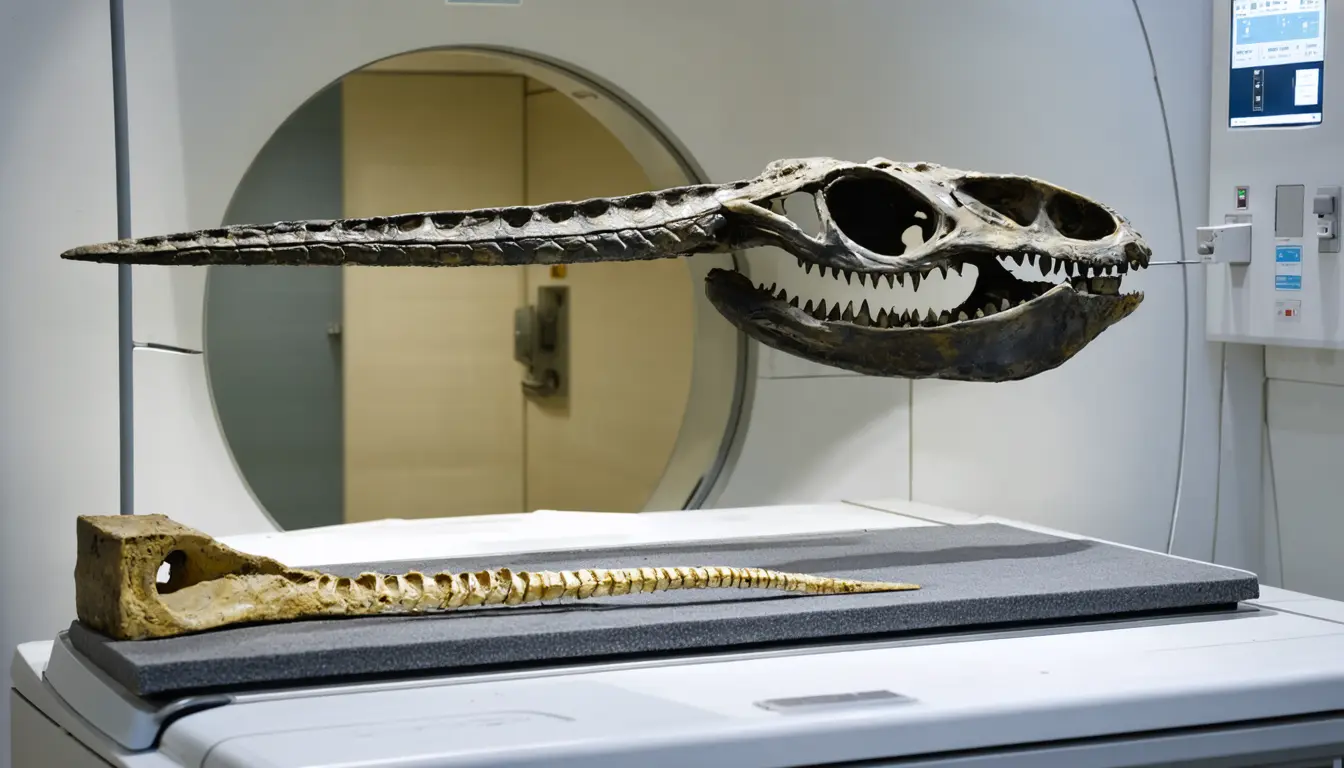
The new name comes from old material [3]. According to phys.org's account, the fossils were assigned to Tomistoma in the 1920s "because of their superficial resemblance to the false gharial" [4]. PopSci's story opens on discoveries that "await deep inside the bedrock" of the Sphinx [14]. This one was made inside a skull [5]. CT scanning and other recent analytical methods let the team, drawn from the UK, Sweden, Germany and Egypt, identify several differences between the fossils and the living false gharial [5][2].
The skull is relatively well preserved, apart from the missing tip of its snout [7]. "Given this coincidence with the famously missing nose of the Great Sphinx, we decided to name the new crocodile after the Egyptian god Heru, who was possibly the inspiration for this iconic monument," said Philip Mannion of University College London, who co-led the study [8][2].
The paper's title presents the result as new insight into gavialoid diversity in the Mediterranean region during the Middle Eocene [15]. "Throughout much of the last 50 million years, the Mediterranean region hosted a high diversity of crocodiles, including gavials," said Paul Burke of the Swedish Museum of Natural History, the lead author [12][2]. "However, this diversity fluctuated over time, seemingly corresponding to changes in global temperature and sea level, before the loss of all crocodiles in this region as a result of the drying of the Mediterranean approximately 6 million years ago." [12]
Burke's own word is "seemingly" [12]. He presents the final loss as a direct result of the sea drying out. The earlier swings in diversity he links to temperature and sea level only as a correspondence [12]. A species count that rises and falls with the climate fits a climate explanation without proving it. Testing it would mean knowing how many species were counted in each interval and how the two series were compared. The press accounts do not list the anatomical differences that separate Herugavialis from Tomistoma, and they do not say how that comparison was made [5].
What to watch
- Whether the full paper's list of cranial differences places Herugavialis nearer to Gavialis or to Tomistoma among living gavials.
- Whether other crocodile specimens taken from the Mokattam Formation in the 1920s are scanned and reassigned.
- Whether the authors test their Mediterranean diversity counts formally against temperature and sea-level records, beyond Burke's 'seemingly corresponding'.