Product1 publisher2 min readPublished
Letting the dopant break down puts up to 100 times more charge into P3HT
Researchers at Concordia, INRS and York report up to 100 times more mobile charges in the organic semiconductor P3HT from a dopant that falls apart after donating an electron. The study does not include a finished device.
The Product Desk · Product desk
What happened
- Researchers describe a method called degradation-assisted doping that can put up to 100 times more mobile electrical charges into organic semiconductors than conventional chemical doping.
- The dopant breaks down after it transfers an electron and its reaction products leave the process, so fresh dopant molecules can keep donating electrons to the semiconductor.
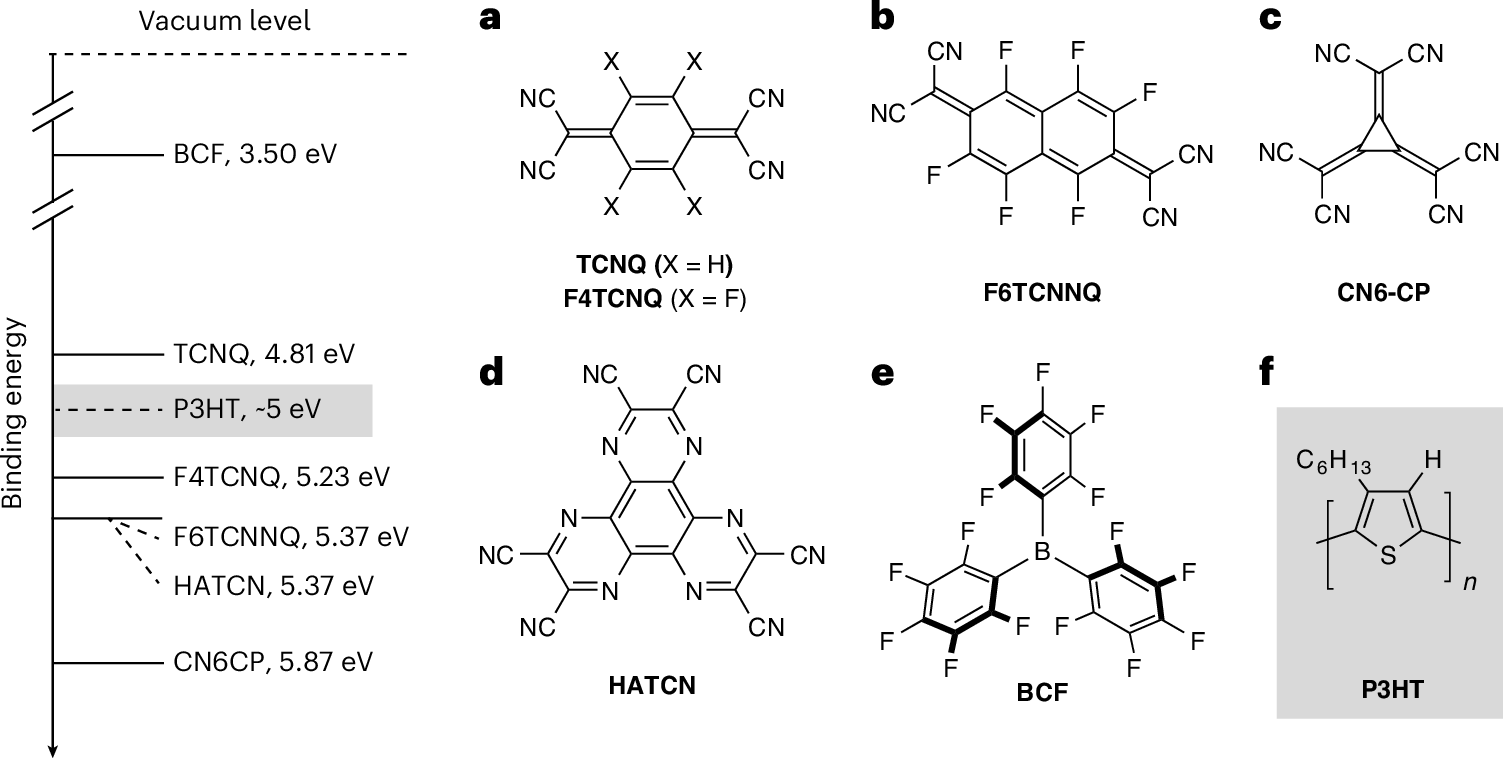
- Teams at Concordia University, INRS and York University demonstrated the approach in the organic semiconductor P3HT using tris(pentafluorophenyl)borane, known as BCF, as the dopant.
Compiled by The Product DeskSomething wrong?How this is made
Why it matters
- cost Doping now consumes its reagent, so higher carrier densities cost dopant that cannot be recovered, and anyone costing a film has a consumable that scales with the charge they want.
- decision For a materials group, the immediately actionable part is a dopant swap it can screen in P3HT with stock it already holds.
- constraint Without a stated baseline or a conductivity value, the result cannot be written into a device specification. The decision stays inside the lab for now.
- capability Controlled self-destruction becomes a design target for dopant chemists. Nobody was previously optimising for it.
Keep adding dopant to a film of P3HT and at some point the extra molecules stop paying for themselves. Interesting Engineering's account of the work describes conventional dopants reaching a limit on how many charges they can generate, with the whole approach bounded by chemical and thermodynamic limits [2][10]. Organic semiconductors are attractive because they can be processed into films and built into flexible devices, and their electrical performance depends heavily on how well they dope [13].
Degradation-assisted doping changes what happens after the electron moves. BCF takes an electron from P3HT and then breaks down, and the report says the breakdown products no longer interfere with later doping reactions, so fresh BCF molecules keep donating [3][4][6]. The team tracked the chemistry with nuclear magnetic resonance, optical spectroscopy, electron paramagnetic resonance and calorimetry, plus simulations [7].
Each molecule works once. Carriers come out in proportion to the dopant consumed, so roughly twice the charge takes roughly twice the BCF, and the spent BCF is gone [16].
The figure that will travel is "up to 100 times" [1]. It is a ceiling, and the account reports no conductivity figure and no baseline for the multiplier, so nobody can turn it into siemens per centimetre for a datasheet [17]. More useful for a materials group is the comparison. BCF produced higher conductivity in P3HT than other commonly used dopants [8], and a lab can screen that substitution with materials it already has on the shelf.
The gain here is not stated in the unit a device is specified in, only as a multiple of an unstated baseline. And the dopant is consumed. A consumed dopant converts a chemistry win into a bill of materials line that scales with carrier density.
The authors' own framing points at the design problem. The result suggests that controlling the fate of the dopant after electron transfer could be as important as the initial charge-transfer step [9], and the researchers say the approach creates a new strategy for designing organic semiconductor systems with higher doping levels [12]. The work may also help develop dopants engineered to degrade in controlled ways after they transfer charge [14]. The study does not establish a finished electronic device or demonstrate commercial-scale manufacturing [11]. It was jointly led by Melissa Berteau-Rainville of INRS and Ingo Salzmann of Concordia University, with researchers from York University and INRS contributing, and was published in Nature Materials [15].
What to watch
- A follow-up that reports absolute conductivity for DAD-doped P3HT alongside the multiplier, with the baseline stated.
- New dopants designed to degrade in controlled ways after transferring charge, a route the researchers named as future work.
- Evidence on whether the breakdown products still stay out of the way at device-relevant film thicknesses and dopant loadings.