Product1 publisher3 min readPublished
Impossible Objects raises $40M to scale a carbon-fiber printer with five orders to date
The Series B, led by Inflection Equity, pays for more CBAM 25 units, deployments and service staff. Three of the four named recipients so far are research or university organisations, and the performance figures are the company's own.
The Product Desk · Product desk
What happened
- Impossible Objects closed a $40 million Series B led by Inflection Equity to increase production of its Composite-Based Additive Manufacturing systems and fund deployments in aerospace, defense and advanced manufacturing.
- At the U.S. Army's Rock Island Arsenal, the company says CBAM can support manufacturing of up to 10,000 drone bodies every month.
- Impossible Objects has separately secured $20 million through U.S. government contracts and awards for work including long-range drones and lightweight wing and fuselage structures.
Compiled by The Product DeskSomething wrong?How this is made
Why it matters
- decision A drone or airframe program holding a mold quote now has a tooling-free option to price against it, and the comparison turns on annual quantity and how many design revisions are still coming.
- constraint The speed and strength figures are the vendor's, so the buyer pays for the coupon testing and process qualification before a printed rib or fuselage part gets onto a drawing.
- contradiction The strength claim is measured against other printers, while the government work is described as parts approaching the strength of traditionally produced composites; anyone substituting a molded or autoclaved part is judging against the harder benchmark.
- exposure Government contracts and awards already equal half the value of the new round. Near-term growth of the installed base is tied to defense procurement decisions.
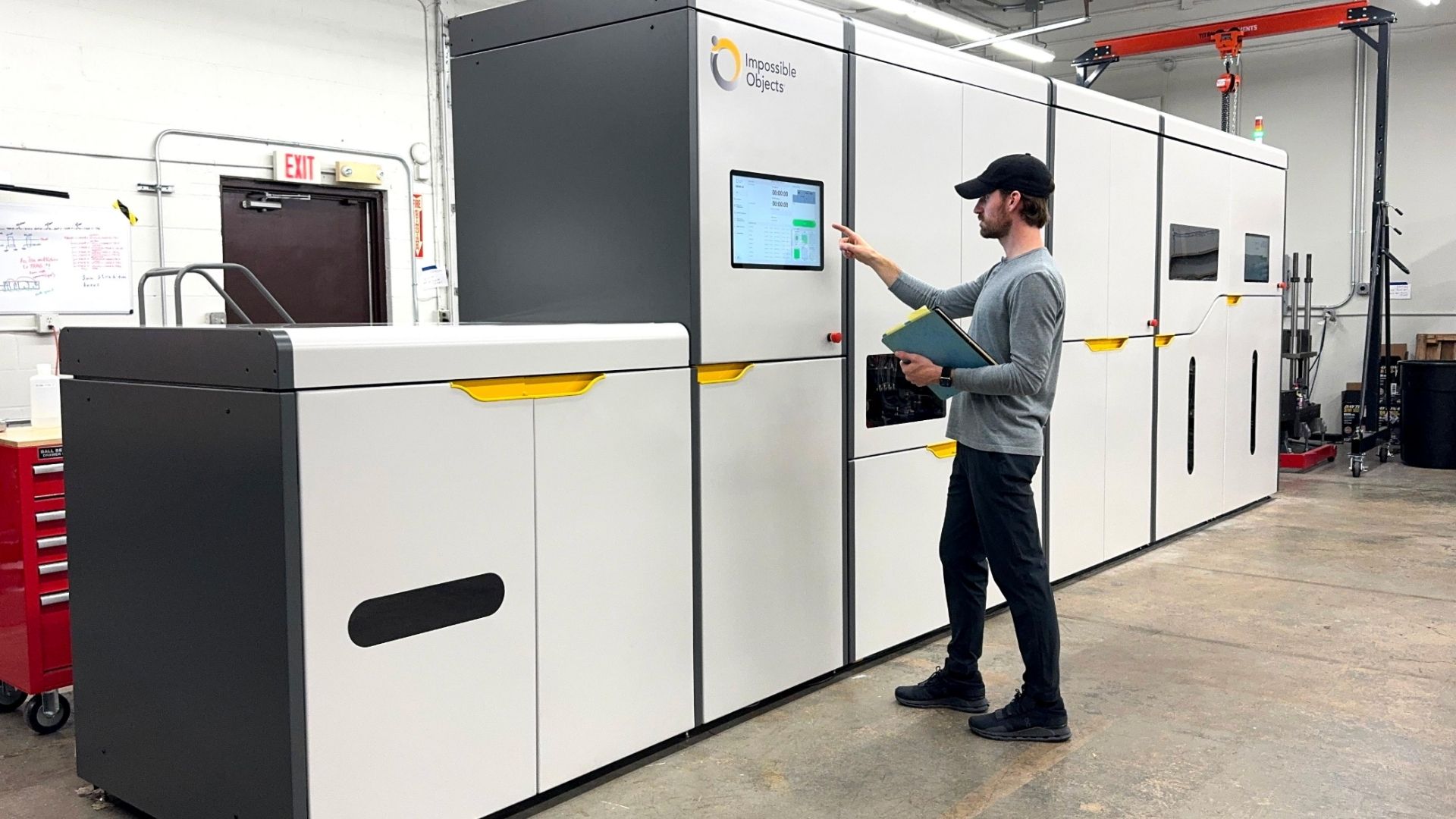
Three of the four named places holding a CBAM 25 exist to qualify processes for other people: the National Institute for Aviation Research, the Oregon Manufacturing Innovation Center, and Rochester Institute of Technology [8][4]. The fourth is the U.S. Air Force [8]. Impossible Objects says it has begun placing machines with customers and research organizations [7]. In my view five machines at those addresses is a qualification stage, and this round buys capacity in front of it.
Five orders since early 2025 against a $40 million raise works out at $8 million of new equity per order booked [1][7][1]. The money goes to building more CBAM systems, deploying them at additional customer sites, and expanding the service and commercial teams behind the installed base [16]. Separately, the company has taken $20 million through U.S. government contracts and awards, equal to half the Series B [10][3].
The performance case is the company's own. Impossible Objects says the CBAM 25 prints as many as 25 layers a minute, which it puts at 15 times faster than competing production additive technologies [4]. It says parts reach 200 MPa, up to four times the strength of parts from rival additive methods [5].
The benchmark that settles a make-or-buy sits in the same account of the company's government work, which covers components "approaching the strength of traditionally produced composites", alongside long-range drones, lightweight wing and fuselage structures and embedded wiring [11]. A rib drawn for autoclaved prepreg gets compared against that harder number. Shrinkage and warpage, which the company says its process minimizes, are what a first article inspection will look for next [6].
At the Army's Rock Island Arsenal, the company says CBAM can support making up to 10,000 drone bodies a month [9], about 333 a day [2]. "We've created a fundamentally new way to manufacture," said Robert Swartz, the founder and chairman [12]. Steve Hoover, the chief executive, said the CBAM 25 is "designed from the ground up to meet the high productivity and high reliability needs of advanced manufacturing combined with the flexibility and tool-less manufacturing that modern flexible supply chains require" [14].
A buyer defending a purchase order has three inputs to settle: the annual quantity for the part, the number of design revisions expected before the design freezes, and the load case on the drawing. Where molding is involved, each revision buys a new tool, and the company's pitch is exactly that reduction in tooling requirements, cost and lead time [17]. Printing without tooling wins the small quantities and the designs still moving; injection molding and CNC keep the high volumes, where slow and costly additive systems have historically lost [15]. The 200 MPa figure decides whether the part enters the comparison at all [5].
What to watch
- Whether orders beyond the first five come from production sites rather than qualification labs, and how soon.
- Customer-published or independent test data on 200 MPa parts at a real part geometry, not a coupon.
- Whether Rock Island Arsenal reports actual drone body output against the stated 10,000-a-month capability.