Science1 publisherNot yet confirmed elsewhere2 min readPublished
Columbia-led team is engineering glowing yeast into a handheld PFAS test for water utilities
Virginia Cornish's Columbia team is building a yeast-and-chip sensor for PFAS, the chemicals found in nearly half of US municipal water supplies. Utilities would get a handheld, real-time reading, though the yeast meant to detect PFOA and PFOS are still being engineered.
The Scientist · Science desk
Drafted by a language model from the sources cited here and checked against its claim ledger before publication. How we use AISend a correction
What happened
- Most water suppliers must send samples to commercial labs running expensive mass spectrometry, and those labs sometimes take weeks to return a report.
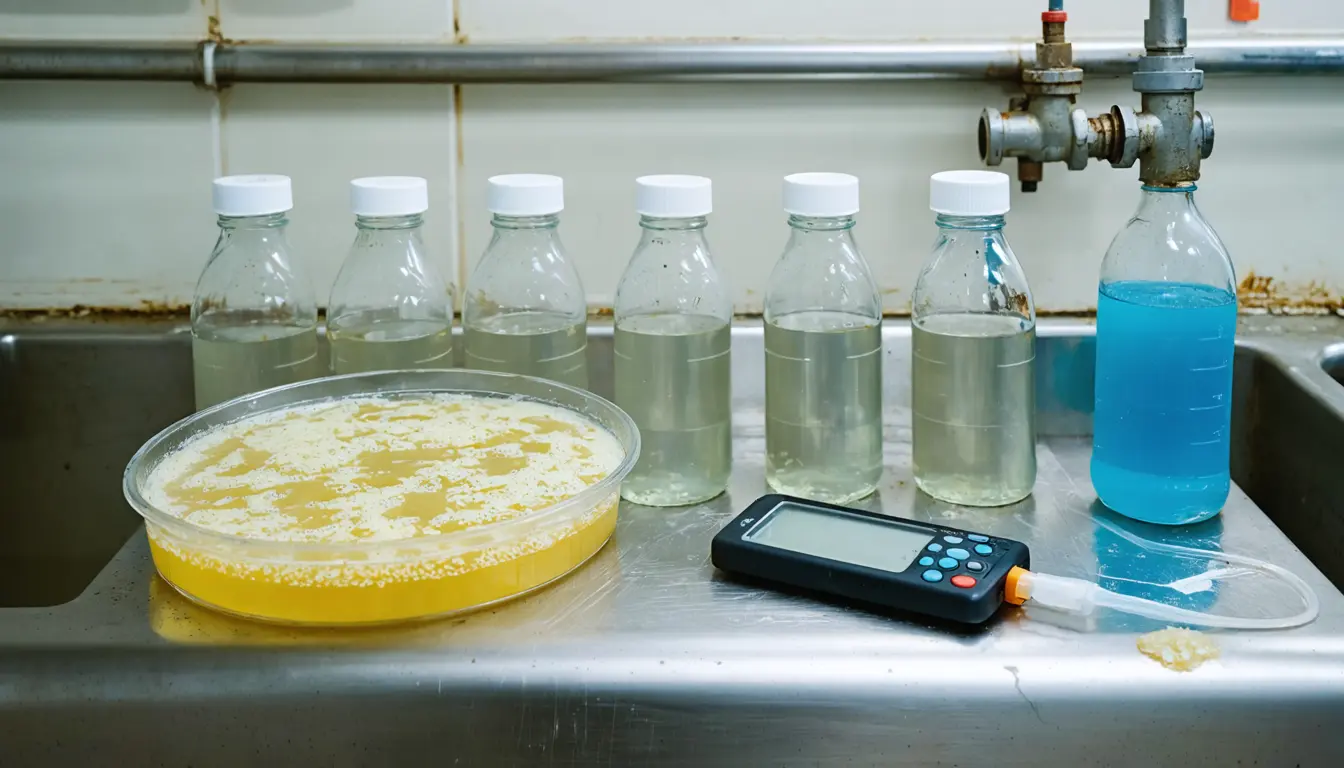
- Each yeast cell carries a designed receptor wired to a fluorescent protein, so the cell glows green when the receptor binds its target chemical.
- An AI tool from Mohammed AlQuraishi's systems biology lab is meant to cut receptor design from a few years to a design-build-test cycle of weeks.
- CMOS chips from Ken Shepard's engineering lab, first built as wireless computer-brain interfaces, read the yeast's fluorescence and convert it into a concentration.
Compiled by The ScientistSomething wrong?How this is made
Why it matters
- decision Treatment operators deciding when to replace PFAS removal components are the clearest users, since that call depends on tracking the equipment closely from the plant itself.
- constraint Readings cover only compounds that have a designed receptor, so each further PFAS a utility wants to track needs its own design-build-test cycle.
- cost Until strip readings are shown to match lab results, water systems keep paying for the frequent mass-spectrometry testing the EPA rules require.
Cornish, a professor of chemistry and systems biology at Columbia, starts from the sniffer dogs at airports [2]. "The dogs detect chemicals from these substances because their noses have odor receptors that bind to those chemicals," she said [8]. "With genetic engineering and synthetic biology, we can design the same type of chemical-detecting receptors and implant them into yeast." [9] The host is Saccharomyces cerevisiae, the species bakers and brewers use [7]. For the water test, the engineered cells would be freeze-dried and set into a material resembling pH paper, and a user would dip a disposable stick to take a reading [17][20].
The AI shortens a step the lab performs once for each target compound [11]. In machine-learning terms it is a training cost. A utility pays the other kind, a cost that recurs with every stick and every sample [20]. That recurring figure is the one that has to come in below what a commercial lab charges for mass spectrometry [5].
The demand case comes from Alex Rosenthal, a professor of civil engineering at City College. "There are approximately 150,000 public water systems in the United States, and PFAS monitoring is becoming a huge cost for them," he said [13]. His evidence of interest is a count of conversations: "We've talked to several dozen water industry professionals around the country, and there is unanimous excitement about how our new technology can optimize operations." [14]
Several dozen interviews measure appetite for a cheaper test. Accuracy takes a different experiment, and the team's published description does not report one, either as a detection limit for the strip or as a side-by-side run against a mass spectrometer on the same water. The description says only that glow intensity is "related to" the chemical's concentration [10]. A utility needs that relation calibrated across the concentrations its own plant sees, with the signal coming from the target compounds and from nothing else in the sample.
"With AI, we should be able to detect any chemical we want, which we couldn't do before with chemistry alone," Cornish said [15]. "It will be a huge breakthrough for the field of sensing and could lead to a new industry of yeast-based sensors in health care." [16] I think the PFAS strip is a fair first test of that ambition. It passes when a receptor from the weeks-long design cycle [11] reads a real water sample and matches what a commercial lab's mass spectrometer reports for the same water [5].
What to watch
- Whether the team can show how long freeze-dried yeast on the strips stay responsive in storage at a working water plant.
- Whether regulators would accept strip readings for any of the required PFAS testing, or only for in-plant tracking of removal equipment.
- Whether the AI design cycle produces working PFOA and PFOS receptors within weeks, as the lab is aiming for.