Product1 publisher3 min readPublished
Ford's $194 million Cold Creek solar park accounts for about 15% of its Michigan clean-power pledge
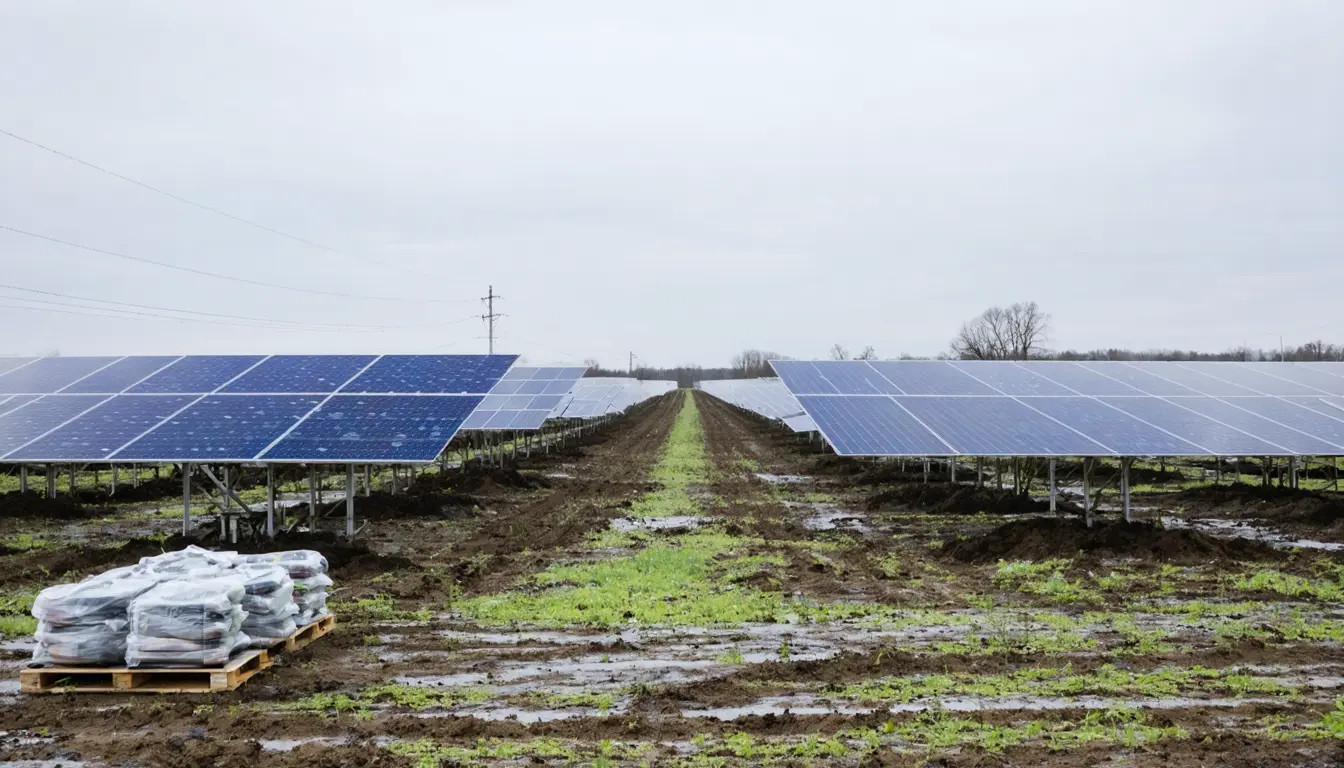
Ford is funding DTE Energy's $194 million Cold Creek solar park, 100 megawatts toward its pledge to buy up to 650 megawatts of Michigan clean power. Buying through a utility green tariff ties Ford's money to a specific new plant and ties its carbon-free factory target to DTE's build schedule.
The Product Desk · Product desk
Drafted by a language model from the sources cited here and checked against its claim ledger before publication. How we use AISend a correction
What happened
- Ford and DTE aimed for 2025 when they signed in August 2022, and the target date is now the end of 2027; neither company has explained the change.
- MIGreenPower is DTE's voluntary program, open to both companies and residents, that ties a customer's electricity use to Michigan-based renewable generation.
- Cold Creek can generate enough power to supply roughly 23,000 to 25,000 homes.
- Ford's wider goal is to run all of its manufacturing sites worldwide on carbon-free power by 2035.
Compiled by The Product DeskSomething wrong?How this is made
Why it matters
- decision A manufacturer that enrolls in a utility green tariff lets the utility's construction schedule set its public target date. It has to decide in advance how much delay its commitments can absorb.
- constraint A DTE tariff only reaches Michigan-based supply, so Ford's 2035 worldwide target will need separate arrangements in every other grid where it builds.
- exposure Ford's Michigan promise has a date and covers every vehicle. If the rest of the pledged capacity arrives late, the shortfall will be public and easy to measure.
At some point someone at Ford will sign off a reporting line saying every vehicle built in Michigan by the end of 2027 was made with 100% carbon-free electricity [1]. Interesting Engineering describes that result as what the Ford-DTE partnership ensures [1]. The first plant behind the line only generates in daylight. For the evening, DTE plans a 75-megawatt battery at Cold Creek that will store surplus midday output and send it to the grid at the evening peak [11].
So far, Ford has funded one park. Cold Creek's 100 megawatts is about 15% of the up to 650 megawatts Ford committed to buy, or 100 divided by 650 [12]. At $194 million, it cost about $1.94 million per megawatt of capacity [13]. Ford's delivery date has already moved once [8].
The green-tariff case is strongest on one point. Ford's money went into a specific new plant in the state where it builds vehicles. DTE built Cold Creek near Coldwater [2], and Ford's enrollment in DTE's MIGreenPower program paid for it [5]. The further claim, that this route beats buying offset certificates, has less behind it. The report's only emissions figure is an EPA estimate that Ford's participation will offset up to 600,000 tons of carbon dioxide a year once fully implemented [9]. Because that figure is counted in tons offset, it can't by itself tell a new park apart from a certificate purchase. The report does not identify the other projects in the commitment, and it does not explain how the 100% figure will be counted for hours when the panels are dark.
DTE pitches the deal as a partnership. "Through MIGreenPower, we're helping companies like Ford achieve their sustainability goals while building the renewable energy infrastructure that will power generations to come," said Matt Paul, president and chief operating officer of DTE Electric [7].
I think the product fits a narrow buyer: a manufacturer with most of its load inside one utility's territory and enough demand to pay for a whole park on its own, as Ford did [5]. For other buyers, the decision turns on how concentrated their load is, meaning how much of their power comes from a single utility that sells a green tariff. It also turns on how much delay their date can take: whether their public target can absorb a two-year slip like Ford's [14] without being restated.
Concentrated load with a flexible date is Ford's position, and in that position I'd take the tariff. The buyer gets a named local plant and accepts that the utility sets the timing. A concentrated buyer with a fixed date can still enroll, but needs backup supply for the years a park runs late. A buyer spread across many grids gets one territory covered and the rest of its footprint left as it was. Ford's Michigan deal says least about the last case: spread-out load with a fixed date.
What to watch
- Whether DTE or Ford names the projects that make up the rest of the up-to-650-megawatt commitment, and when each one is due online.
- When the 75-megawatt Cold Creek battery comes online, since it decides how much daytime output reaches the evening peak.
- How Ford reports the 2027 Michigan claim: annual totals against consumption, or hour-by-hour matching.