Science2 publishers2 min readPublished Updated
Chalmers AI scientist designs and interprets its own brewer's yeast experiments
Chalmers University of Technology researchers report an AI system that designs and interprets its own brewer's yeast experiments in a closed loop. The account does not say how often its hypotheses held up, the figure a lab head needs before planning around one.
The Scientist · Science desk
Drafted by a language model from the sources cited here and checked against its claim ledger before publication. How we use AISend a correction
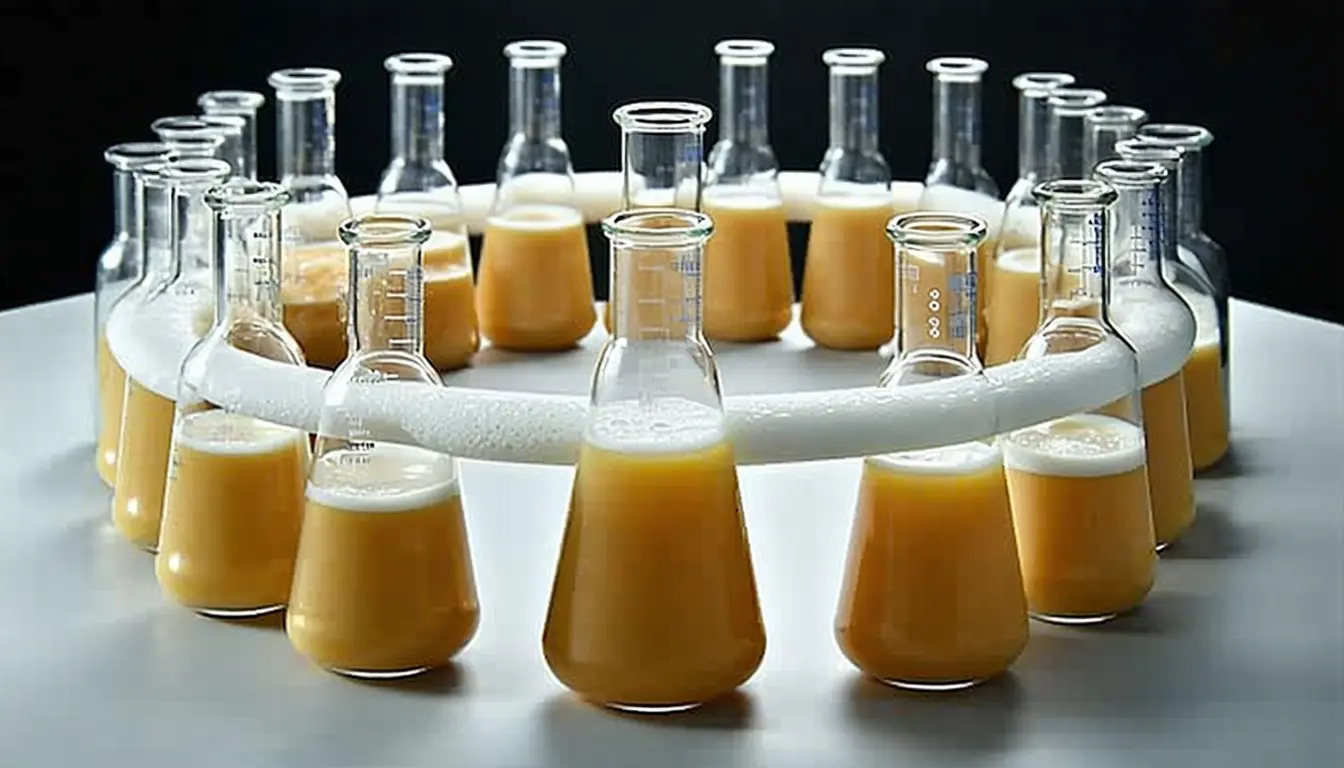
What happened
- Before it began, the AI was given the yeast's genome, its metabolism and results from previous studies as its knowledge base.
- Co-author Ievgeniia Tiukova says the system generates new scientific knowledge itself instead of serving only as a decision-support tool.
- The work appears in the Journal of the Royal Society Interface as 'Agentic AI integrated with scientific knowledge: laboratory validation in systems biology'.
Compiled by The ScientistSomething wrong?How this is made
Why it matters
- decision A lab head deciding whether to automate hypothesis testing will need the paper's validation data to set the system's hit rate and cycle time against a postdoc's output.
- constraint The loop needed a genome, metabolism and prior literature handed to it at the start. Groups working on less-documented organisms would have to build that knowledge base before the approach applies.
- precedent The authors expect machines to take over the routine hypothesis-and-test cycle while humans keep priorities and oversight. Lab jobs built around running that cycle are the ones this would reshape first.
The system joins large language models and automated reasoning to laboratory automation [2]. A hypothesis the software proposes becomes an experiment, and the result goes back to the same software, which revises what it believes [5]. It started from the yeast's genome, its metabolism and earlier studies [3].
Ievgeniia Tiukova, a postdoctoral researcher in Chalmers' Department of Life Sciences and one of the authors [7], makes the case for automation on volume. "It is too much information for a human to analyze, but our AI scientist could identify promising biological questions, recommend experiments to test them, evaluate experimental outcomes and iteratively refine its understanding based on new evidence," she said [5]. She compares the work to self-driving cars [12]. "Rather than serving solely as a decision-support tool, the AI scientist actively generates new scientific knowledge," she said [6].
The phys.org account is headlined as new discoveries, but it names no finding and does not disclose how many hypotheses the system proposed, how many it tested, how many held up or how long a cycle took [1]. Those counts are the denominator. Without them the system can't be compared with a postdoc choosing the same experiments, or with experiments picked at random. The paper's title promises "laboratory validation in systems biology" [4], and that validation section is where the counts should appear.
Ross King is the study's senior author and a professor of computer science and engineering at Chalmers and the University of Gothenburg. He says autonomous laboratories will investigate biological systems much faster than is possible today [8]. "Such AI systems have the potential to reduce the time required to explore complex scientific questions and optimize the use of laboratory resources," he said [9]. Both are forecasts about the approach.
For a research leader, I think the planning question is narrower than the headline. The authors say that for now the system will augment scientists by taking on the routine cycles of hypothesis generation and testing [11]. "Human scientists remain essential for defining research priorities, interpreting broader scientific significance and ensuring ethical oversight," King said [10]. The loop also ran on an organism whose genome, metabolism and prior studies could be handed over at the start [3]. A lab working on a less-documented system would have to assemble that input first. It would also need automation that can run its assays.
In my view this is a working demonstration in one well-described organism. It is worth planning for in groups that already run automated yeast assays. For anything wider, I would wait for the paper's validation numbers.
What to watch
- The validation section of the Journal of the Royal Society Interface paper: how many hypotheses were proposed, tested and confirmed, and whether results were compared with human-chosen or random experiments.
- Whether the Chalmers group runs the same loop on an organism with a thinner knowledge base than brewer's yeast.
- Independent replication by another lab of any biological finding the system reports.