Science2 publishers2 min readPublished
Mount Mantap's earthquakes kept accelerating for eight years after North Korea's last test
An international team detected 1,399 small earthquakes in 17 years of continuous recordings from stations in China and South Korea, and the 955 they could locate trace two faults, one of which was never on a map.
The Scientist · Science desk
What happened
- Before 2017, the ground around Mount Mantap was quiet enough that no crustal earthquake had been documented within 50 kilometres of the North Korean test site for more than a century.
- North Korea conducted six underground nuclear tests beneath the mountain, in North Hamgyong province, between 2006 and 2017.
- A team led by Xingli Fan of Chengdu University of Technology detected 1,399 small local earthquakes in 17 years of continuous data and found the rate still climbing through 2025.
- The 955 events the team could locate lie along two roughly parallel tracks running away from the site, one of them extending a fault geologists had already mapped.
- The catalogue came from stations in China and South Korea between 80 and 200 kilometres away, with matched-filter pattern matching used to recover tremors standard networks miss.
Compiled by The ScientistSomething wrong?How this is made
Why it matters
- constraint Treaty verification in this region loses its easy background: small events near Punggye-ri now have to be argued into one category or the other, and that burden falls on the analysts doing attribution.
- exposure Rock fractured enough to stop holding radioactive gas turns any further work at the complex into a release question as well as a detection one.
- precedent The paper's claim is general, so other test sites in heterogeneous, critically stressed crust become places to look for sequences that outlast the shooting by years.
- decision The collapse takes the peak itself out of use, so a future North Korean test has to be sited on other ground inside Punggye-ri.
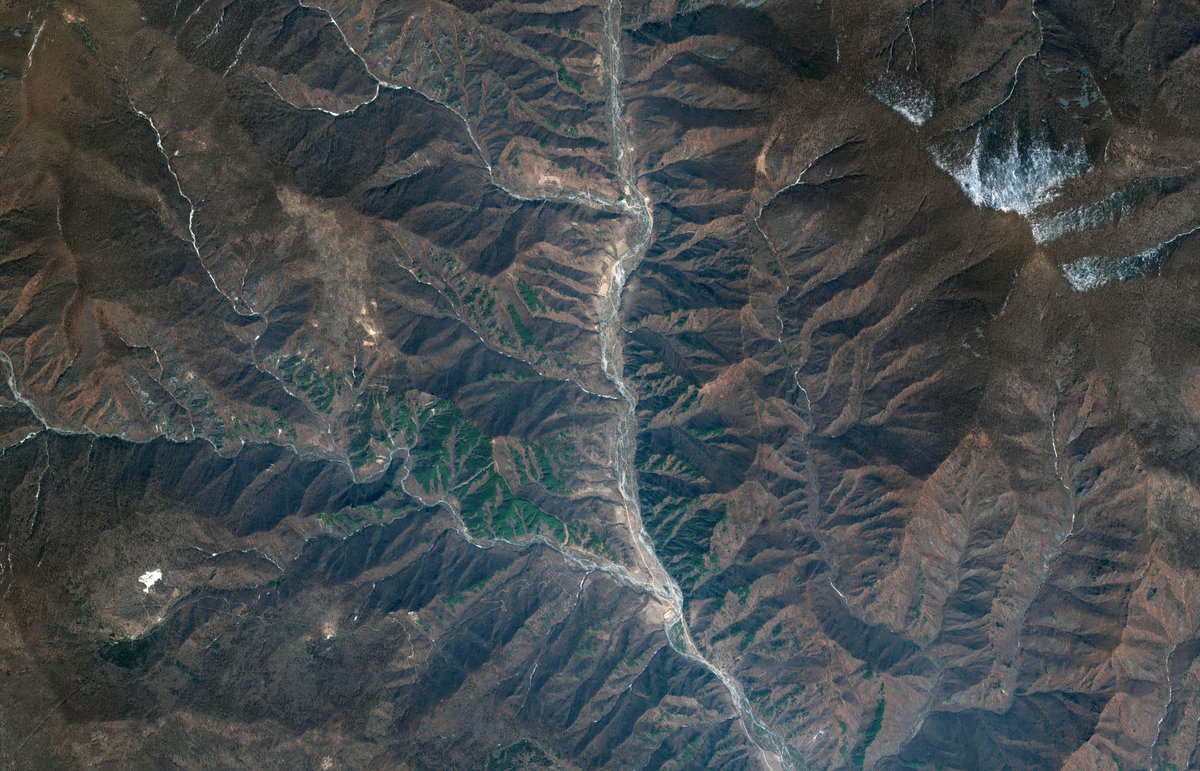
The explanation the team offers starts with the mountain itself. Mount Mantap's steep, heavy slopes press down on the rock beneath the peak, and the group's computer models put that rock under intense stress before any device went into it [11]. Six explosions damaged that already stressed rock and weakened the crust around it [12]. The 2017 test, with an estimated yield of 100 to 250 kilotons of TNT, effectively collapsed the top of the mountain [19][25]. Stress then redistributed through the damaged volume slowly, and faults slid years after the blasts stopped [12]. The authors wrote that the Mount Mantap sequence shows underground nuclear explosions can produce long-lasting crustal effects in a heterogeneous and critically stressed environment [13].
Kwang-Hee Kim, a seismologist at South Korea's Pusan National University and a co-author, said repeated underground nuclear tests have progressively disturbed and damaged the surrounding rock and changed the stresses acting on pre-existing faults [16]. Kim said the 2017 test did the most damage, and that once faults on the mountain were disturbed it started a domino effect [17].
The causal argument leans on timing and on geometry. Recorded activity grew in both frequency and magnitude after 3 September 2017 [18], and the located events line up along two tracks [9]. The century of documented quiet is the softer support [2]. Matched-filter detection pulls out small tremors that standard networks miss [5], so a historical record assembled without it is not a like-for-like background. The comparison inside the study is stronger: same stations, same method, 2008 through 2025 [3][4]. That catalogue opens two years after the first test [29].
The team detected 1,399 events and located 955 of them, about 68 percent, which leaves 444 detections with no mapped position [7][9][28]. Contributing stations sit between 80 and 200 kilometres from the site [4]. So the previously unmapped fault is drawn from roughly two-thirds of the catalogue [10].
The record does not show how large the sequence can get. "The phenomena they've identified and documented is a bit surprising," said Paul Richards, a Columbia University seismologist who was not involved in the work [21][22]. He called the situation "potentially dangerous" and asked, "Will it lead to even bigger earthquakes?" [23].
I would not call the crust under Mount Mantap permanently destabilised on this evidence. The paper's own term is long-lasting [13], and the record covers about eight years after the last test [30]. What the faults do after 2025 is outside it.
What to watch
- Whether the 444 detections that could not be located are placed later, which would test the two-track fault geometry against the full catalogue.
- Whether monitoring bodies revise the discrimination baseline they use for events near Punggye-ri in published bulletins.
- A test at another underground site in the Punggye-ri complex would put the stress model to work on ground that has not been shot before.