Science1 publisher3 min readPublished
Relocation is not adaptation: South Asian evidence on what moving people leaves behind
Researchers who interviewed relocated households in Bangladesh and India report that new houses without land, work or services move the risk rather than reduce it.
The Scientist · Science desk
Drafted by a language model from the sources cited here and checked against its claim ledger before publication. How we use AISend a correction
What happened
- The abandoned houses of Old Podampetta on India's east coast are the remains of a small fishing village that no longer exists; years of coastal erosion and relentless cyclones eventually made staying impossible.
- Bangladesh and India recorded nearly 8 million people displaced within their borders by rapid-onset climate hazards in 2024 alone.
- Nearly 8 million internal displacements across Bangladesh and India in 2024 is an average of roughly 22,000 people per day.
- Most of the 2024 displacements were emergency evacuations before or after disasters such as cyclones, with people hoping to return home as soon as it was safe.
- The authors' research in Bangladesh and India shows that a successful relocation only becomes a durable solution when people can rebuild their livelihoods, relationships and sense of belonging.
Compiled by The ScientistSomething wrong?How this is made
Why it matters
Researchers who have spent the past few years interviewing relocated residents in Bangladesh and India report that permanent moves away from unsafe coastlines only become durable solutions when people can rebuild livelihoods, relationships and a sense of belonging [5]. That finding lands in a region where Bangladesh and India together recorded nearly 8 million people displaced inside their own borders by rapid-onset climate hazards in 2024 alone [2], an average of roughly 22,000 a day [3].
Most of that 2024 figure was emergency evacuation before or after events such as cyclones, by people expecting to go home [4]. For some places there is no home to go back to. The abandoned houses of Old Podampetta on India's east coast are what remains of a fishing village that no longer exists, after years of coastal erosion and repeated cyclones made staying impossible [1]. The alternative on offer is planned relocation: permanent movement out of places climate change has made unsafe, sometimes initiated by communities and sometimes planned and supported by governments [6].
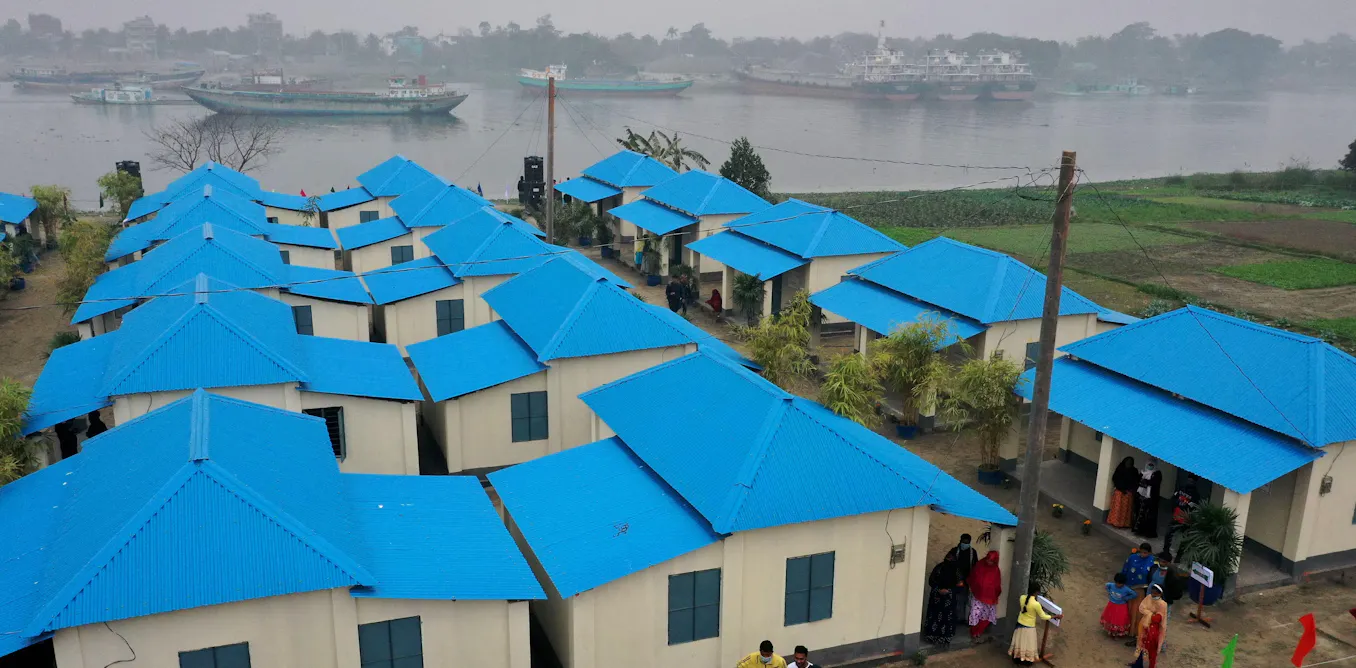
The upside is real and specific. For households that lacked secure housing, relocation delivers shelter and legal recognition, and in Bangladesh an official address can unlock social security benefits, other government support, loans and skills training [7]. One person interviewed in Khulna district described the before state plainly: living as tenants in other people's houses, moving from place to place, with no fixed house [8].
The failure mode is equally specific. Another participant said fear of cyclones had eased, then noted there are no roads and that every time it rains there is waterlogging in front of the houses [9]. The researchers describe relocation schemes run by authorities as often involving poor compensation and limited engagement with the communities affected, focused on moving people to safety without ensuring they can rebuild their lives [10]. Their interviews covered sites in Khulna and Chattogram in Bangladesh and Kendrapada and Ganjam districts of Odisha in eastern India [11]. Some households gained better access to markets or housing; others lost the land, forests, fishing grounds or informal work that had sustained them [12]. A participant in Kendrapada said farming was no longer possible because there was no compensation for lost agricultural land, only land to build a house, and no work in the village [13]. The same person described the shift to buying rice, vegetables and fish that had previously not been purchased at all [14].
That is the mechanism by which relocation relocates vulnerability rather than removing it. Greater dependence on cash income plus the absence of local work pushed people to migrate elsewhere in Bangladesh and India, and the remittances they sent back were used to improve the houses at the relocation sites [15]. Relocation does not necessarily end migration; it changes its form [16]. It also explains resistance: fishing households may stay on eroding coastlines because moving inland means losing access to the sea, and therefore to work [17]. Whether people thrive in a new site depends on jobs, transport, schools and health care, and on being able to maintain cultural traditions while building belonging [18]. One participant in Odisha asked whether there is a sadness greater than leaving your place of birth, describing arrival somewhere with not even flowers to offer the gods [19].
What to watch: whether relocation budgets in the region start carrying line items for lost productive land, road drainage and local employment rather than housing units alone, and whether outward migration from relocation sites is tracked as a programme outcome instead of treated as unrelated.