Science1 publisher2 min readPublished
Lac des Brenets on the French-Swiss border is days from passing its 1906 record low
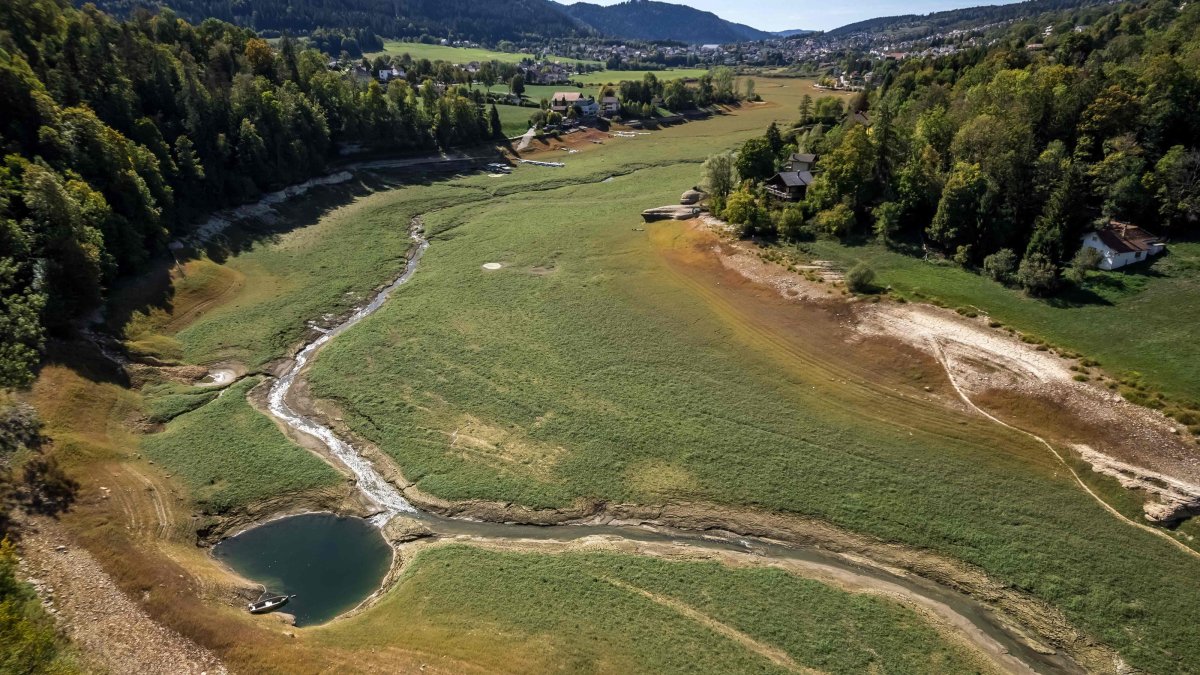
Lac des Brenets on the Doubs fell 14.66 metres below normal on October 1 and is days from passing a low-water record set in 1906. A local historian says it now empties every couple of years, a pattern AFP's account supports only with residents' testimony.
The Scientist · Science desk
Drafted by a language model from the sources cited here and checked against its claim ledger before publication. How we use AISend a correction
What happened
- At the deepest point only 9 metres of water remain, against a normal 25 to 30 metres, and the fish there are packed together, according to the navigation company's owner.
- The 27-metre waterfall where the lake ends has stopped flowing.
- The Lac des Brenets navigation company halted boat operations on July 20, in a season when it normally carries 200 to 300 passengers a day.
- June, July and August were each the hottest month ever recorded in Switzerland since measurements began in 1864.
- A task force that French and Swiss authorities set up in 2022 has not produced decisive action, according to AFP.
Compiled by The ScientistSomething wrong?How this is made
Why it matters
- cost If Favre's two-year cycle holds, the Brenets boat trade loses a season every other summer, and no single operator can repair a lake bed on its own.
- decision Because part of the water drains through fissures, the lake's future depends partly on an engineering choice that French and Swiss authorities have to make together.
- contradiction The lake already hit a severe low in 1906, so one record year cannot by itself show that drought on the Doubs has become a regular event.
On October 1 the surface stood at 735.34 metres above sea level [2]. Add back the 14.66-metre shortfall and the lake's normal surface is 750 metres [1]. The record drop, set in 1906, is 15.35 metres [3]. That left 0.69 metres between this year and a mark that had stood for 120 years [2] [4]. Yvan Durig, owner and captain of the Lac des Brenets navigation company [22], puts the daily fall at 20 to 22 centimetres [4]. At those rates the record goes three to three and a half days after October 1 [3]. Durig takes the readings by hand because the lake's monitoring station is now stranded well outside the remaining basin [5].
The Doubs rises in the French Jura and forms the lake at Les Brenets, where the river begins to mark the border between Franche-Comte and the canton of Neuchatel [21]. AFP attributes the drying to three causes acting together: geological fissures that drain water underground, below-average rainfall and repeated heat waves [6]. Only the last two are weather. The fissures are part of the lake bed itself. Among other things, the task force was set up to explore ways of limiting the water that drains into them [16].
The case that this now happens often rests on residents. David Favre, a 76-year-old amateur historian in Les Brenets [10], told AFP that "since the last drought in 2018, it's been a disaster" [8]. "Unfortunately, the lake empties out every couple of years, or soon, perhaps every year," he said [9]. AFP reports that locals are used to periods of low water, and that this spell is alarming because the 1906 record is about to fall [11]. The only earlier drought Favre gives a date for is 2018, eight years before this summer [5]. The thing the reporting does not tell you is how many times the lake emptied in between, or how this year's loss splits between the fissures and the weather.
I think the leaking bed is the stronger finding in AFP's account. It is the one listed cause that people could act on [16]. Durig said action is needed to "seal the lake bed" [18]. "But this can no longer take years. That is simply not an option anymore," he said [17]. Maxime Fallet, who works for a Doubs riverboat excursion company, fears the lake is "destined to disappear" for lack of a plan to save it [19].
What to watch
- Whether Durig's manual readings confirm the lake passing the 15.35-metre drop recorded in 1906.
- Any decision by the Franco-Swiss task force formed in 2022 to limit drainage through the fissures or seal the lake bed.
- Publication of a historical water-level series for the lake that would show whether emptying has become more frequent since 2018.