Science1 publisher2 min readPublished
AI-assisted assimilation of raw satellite radiance roughly halves aerosol model error over China
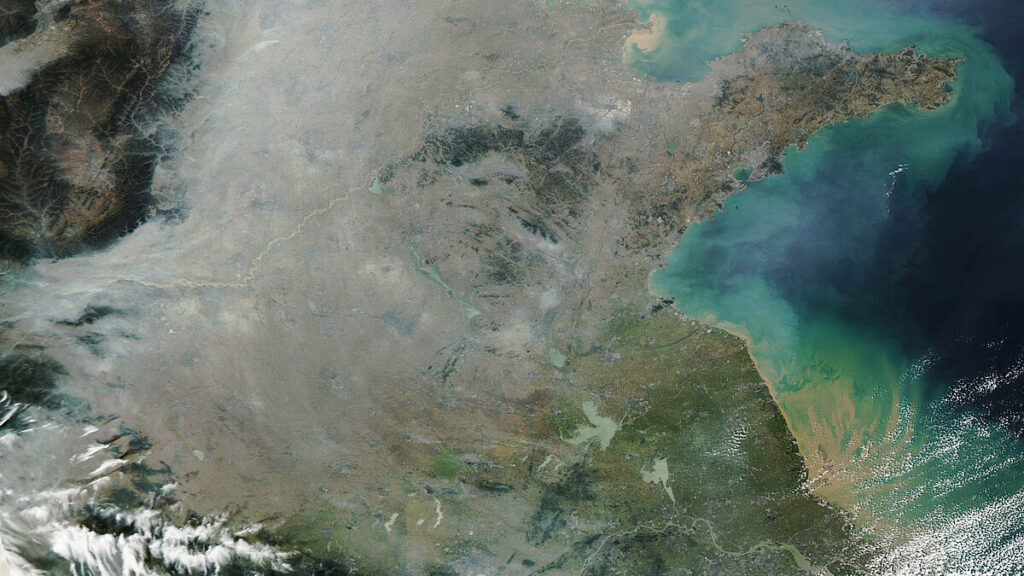
Chongzhao Zhang's team fed raw satellite radiance directly into aerosol simulations and cut prediction errors by about 50% in tests over China. A pretrained AI step makes the approach affordable, though the test scored aerosols against satellite data and left any forecast gains unmeasured.
The Scientist · Science desk
What happened
- Feeding raw visible and infrared satellite radiances straight into aerosol simulations has historically taken too much computing power to be practical.
- Simulations instead typically ingest preprocessed satellite products that capture aerosol properties indirectly, an efficient approach that yields less accurate predictions.
- The new method's AI component, pretrained on a large dataset, quickly works out how aerosols and sunlight reflected from Earth's surface combine in what the satellite sees.
- The paper, "Direct Assimilation of Satellite Visible and Near-Infrared Radiances to Improve Aerosol Simulations," appears in the Journal of Advances in Modeling Earth Systems.
Compiled by The ScientistSomething wrong?How this is made
Why it matters
- constraint Until forecasts are run with and without the radiance step, the promised gains for weather and climate prediction rest on aerosol-only scoring in one region.
- cost Most of the computing shifts to a one-time pretraining job, so a forecast centre would pay mainly for the fast parsing step each cycle, if the efficiency holds at operational scale.
- decision Centres that assimilate preprocessed aerosol products now have a candidate route to raw radiances, but they need the baseline and runtime figures before a 50% claim can justify switching.
Sarah Stanley's summary of the study for Eos says the new approach reduced prediction errors by about 50% "compared to aerosol simulations" [9][12]. The baseline decides what that figure means. Halving error against a model that takes in no satellite data is one result. Halving it against the preprocessed satellite products that simulations typically use would be a stronger one [7]. The summary does not say which comparison the figure refers to, whether the observations used for scoring were independent of those fed into the model, or how long the method takes to run [4][9].
The test bed, as described, is real-world satellite observations in China [9]. Aerosols come in many types, including desert dust, sea salt and wildfire smoke [1], and the AI component learned its job from a large pretraining dataset [8]. A single-region test cannot show whether it separates aerosol from surface reflection as well over a bright desert or open ocean as it does over China [8][9].
The efficiency comes from where the computing is spent. The expensive learning happens once, before any simulation runs. The recurring cost is the quick parse the component performs on incoming observations [8]. That split is how the method gets past the computing cost that kept raw visible and infrared radiances out of aerosol simulations [6]. In the summary's words, satellite data can now be incorporated "far more efficiently" [4].
The step from aerosol fields to forecasts is where the evidence thins. Aerosols reflect or absorb sunlight and act as collection points for the water molecules that form clouds [2]. Their complex behaviour contributes to uncertainty in weather and climate modeling [3]. The Eos summary puts the payoff this way: "The findings suggest the technique may serve as a computationally feasible way to improve aerosol simulations and, in turn, boost the accuracy of weather and climate predictions" [10]. The study did not score the second half of that sentence. Its test compared aerosol predictions with satellite observations [9][10]. Air quality sits closer to what was measured, since the particles themselves affect visibility and human health [13].
I think the study makes a credible case that raw radiance assimilation is now cheap enough to use in aerosol simulations [4][8]. On the evidence described, better weather and climate forecasts are still a suggestion, phrased with "may" [10].
What to watch
- A weather or air-quality forecast run with and without the radiance assimilation, scored on forecast skill.
- Reported runtimes for the AI step inside an operational assimilation cycle.
- Validation over regions dominated by desert dust or sea salt, away from China.