Science1 publisher2 min readPublished
One giant clam shell shows northern Great Barrier Reef summers ran up to 1.2C cooler around 1800
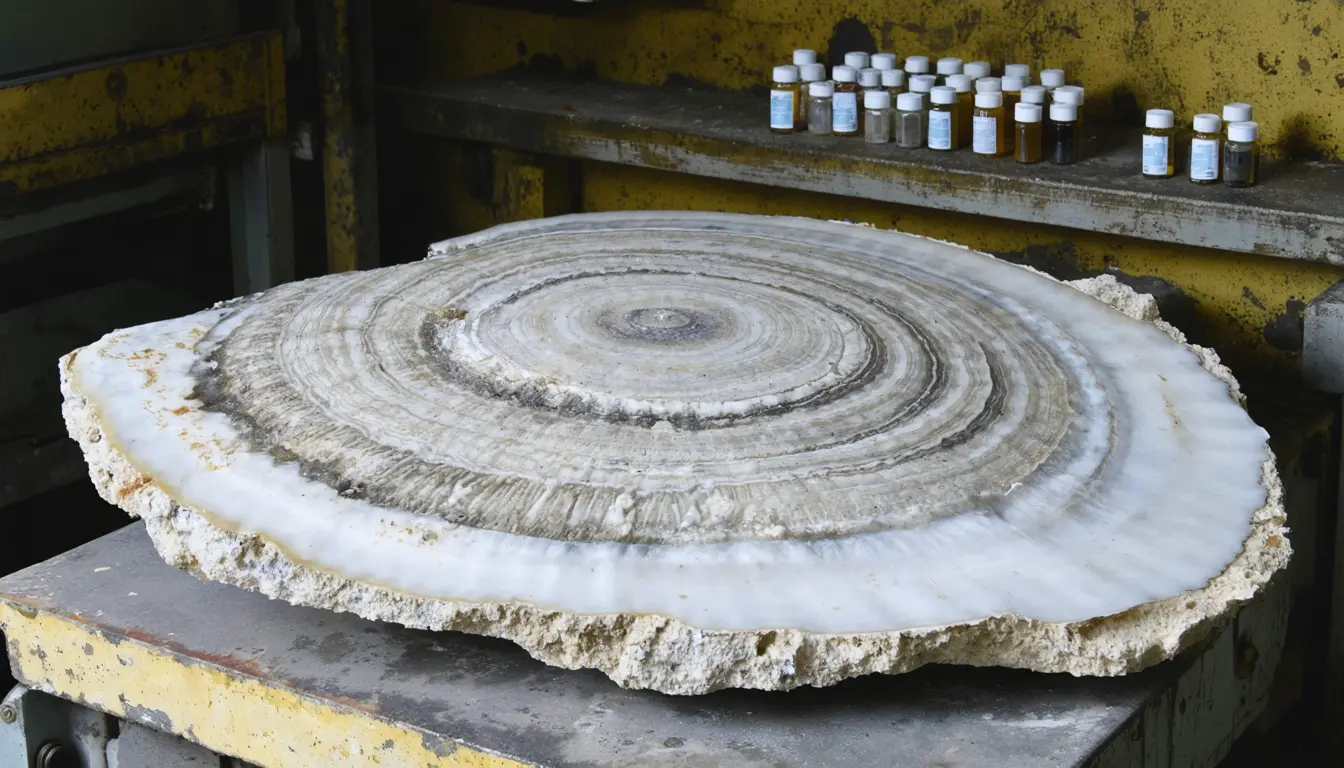
Growth lines and isotopes in one giant clam shell from Jiigurru put northern Great Barrier Reef summers around 1800 at 0.9 to 1.2C cooler than in 1995-2015. Winters were nearly unchanged, so this site's warming has come mostly in the hot season, on the evidence of one animal.
The Scientist · Science desk
Drafted by a language model from the sources cited here and checked against its claim ledger before publication. How we use AISend a correction
What happened
- Averaged over the whole year, the shell's temperatures run 0.6 to 0.9C below those logged by instruments in the same lagoon between 1995 and 2015.
- Radiocarbon dating places the clam's life between about 1785 and 1827, near the end of the preindustrial cooling period known as the Little Ice Age.
- The team drilled 784 powder samples from the shell, using oxygen isotopes to estimate sea temperature and carbon isotopes as clues to rainfall.
- Temperatures in the record rise and fall in two- to three-year cycles consistent with El Nino-like and La Nina-like swings, and carbon isotopes trace a wet-dry seasonal rhythm.
Compiled by The ScientistSomething wrong?How this is made
Why it matters
- decision A heat-stress baseline for Jiigurru has to be built season by season, because the annual mean captures only about two-thirds to three-quarters of the summer change.
- constraint One shell from one lagoon sets a baseline for Jiigurru alone, and the summer-heavy pattern needs shells from other reefs before it can describe the Great Barrier Reef as a whole.
- capability The method can be repeated wherever giant clams grow in the tropical Indo-Pacific, giving seasonal preindustrial records for Southern Hemisphere tropical seas that are now poorly documented.
The comparison has its own control. The modern reference comes from instruments in the same lagoon [12], so the old and new numbers describe one patch of water. The sampling is also dense enough to earn the month-by-month label. Spread over about 30 years of growth [9], the drill holes come to roughly 26 samples a year, a little over two a month [1]. Microscopic daily lines from the cycle of day and night, and broader annual bands from the seasons [2], fix each sample's place in the clam's life.
On the researchers' figures, the gap between the coolest and warmest months at this site is roughly 0.9 to 1.2C wider now than it was in the clam's lifetime [2]. For judging reef heat stress, I'd expect the warm end of the year to matter most, and this record puts the change at that end. "A single average would miss all this detail," the authors wrote [16].
The calendar dates are less precise than the sampling. The radiocarbon window is 42 years wide, for an animal whose roughly 10,900 daily lines add up to about 30 years [4]. The account does not say where in that window the 30 years fall.
The thing this doesn't tell you is how typical those decades were. They came near the end of the Little Ice Age, a preindustrial cooling period [8]. The clam's own record shows the climate changing during its life [15]. Warm, dry El Nino-like episodes were more common in the late 1700s. Cool, wet La Nina-like conditions became more frequent in the early 1800s and included the strongest events in the record [15]. A baseline drawn from a cool interval could make modern warming look larger than it would against a longer preindustrial average. I'd put more weight on the seasonal contrast than on its exact size. An error that shifted every month by the same amount would move summers and winters together, and it would not produce the asymmetry on its own.
Longer records are possible in principle. Tridacna gigas can grow to 1.2 metres and live for more than a century [1], so an older shell than this 58-centimetre one [6] could cover decades this clam never saw. The study, published in Global and Planetary Change, was done in partnership with the Walmbaar Aboriginal Corporation and the Nguurruumungu Indigenous Corporation [5]. Jiigurru is a culturally important place for the Dingaal and Ngurrumungu Aboriginal communities, and excavations at shell midden sites there show at least 6,500 years of Aboriginal occupation [7].
What to watch
- Shells from other Great Barrier Reef lagoons, compared against their own local instruments, showing whether the summer-heavy gap holds beyond Jiigurru.
- A Jiigurru shell from a different preindustrial window, outside the end of the Little Ice Age, to test whether the 1785-1827 decades were unusually cool.
- Coral heat-stress studies at Lizard Island that adopt the seasonal reconstruction as their preindustrial reference.