ScienceNot yet confirmed elsewhere1 publisher2 min readPublished
Budhi Gandaki flood in Gorkha was smaller and slower than August's Langtang Lirung event
Debris flow from a breached landslide dam on Nepal's Budhi Gandaki probably killed five people on 11 October, Eos's Landslide Blog reported. Warnings appear to have been disseminated successfully, but the evidence so far is video and a seismic post.
The Scientist · Science desk
Key figures: about 98 minutes between the 04:22 landslide and the dam breach at about 6 am; five people probably killed; a planned 225 metre hydropower dam whose camp was destroyed; 46 days after the 26 August Langtang Lirung event.
| Figure | Value | Note | Claim |
|---|---|---|---|
| Landslide to dam breach | 98 minutes | About; slide 04:22, breach about 6 am | 5 |
| People probably killed | 5 people | 7 | |
| Planned Budhi Gandaki dam height | 225 m | 9 | |
| Days after Langtang Lirung event | 46 days | 6 |
What happened
- Seismic data posted to Bluesky by Kristen Cook recorded a landslide near Chumchet at 04:22 local time, then a breach of the landslide dam at about 6 am.
- The flood damaged houses, roads and bridges downstream, according to the Eos post.
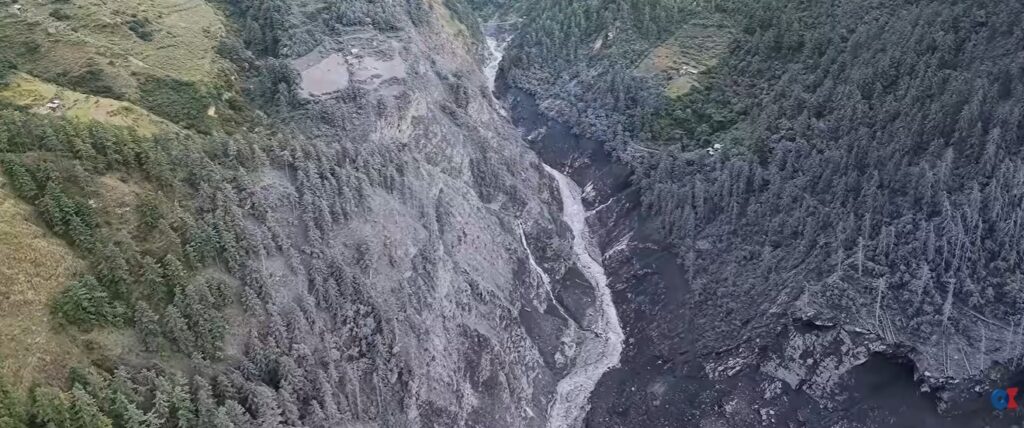
- Helicopter footage from Online Khabar shows heavy dust on the slopes beside the upper track and possible evidence of an air blast.
Why it matters
- constraint The comparison with 26 August is qualitative. Until volumes, discharge and travel times are measured, it cannot size the next dammed valley.
- decision About 98 minutes from slide to breach is a concrete timing to plan against. One event does not make a distribution, so operators should not treat it as typical.
- exposure A site under construction faces this hazard before the dam exists to be assessed, and the planned 225 m dam has already lost a camp to the flow.
The seismic post puts 98 minutes between the landslide and the breach [5]. If warnings went out after the slide, that is the window they had to work in. The post hedges both of its human figures. It says there "appears to have been successful dissemination of warnings" [10] and that five people have "probably been killed" [7]. It does not say how many people live downstream, so the deaths cannot be set against the number warned.
The 26 August Langtang Lirung event came 46 days earlier [6], and the post introduces 11 October as "yet another major debris flow/flood" in Nepal [1]. It places this flow below the August one: less damage, smaller, slower [3]. These are qualitative. With one event and no downstream count, the post cannot say how much of the milder outcome belongs to the hazard and how much to the warnings.
The initiating slide is still an open question. Helicopter footage from Online Khabar shows a large amount of dust coating the slopes beside the upper track and, about 53 seconds in, possible evidence of an air blast [11]. Those features lead the post to ask whether the slide was a rock avalanche [12].
The post's author also wonders whether the Budhi Gandaki hydropower project is viable in light of this summer's events [4]. We would treat that as a question for the engineers. The destroyed camp shows the flow reached a project site.
What to watch
- Satellite and aerial imagery, which the post expects within days, would give volume and runout and settle whether the initiating slide was a rock avalanche.
- An official casualty count and a figure for people living downstream, which would test both 'probably five' and the claim that warnings worked.
- Any response from the Budhi Gandaki hydropower project after the loss of its camp.
Clarity's read
What the record supports and how the coverage leans. The claims behind it follow.
Reality
- Evidence35
- Adoption
- Insufficient
- Hype gap−5
- Incentives
- Insufficient
- Confidence40
Claim ledger
Ranked by verification strength, evidence, and original report placement.
- [1]
On 11 October 2026 a major debris flow/flood swept down the Budhi Gandaki River in Gorkha district, Nepal; the post describes it as 'yet another major debris flow/flood' to occur in Nepal.
- [2]
Seismic data posted to Bluesky by Kristen Cook records a landslide, thought to be in the vicinity of Chumchet, at 04:22 local time, followed by a breach of the landslide dam at about 6 am, which caused the debris flow/flood.
- [3]
The event caused substantial damage, but not on the scale of the 26 August 2026 Langtang Lirung event; the flow travelled more slowly and was smaller.
- [4]
The post's author wonders whether the Budhi Gandaki hydropower project is viable in light of events this summer.
- [5]
The interval between the landslide (04:22) and the dam breach (about 6 am) is about 98 minutes.
- [6]
The 11 October event came 46 days after the 26 August Langtang Lirung event.
- [7]
It appears that five people have probably been killed.
- [8]
There has been damage to houses, roads and bridges.
- [9]
A video shows the destruction of a camp for the Budhi Gandaki hydropower project, which will be a 225 metre high dam.
- [10]
There appears to have been successful dissemination of warnings.
- [11]
Helicopter video posted by Online Khabar shows the upper track of the debris flow, with a huge amount of dust coating the adjacent slopes and possible evidence of an air blast about 53 seconds in.
ReportedInsufficientSource: Eos Landslide Blog post, describing Online Khabar videoView cited source - [12]
The post says helicopter video suggests the event was initiated by a very dynamic landslide and asks whether it was a rock avalanche.
- [13]
The post's author hopes better satellite and aerial imagery will emerge in the coming days that will allow the event to be analysed properly.
Sources
1 independent publisher whose own reporting we read for this story.
- eos.orgThe 11 October 2026 landslide and debris flow/flood on the Budhi Gandaki River in Gorkha district, Nepal
1 article · October 11, 2026
Topics and entities
Follow any of these and your For You feed starts watching them — no settings page required.