One glacier collapse reached more than eleven Nepali hydropower sites
Nepal counts 933 workers missing from those sites and thinks about 100 may still be alive inside the tunnels, which turns a single upstream hazard into one correlated claim on a whole basin of run-of-river assets.
The Investor · Invest desk
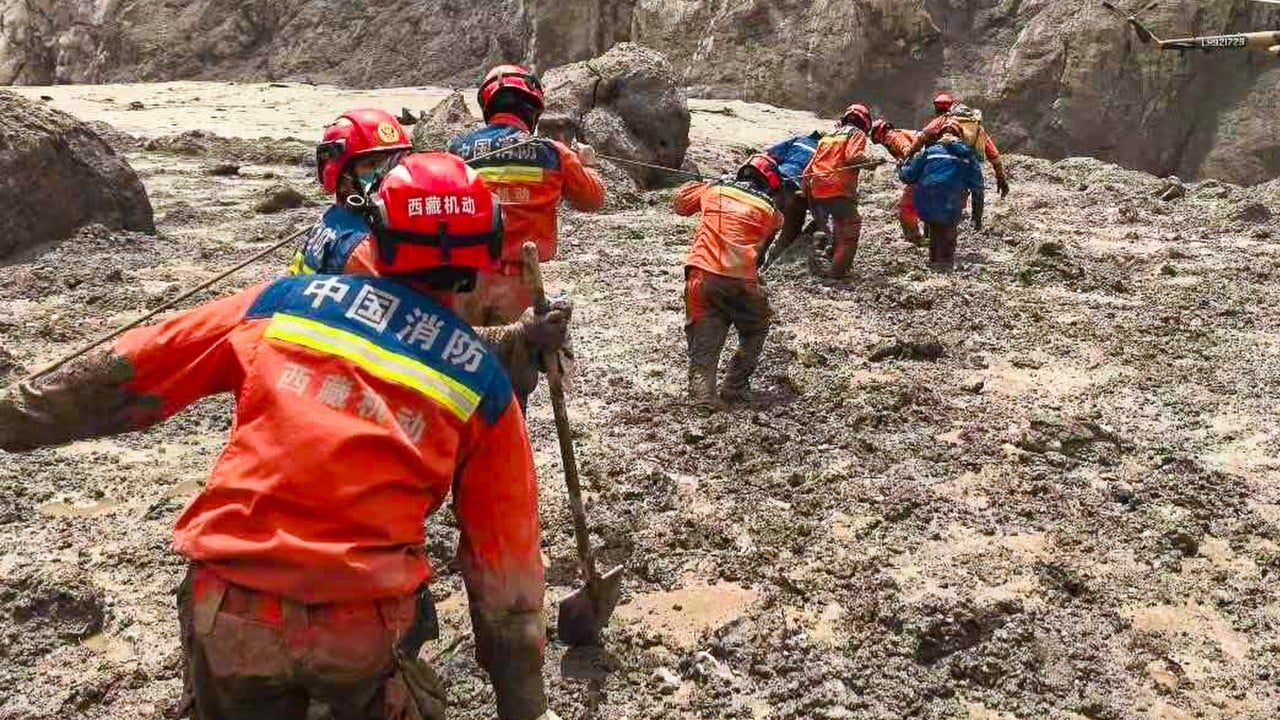
What happened
- Five days after the Himalayan flooding on the Nepal-China border, the confirmed death toll stood at 750 on the 30th, with 3,044 people still listed as missing across Nepal and Tibet.
- Nepali authorities count at least 933 workers missing from more than 11 hydropower plant sites, and believe about 100 of them may still be alive inside the tunnels.
- Home Minister Sudan Gurung said air was already being pumped through a small hole into the buried tunnel at Trishuli 3A, with excavation and entry by rescue teams to follow.
- Tibet's missing include 261 foreign nationals from 23 countries, led by 104 Nepalis, 49 Indians, 33 Latvians, 18 Americans and 15 Britons.
Why it matters
- exposure By publishing a country-by-country list and notifying the missions concerned, Beijing has given 23 foreign ministries standing in what had been a bilateral rescue operation, and roughly half of Tibet's missing are their nationals.
- constraint A telemetry agreement improves warning without changing geometry: the tunnels remain where the gradient is, and the barrier lakes remain upstream and on the other side of a border.
- decision Sponsors and insurers at the other sites on that list now have to decide whether crews working underground during a glacial-hazard window is a priceable condition or an excluded one.
- contradiction Two publishers carry Nepali death tolls 59 apart, so anyone building a loss estimate off the 750 top line is anchoring to the most revisable figure in the story.
The missing-to-death ratios on each side of the border no longer describe the same event: Tibet reports 546 missing against 16 deaths, a ratio near 34 to 1, while Nepal reports 2,498 missing against 734 deaths, a ratio near 3.4 to 1 [20][1][14]. A tenfold gap in that ratio is either a difference in how a valley gives up bodies or a difference in how a register of the missing gets compiled, and until it resolves, the 750 headline is the least settled number in the file [19][14].
The number that matters for capital is the other one. At least 933 workers are missing from more than 11 hydropower sites, which averages under 85 a site and amounts to about 37 per cent of everyone Nepal currently counts as missing [3][16][17]; roughly 100 of the 933, about one in nine, are thought to still be alive underground [3][18].
A run-of-river asset earns from gradient, and gradient here means a steep valley with a tunnel cut into the side of it, which is where the workers were when the ice, rock, mud and debris came down the rivers [5][3]. More than eleven sites were hit by a single glacier collapse on a single Wednesday [4][3]. For a lender, that is eleven exposures tied to one hazard, a book that looks diversified on a schedule but concentrates risk within a single basin.
This is probably wrong, but I would expect the repricing to arrive as tunnel-occupancy rules and construction-phase cover rather than as abandoned sites, because the head is where the gradient is and no sponsor can move a river. The cheapest fix has in fact already been agreed at nearly no capex: China and Nepal said on the 29th they would expand real-time hydrological sharing [12], and Wang Yi said China had passed footage, satellite and hydrological data, and warnings about upstream barrier lakes [13]. That is where the hazard signal was living: upstream, across a border, on another ministry's desk.
What would prove the siting read wrong: if most of the 933 turn out to have been in surface camps and spoil yards rather than inside the tunnels [3], this becomes a question of where you house people in monsoon and not a question of where you put concrete. And if Nepal's toll settles toward the 675 the South China Morning Post carried rather than the 734 in the count relayed by en.sedaily.com from Reuters and the Associated Press, a gap of 59, roughly 8 per cent, the human total moves while the eleven sites stay exactly where they are [21][20][22].
The allocation choice is visible in the field, meanwhile, because rescue capacity is concentrated on Trishuli 3A and 3B [8], where the army drilled into the upper section of a buried tunnel in Bagmati Province before starting excavation [6], while the Bhote Koshi rises [2]. Nine or more sites are waiting their turn.
What to watch
- Whether excavation at Trishuli 3A reaches any of the roughly 100 workers believed to be alive underground.
- Whether the missing count at the remaining hydropower sites rises as crews finally reach them.
- Whether lenders or insurers start attaching early-warning tie-ins and tunnel-evacuation terms at other Nepali sites.
Clarity's read
What the record supports and how the coverage leans. The claims behind it follow.
Reality
- Evidence60
- Adoption
- Insufficient
- Hype gap+10
- Incentives
- Insufficient
- Confidence58
Perspective Coverage
3 publishers- Builder
- Builder 18%
- Operator
- Operator 57%
- Investor
- Investor 25%
Claim ledger
Ranked by verification strength, evidence, and original report placement.
- [1]
Chinese authorities said 16 people died and 546 are missing in Tibet.
- [2]
Nepali authorities said water levels in the Bhote Koshi River were rising and urged residents of flood-hit areas to stay alert for further flooding.
- [3]
Nepali authorities believe at least 933 workers are missing from more than 11 hydropower plant sites, and that about 100 of them may still be alive while trapped inside tunnels.
- [4]
The disaster followed Wednesday's glacier collapse.
- [5]
Ice, rock, mud and debris poured down along Himalayan rivers.
- [6]
Nepali army rescuers drilled an access route overnight into the upper section of a tunnel buried under earth and rock at the Trishuli 3A hydropower plant in Bagmati Province in central Nepal, one of the hardest-hit areas.
- [7]
Home Minister Sudan Gurung said "We have already begun pumping air through a small hole," adding that excavation work would now begin and rescue teams would be sent inside.
- [8]
Rescue efforts are focused on the Trishuli 3A and Trishuli 3B plants.
- [9]
The missing on the Tibetan side include 261 foreign nationals from 23 countries: 104 Nepalis, 49 Indians, 33 Latvians, 18 Americans and 15 Britons among them.
- [10]
China mobilized large cargo drones and helicopters to airlift equipment and supplies to rescue teams near border checkpoints, and its military is searching using survivor detection equipment, drones and navigation systems.
- [11]
Sunday's list of missing foreigners was China's first release of country-by-country details, and Beijing said it had notified the diplomatic missions of the countries affected; local officials said no foreign survivors were stranded in the area.
- [12]
China and Nepal agreed to expand real-time sharing of hydrological data after Wang Yi spoke by telephone with Nepali Foreign Minister Sishir Khanal on the 29th, agreeing to strengthen cooperation on flood early warning and disaster response.
- [13]
Wang Yi said China had shared footage of the disaster areas, satellite and hydrological data, and warning information on upstream barrier lakes with the Nepali side.
- [14]
Tibet's ratio of missing to confirmed dead is about 34 to 1, while Nepal's is about 3.4 to 1, a tenfold difference.
- [15]
The 261 missing foreign nationals are about 48 per cent of the 546 people missing in Tibet.
- [16]
With at least 933 workers missing from more than 11 hydropower sites, the average is fewer than 85 missing workers per site.
- [17]
The 933 missing hydropower workers are about 37 per cent of the 2,498 people Nepal lists as missing.
- [18]
The roughly 100 workers thought to still be alive are about one in nine of the 933 missing.
- [19]
The death toll from flooding along the Nepal-China border rose to 750 on the 30th, the fifth day after the disaster, with 3,044 people missing in Nepal and China's Tibet Autonomous Region according to Reuters and the Associated Press.
- [20]
Nepali authorities put their toll at 734 dead and 2,498 missing.
- [21]
The South China Morning Post reported that 675 have been confirmed dead in Nepal with 2,498 still missing.
- [22]
The two published Nepali death tolls differ by 59, about 8 per cent of the higher figure.
Get this ledger inside ChatGPT. Ask about any of our stories and the answer brings its figure, each claim’s verdict and the sources. Free, no account.
Sources
3 independent publishers whose own reporting we read for this story.
- en.sedaily.comNepal-Tibet Flood Death Toll Climbs to 750 on Fifth Day
2 articles · August 30, 2026
- fortune.comNearly 1,000 people are missing in Nepal’s floods, and hundreds more are trapped in hydropower tunnels as flood knocks 10% of power capacity offline
1 article · August 31, 2026
- scmp.comChina-Nepal floods: hundreds of foreigners missing in Tibet after disaster
2 articles · August 30, 2026
Topics and entities
Follow any of these and your For You feed starts watching them — no settings page required.
Topics
Entities
- Jakob SteinerFollow
- Wang YiFollow
- Sishir KhanalFollow
- International Center for Integrated Mountain DevelopmentFollow
- Trishuli 3A hydropower plantFollow
- Trishuli 3B hydropower plantFollow
- Sudan GurungFollow
- ReutersFollow
- Associated PressFollow
- Doosan EnerbilityFollow
- Independent Power Producers' Association, NepalFollow
- Coalition for Disaster Resilient InfrastructureFollow
- Biraj Bhakta ShresthaFollow
- Bhote Koshi RiverFollow