Science1 publisher3 min readPublished
Nepal's Rasuwa flood request tests a UN loss and damage fund built around scheduled windows
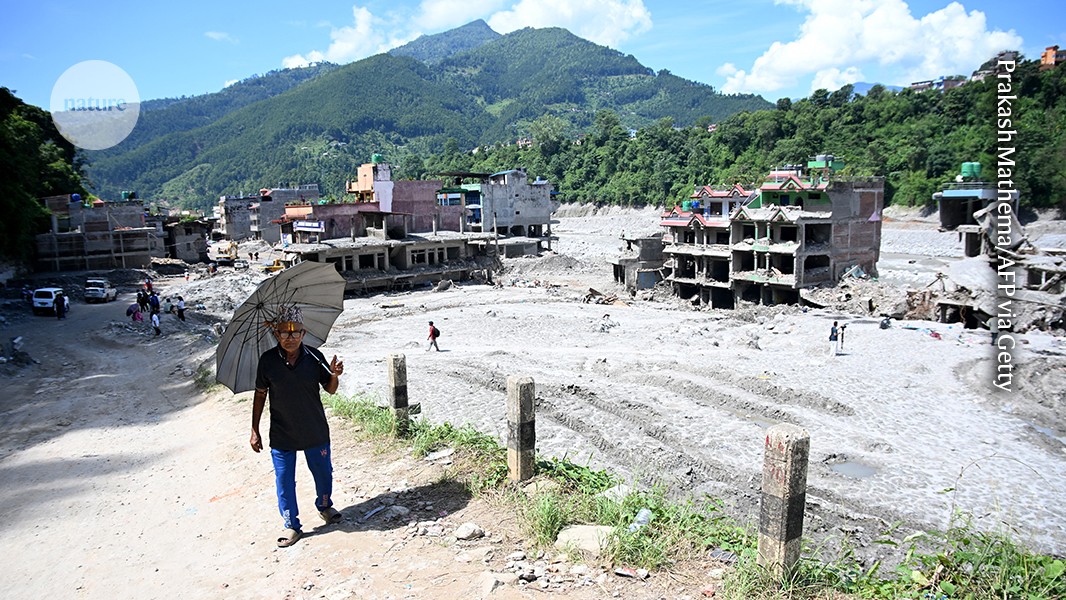
Nepal is still waiting on the UN loss and damage fund a month after Rasuwa floods killed more than 1,400 people and left a rebuild costing almost $5 billion. How the fund weighs climate change's role, which it has yet to decide, will shape how fast vulnerable countries get paid.
The Scientist · Science desk
What happened
- On 26 August a surge of water, mud and boulders swept through Nepal's Rasuwa region, killing more than 1,400 people and leaving about 6,000 missing.
- Nepal's government puts the cost of reconstruction at almost $5 billion, roughly a tenth of the country's GDP.
- Five days after the floods, Nepal formally asked the UN loss and damage fund for urgent support, and the fund said it would respond with urgency, compassion and careful consideration.
- A month after the disaster, no arrangement for Nepal had been made and the fund had made no further announcement, according to a comment in Nature.
Compiled by The ScientistSomething wrong?How this is made
Why it matters
- constraint With applications open only in scheduled windows, a country hit between them has no formal route to the fund's emergency money, however urgent its needs.
- cost Every week of delay while attribution evidence is gathered leaves the bill with Nepal, which the author warns could mean deeper losses and high-interest borrowing.
- decision The fund now has to settle whether attribution evidence is a condition of payment or one input among several, and the author wants that settled before the next catastrophe.
- precedent Rasuwa is the fund's first big operational test, so the terms it offers Nepal become the baseline other climate-vulnerable countries will expect after their own disasters.
The hardest part of the Rasuwa case is scientific. In a comment in Nature, an environmental scientist who has studied change in the Himalayas for more than 20 years describes how disasters like this one unfold as a chain [17][13]. A slope fails. The failure sets off an avalanche of rock and ice, the ice melts into a debris flow that picks up sediment, and the flow floods valleys downstream [13]. Each link carries its own uncertainty about how much climate change caused or intensified it [13].
Several factors shaped both the odds of the disaster and the damage it did, according to the comment: how long-term warming had altered the ice, how much sediment moved with the water, where downstream flooding occurred, and how exposed and prepared communities were [19]. Separating the warming contribution from the rest is the job of attribution science.
The fund needs that evidence and cannot wait for it. In a highly competitive funding environment it needs credible evidence of climate influence to protect its mandate, the author wrote, yet robust attribution of complex cascading disasters takes time [20][14]. The fund has also not set out how climate's role would count in a funding decision at all [9].
The author's answer is to split the decision by speed [11]. An emergency allocation would come first, covering urgent humanitarian work and essential services, decided on a streamlined assessment of need and vulnerability [11]. Reconstruction and long-term recovery money would follow within a few years, after a fuller assessment [11]. For the first stage, the author argues, established evidence already shows global warming played a part in the risk of this disaster [12].
In my view the split is sound, provided the second stage has a rule for cascades whose attribution comes back weak or ambiguous. It separates a fast judgement about need from a slow one about cause [11]. On the ambiguous cases, the author cites Coumou and colleagues in PNAS Nexus in 2024 and argues that a lack of formal evidence must not be read as meaning climate played no part, and must not justify denying support [16].
The burden of proof would fall unevenly. Attribution needs plentiful data, modelling infrastructure and access to experts, and the author wrote that countries such as Nepal cannot be expected to have them [15]. Nepal has contributed 0.01% of global carbon emissions [10]. A rebuild of almost $5 billion at roughly 10% of GDP implies an economy of about $50 billion [1].
The fund was set up in 2022, and one of its main roles is to provide finance quickly for humanitarian action in emergencies [7]. Its reasons for the pace on Nepal are not on the record beyond its initial reply, and the account of the delay comes from the comment [5][6]. "Rasuwa must set a precedent for future emergencies," the author wrote [18].
What to watch
- Whether the fund announces an emergency allocation for Nepal, and whether it rests on a streamlined assessment of need and vulnerability.
- Whether the fund creates a rapid-access pathway that lets countries apply outside scheduled application windows.
- Whether the fund publishes its framework for weighing climate attribution, and whether strong attribution evidence becomes a prerequisite for payment.