InvestNot yet confirmed elsewhere1 publisher2 min readPublished
Boston Fed's Collins expects rates to rise "a bit further" with inflation nearly six years above 2%
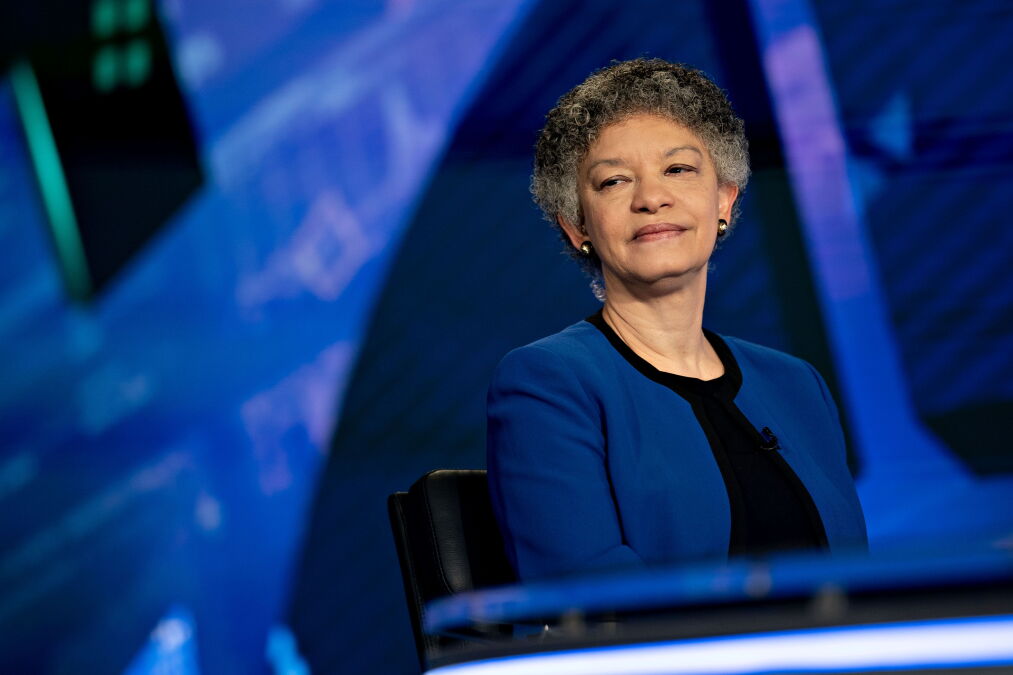
Boston Fed President Susan Collins said the Fed will have to raise rates "a bit further" after last month's 25-basis-point hike. Her own central case still has inflation easing to 2%, so how far depends on whether fuel and AI-construction costs spread.
The Investor · Invest desk
What happened
- At the Boston Fed's annual conference for regional and community banks, Collins said she supported last month's FOMC hike and that higher rates are needed to bring inflation down.
- Her most likely scenario keeps GDP growth healthy and the labor market near full employment, with inflation drifting back to 2% as efficiency gains help supply and demand balance.
- She tied the upward pressure to the war with Iran, which has raised diesel and home heating oil costs, and to AI data-center spending that has raised construction costs.
- Five-year loans at New England community banks have begun to reprice at higher rates, and she said the banks' net interest margins are returning to their post-financial-crisis averages.
Why it matters
- decision A plan for more tightening needs a size: one further step of last month's scale is 25 basis points, two is 50, and Collins has not said which she means.
- contradiction The same speech calls for more hikes and describes a central case in which inflation returns gradually to 2%. The case for tightening rests on fuel and construction costs not spreading.
- exposure New England community banks hold more of their assets in loans than banks elsewhere, so their margin recovery depends on how far rates go from here.
- constraint This is one regional president's view, relayed by one outlet, and the report includes no FOMC guidance on size or timing. "A bit further" comes with no size or date.
Her stated test for how much further is breadth. Collins said it will be important to monitor "whether elevated inflation remains largely confined to energy and AI-buildout-related categories" or "whether evidence of price pressures broadens" [7]. If the first answer holds, her own central case of gradual disinflation applies, and we think a second step becomes hard to justify. If the second holds, that central case is the part that was wrong. Her efficiency story includes a district-level observation: in her interview with American Banker, she said the productivity gains at companies in the region come mostly from better processes, and that swapping workers out for AI is not necessarily the source [13].
She did not put a number on "a bit further" [1]. Last month's step was 25 basis points, so one more of the same size is 25 and two is 50 [15]. We'd plan for one further step as the base case and two as the stress case, a reading of "a bit" that is ours. The base case rests on her description of an economy showing "resilience," especially in its low unemployment rate [5]. The stress case is the one where the breadth test fails, and her forecast of disinflation fails with it, with inflation by then well past six years above target [2].
For the banks in her audience, the cost side has stopped getting worse. She said rates paid on interest-bearing accounts have stabilized after rising over the past two years, and that banks are posting strong earnings [10]. She still said "overall returns for community banks in the region remain below those of national peers, continuing a long-term pattern" [11]. Deal flow is lower so far this year. Fed data cited by American Banker show five New England bank mergers against 15 in all of 2025 [12], a third of last year's total with the year unfinished [14].
What to watch
- Whether inflation readings outside energy and AI-buildout categories start to firm, which is the breadth test Collins named.
- Home heating oil and diesel prices through the New England winter, the cost pressure she singled out.
- The FOMC's next decision, to see whether a second 25-basis-point step follows last month's.
Clarity's read
What the record supports and how the coverage leans. The claims behind it follow.
Reality
- Evidence55
- Adoption
- Insufficient
- Hype gap−5
- Incentives
- Insufficient
- Confidence58
Claim ledger
Ranked by verification strength, evidence, and original report placement.
- [1]
Collins said she supported the FOMC's 25-basis-point rate hike last month and feels the central bank will have to raise rates "a bit further"; the report gives no size or timing for the further increase.
ReportedSupportedSource: Susan Collins, as reported by American Banker2 sources— create a free account to open themView cited source - [2]
Collins said inflation is coming up on six years above the Fed's 2% target.
ReportedSupportedSource: Susan Collins, Boston Fed president, as reported by American BankerView cited source - [3]
Speaking at the Boston Fed's annual conference for regional and community banks, Collins said she supported the FOMC's 25-basis-point hike and that higher interest rates are needed to bring inflation down.
- [4]
Collins said the most likely scenario, per her reading of the data, "continues to feature healthy GDP growth, with the labor market remaining near full employment," with inflation gradually returning to two percent as continued efficiency gains support the balance between demand and supply and contribute to disinflation.
- [5]
Collins said the U.S. economy is showing "resilience," especially with regard to a low unemployment rate.
- [6]
Collins said pressure from the war with Iran has driven up costs for fuels like diesel and home heating oil, which matters for New England as winter approaches, and that spending on AI data centers has driven up construction costs.
- [7]
Collins said it will be important to monitor "whether elevated inflation remains largely confined to energy and AI-buildout-related categories" or "whether evidence of price pressures broadens."
- [8]
Collins said New England community banks have a higher proportion of their assets in loans than banks elsewhere in the country, specifically residential loans for one- to four-family homes.
- [9]
Collins said loans with five-year rate terms have begun to reprice in the higher rate environment, and local banks' net interest margins are coming back to their averages from after the global financial crisis.
- [10]
Collins said banks are posting strong earnings, the interest rates banks pay on interest-bearing accounts have stabilized after rising over the past two years, and core-deposit ratios are up.
- [11]
Collins said: "New England remains a highly competitive lending environment, and overall returns for community banks in the region remain below those of national peers, continuing a long-term pattern."
- [12]
Fed data shows there were 15 bank mergers in New England in 2025 and five so far this year.
- [13]
In an interview with American Banker, Collins said regional companies are mostly getting productivity gains from process enhancements, not necessarily from replacing workers with more-efficient AI.
- [14]
Five New England bank mergers so far this year equal one third of the 15 recorded in all of 2025.
- [15]
One further step of last month's 25 basis points is 25 basis points; two such steps are 50 basis points.
Sources
1 independent publisher whose own reporting we read for this story.
- americanbanker.comInflation likely to spark more rate hikes: Boston Fed's Collins
1 article · October 13, 2026
Topics and entities
Follow any of these and your For You feed starts watching them — no settings page required.
Entities
- Federal Open Market CommitteeFollow
- American BankerFollow
- Susan CollinsFollow
- Federal Reserve Bank of BostonFollow