Science1 publisherNot yet confirmed elsewhere3 min readPublished
Struck along the normal direction, rolled AZ31 magnesium plates absorb up to 6.7% more ballistic energy
Pusan National University researchers found rolled AZ31 magnesium plates absorbed 6.5% to 6.7% more impact energy when struck along the normal direction. How the plates broke differed more than the energy did, in tests of one alloy at a single impact speed.
The Scientist · Science desk
Drafted by a language model from the sources cited here and checked against its claim ledger before publication. How we use AISend a correction
What happened
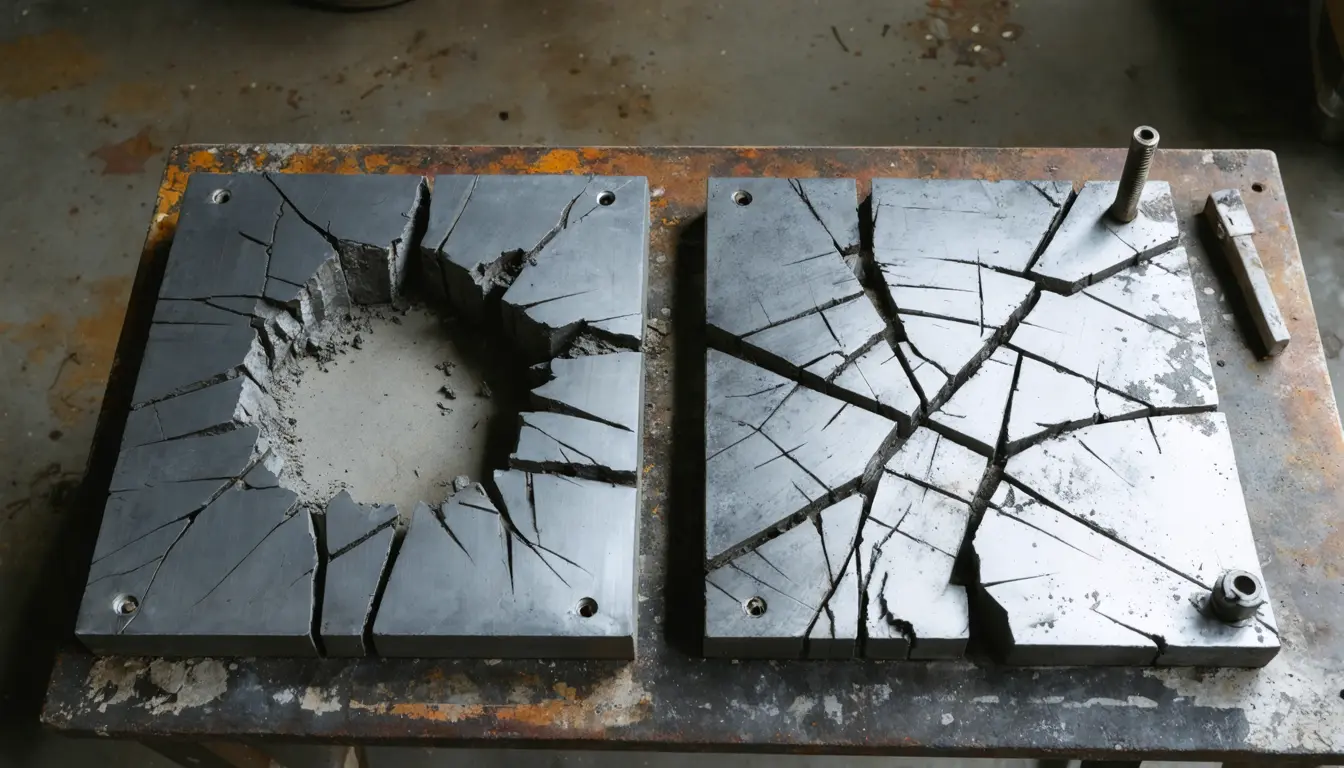
- Hits along the rolling direction left localized shear bands and asymmetric, elliptical fractures.
- Microscopy and simulations tied the normal-direction response to uniform twinning, and the rolling-direction response to shear localization, adiabatic heating and recrystallization.
- Taekyung Lee led the work with Seoul National and Kyungpook National universities, and it is published in the Journal of Magnesium and Alloys.
Compiled by The ScientistSomething wrong?How this is made
Why it matters
- capability A panel maker using rolled AZ31 can gain some energy absorption and a symmetric failure by matching plate orientation to the expected threat, with no change in alloy or mass.
- decision Specifying AZ31 for protective parts now calls for recording texture direction alongside thickness, because plates of the same alloy failed differently depending on the axis of the hit.
- constraint With only two axis-aligned directions tested at one speed, the results cannot yet support design rules for oblique hits or other threat velocities.
Magnesium alloys appeal to aircraft and defence designers because they are light, strong for their weight and good at damping [13]. Their hexagonal close-packed crystals complicate that. How the metal deforms depends on the direction of the load relative to the crystal lattice, and the texture left by processing amplifies the effect [2]. That anisotropy has been studied extensively under slow loading. Under high-velocity ballistic impact it has been poorly understood [3].
One variable changes between shots. Hot-rolled AZ31 plates with a strong basal texture were struck at about 884 m/s, either along the normal direction or along the rolling direction [4]. Plate thickness ran from 5 to 20 mm, a fourfold span [15]. The team measured projectile velocity, absorbed energy, penetration, bulging and fracture surfaces, then ran finite-element simulations to map where stress concentrated and damage built up [5].
On energy, the gap is modest. Plates hit along the normal direction "consistently absorbed 6.5%-6.7% more energy and fractured in a symmetric manner upon perforation," Lee said [6]. That band is 0.2 percentage points wide [14]. The release does not give absolute energies, the number of shots per condition or the scatter between shots, so a reader cannot yet weigh "consistently" against shot-to-shot variation.
Fracture differed more sharply. "In thicker plates that resisted full perforation, ND impact promoted bulging rather than cracking. By contrast, impact along the RD produced localized shear bands and asymmetric, elliptical fractures," Lee said [7] [8]. Microscopy and the simulations trace the split to what happened inside the grains. Normal-direction hits drove uniform extension twinning and spread stress evenly. Rolling-direction hits set off uneven slip and twinning, concentrated the shear, heated the metal adiabatically and recrystallized it during the impact [9].
Lee argues that orientation is a gain engineers already have in hand. "Instead of inventing a new alloy or adding weight, engineers can boost ballistic resistance simply by orienting the plate so that impacts arrive along the direction in which its texture promotes uniform, symmetric deformation. This is essentially 'free' performance extracted from material that already exists," Lee said [10]. The paper names crystallographic texture and component orientation as important design variables for textured magnesium alloys [11], with military vehicle panels and protective structures among the suggested uses [16].
I think the design-variable conclusion is sound for this alloy at this speed, and the bulging-versus-cracking contrast is stronger evidence for it than the energy gap. In my view the "free" label holds only where a part's shape and mounting let the favourable direction face the expected threat. The thing this doesn't tell you is how a plate behaves when a round arrives at an angle between the two tested directions, or at a speed other than the roughly 884 m/s used here [4]. The authors say further research is needed under more complex, real-world impact conditions [12].
What to watch
- Tests of AZ31 plates struck at angles between the normal and rolling directions, or at speeds well away from 884 m/s.
- A follow-up that reports absolute absorbed energies and shot-to-shot scatter, so the 6.5% to 6.7% gap can be judged against variation.
- Trials of texture-oriented magnesium in assembled vehicle panels or protective structures under real-world impact conditions.