Researchers say the Wildlife Photographer of the Year elephant has picked up other females' dead calves
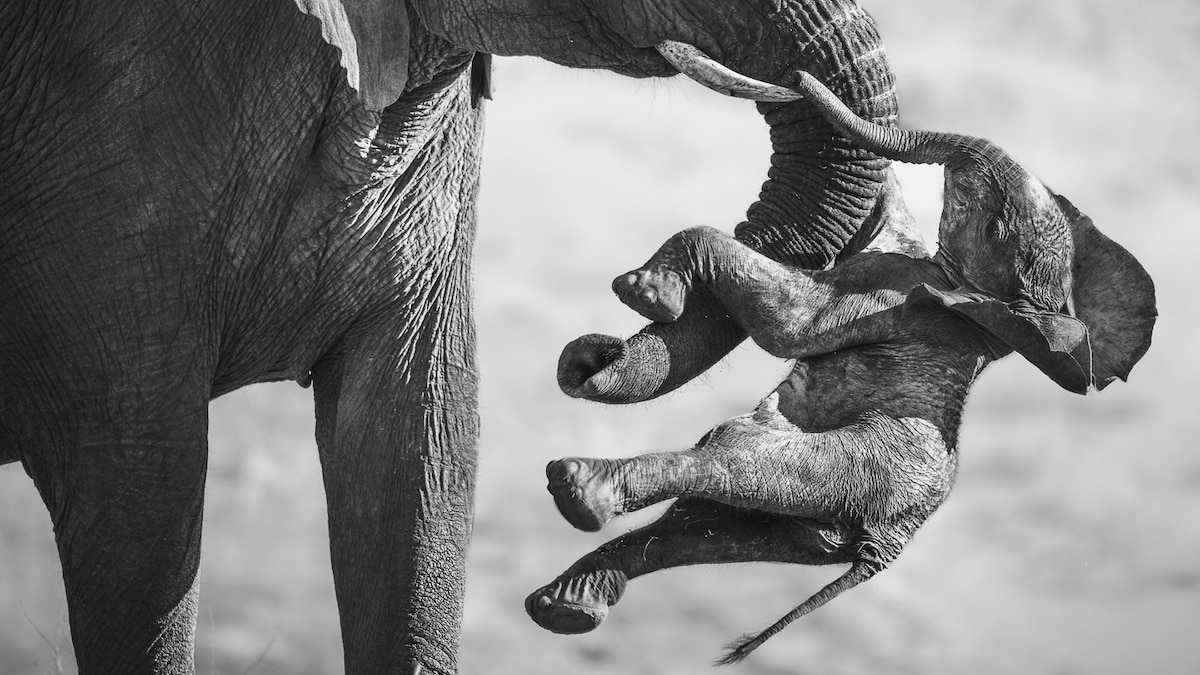
Federico Veronesi's photo of an elephant carrying a dead calf in Namibia won Wildlife Photographer of the Year 2026. Veronesi learned from researchers who recognised her that it is not certain the calf was hers.
The Scientist · Science desk
What happened
- Tracking elephants in Namibia's Huab River Valley, Veronesi followed drag marks across a dry riverbed and found a female carrying a dead calf, its leg wedged between her tusk and trunk.
- He had first assumed the elephant was the calf's mother, and the check came when he shared his photographs with an elephant research project working in the area.
- By their account, she had previously picked up dead calves belonging to other females.
Why it matters
- constraint A photograph can show an elephant carrying a calf but not whose calf it is, so a mother-and-calf caption needs an identification from people who know the animal.
- capability Long-term recognition of individual elephants lets a research project add a known history to a photographer's single encounter, which is how this question could be raised at all.
- contradiction Veronesi reads the scene as revealing animals' emotions, while the researchers' history for this elephant leaves open whether those emotions are a mother's grief.
The researchers' two facts do not settle whose calf this was. A calf lost several years earlier [5] says nothing about the calf in the photograph, and a record of picking up other females' dead calves [6] makes a stranger's calf a live possibility. We think the honest label is unconfirmed. The history reopens a question Veronesi had closed by assumption [3], and nothing in the report closes it again.
The identification is the useful piece of method here. Veronesi had one encounter on one dry riverbed [2]. A project that could recognise her [5] could set that encounter against what it already knew of the same animal [6].
The thing this doesn't tell you is the denominator. The report does not name the project, say how many calves she has picked up or how often, or say whether the calf's mother is known. One identified animal also cannot stand in for elephants in general.
Veronesi's stated aim survives the correction. He wants people who see the image to get past how animals look and to see each one as an individual, with emotions, memories and relationships of its own [8]. "It's a small window that opens just a crack into the complexity of their world," he said [7]. An elephant with a history of her own fits that aim well. What the photograph cannot support is the assumption he started with, that she was the calf's mother.
What to watch
- How the exhibition, which opens at the Natural History Museum on Friday 16 October 2026, words the caption on the elephant and the calf.
- Whether the research project publishes its records on this elephant, including how many dead calves she has picked up and whether this calf's mother has been identified.
Clarity's read
What the record supports and how the coverage leans. The claims behind it follow.
Reality
- Evidence50
- Adoption
- Insufficient
- Hype gap
- Insufficient
- Incentives
- Insufficient
- Confidence55
Claim ledger
Ranked by verification strength, evidence, and original report placement.
- [1]
Italian photographer Federico Veronesi won Wildlife Photographer of the Year 2026 with an image of an elephant carrying a deceased calf.
- [2]
While tracking elephants in Namibia's Huab River Valley, Veronesi spotted drag marks across the sand of a dry riverbed, followed them, and found a female elephant carrying a dead calf, its leg wedged between her tusk and trunk.
- [3]
Veronesi initially assumed the elephant was the calf's mother.
- [4]
After Veronesi shared his photographs with an elephant research project working in the area, he learned that the elephant being the calf's mother was not certain.
- [5]
Researchers recognised the elephant as a female who had lost a calf several years earlier.
- [6]
The researchers said the elephant had previously picked up dead calves belonging to other females.
- [7]
"It's a small window that opens just a crack into the complexity of their world," Veronesi said.
- [8]
Veronesi hopes the image will encourage people to look beyond animals' physical appearance and recognise them as individuals with their own relationships, memories and emotions.
- [9]
The competition's annual exhibition opens at the Natural History Museum on Friday 16 October 2026.
- [10]
Veronesi described the encounter as "revealing of the depth and complexity of the emotions, the feelings of the animals."
Sources
1 independent publisher whose own reporting we read for this story.
- bbc.co.ukPictured: Winning entries for Wildlife Photographer of the Year 2026
1 article · October 13, 2026
Topics and entities
Follow any of these and your For You feed starts watching them — no settings page required.