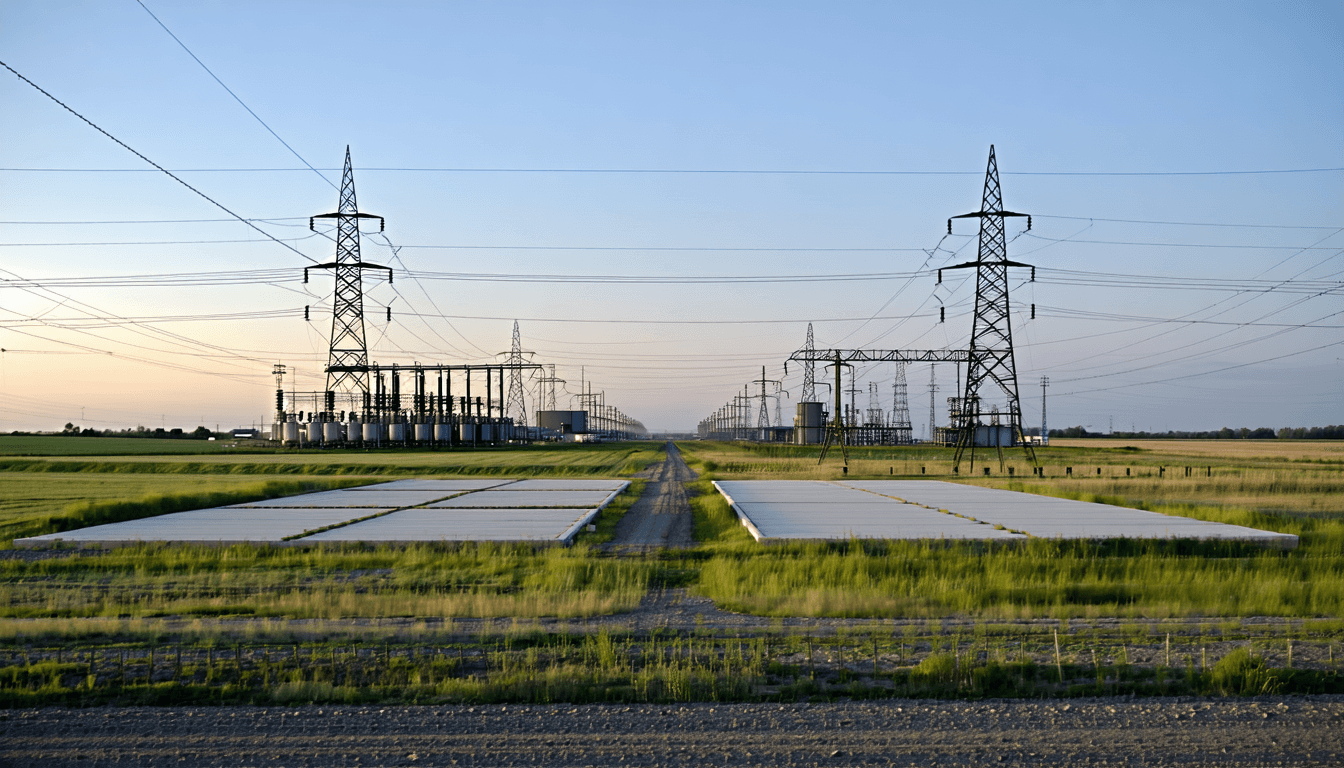
AEMO now plans for data centres at 13% of the grid, which changes where they can go
The forecast sits in the Electricity Statement of Opportunities, the document utilities and governments plan against. It arrives with a third of last year's project list already cancelled.
The Product Desk
What happened
- AEMO's forecast puts data centres at 13% of Australia's main electricity market by 2035-36, up from 3% now, on Bloomberg's reporting.
- In energy terms that is 34 terawatt hours a year drawn from the National Electricity Market.
- About 9 gigawatts of new generation and storage reached full output in 2025-26, twice the previous year's total.
Why it matters
- What it limits constraint Once the load sits in the document utilities and governments plan against, the binding question for a developer stops being who sells the electricity and becomes where the network can carry a flat...
- Who's exposed exposure The Clean Energy Finance Corporation's failure mode is paid for by retail customers and by the emissions ledger, not by whoever built the hall.
- Who has to decide decision A federal renewables condition turns the supply contract into an approval matter, so operators must either sit in a queue for firmed capacity or generate their own and argue about it later.
- What doesn't add up contradiction The same report supports two opposite reads: plan for a load seven times larger, and discount any pipeline that shed a third of its projects in twelve months.
Thirty-four terawatt hours a year, spread evenly across 8,760 hours, works out at about 3.9 gigawatts of continuous draw [18]. The size is not really the complaint. AEMO's stated reason for singling out this load is its shape: data centres run at much the same rate through the day and across the seasons, the way a large industrial site does [5]. Households and factories hand a planner a trough to work in. A hall of accelerators does not.
The report flags one trap before anyone else can fall into it. Roughly 13 gigawatts of coal and almost 2 gigawatts of gas are due to leave the system within the decade [4], but energy measured over a year and capacity measured at an instant are different quantities and do not subtract [17]. Comparing them honestly would need the capacity factor of the 9 gigawatts of generation and storage that reached full output in 2025-26 [7], and that number is not in the reporting.
There is a second figure inside the 13% that nobody has printed. If 34 terawatt hours is 13% of the market in 2035-36, the market itself is about 262 terawatt hours [19]. Run the same arithmetic backwards through the almost sevenfold rise and today's 3% share, and you get roughly 4.9 terawatt hours of data centre load now against a market of about 163 terawatt hours, which means AEMO's share figure only holds if total demand grows on the order of 60% [20]. So the 13% is a statement about electrification as much as about racks. If the rest of that growth arrives late, the same 34 terawatt hours becomes a larger slice of a smaller market, and the reliability problem worsens without a single extra server being installed.
Then there is the quality of the input. Developers have cancelled more than a third of the data centre projects AEMO listed a year ago [9]. Wires and transformers have no setting for that: the planning cycle is longer than the interval in which a third of a pipeline can disappear, and the same interval could see it refill. Commonwealth Bank puts the national buildout at as much as A$150bn, about $108bn, by 2030 [10], and the Clean Energy Finance Corporation has already named the failure mode if connections lag the load: bottlenecks, higher prices for consumers, and more reliance on fossil generation than was planned for [11].
The rulebook that would arbitrate any of this is not settled. The federal government is pushing for new data centres to run on renewable energy, and some regional administrations object [12]. Anthony Albanese is expected to use Wednesday's national cabinet to tell premiers that federal approval rules will complement state ones rather than override them, according to the Guardian [13]. Queensland and the Northern Territory have been the loudest objectors, and a climate expert told that paper Australia has "one shot to get the rules right" [14]. Australia's world-first data centre rules required every state to agree, and two refused in July [15]. Some builders are not waiting for a connection at all [16]. AEMO's own chief executive, Daniel Westerman, has framed the timing plainly: plenty of capacity is coming before the early 2030s, and the wave after 2030 is the one that decides reliability [8].
What to watch
- Whether next year's Electricity Statement of Opportunities revises the 34 terawatt hour figure down after further project cancellations, or up.
- Whether Wednesday's national cabinet converts the renewables preference into a binding approval condition, and whether Queensland and the Northern Territory sign.
- How much of the post-2030 investment wave Westerman called critical actually reaches financial close before the coal retirements bite.
Clarity's read
What the record supports and how the coverage leans. The claims behind it follow.
Reality
- Evidence62
- Adoption44
- Hype gap+14
- Incentives63
- Confidence58
Claim ledger
Ranked by verification strength, evidence, and original report placement.
- [1]
AEMO forecasts data centres will take 13% of Australia's main electricity market by 2035-36, up from 3% today, almost a sevenfold rise in a decade. Keira Wright reported the forecast for Bloomberg.
- [2]
The figure appears in AEMO's annual Electricity Statement of Opportunities, the operator's read on whether supply will meet demand across the National Electricity Market over the coming decade, and the document utilities and governments plan against.
- [3]
On AEMO's projection, data centres will draw 34 terawatt hours a year from the National Electricity Market by 2035-36.
- [4]
Roughly 13 gigawatts of coal-fired plant will retire within the decade, along with almost 2 gigawatts of gas generation.
- [5]
AEMO said in its report: "Data centers are particularly influential because they operate relatively consistently throughout the day and across seasons, similar to large industrial loads."
- [6]
Generation and storage connections more than doubled last year's record, and AEMO says that has improved the reliability picture.
- [7]
About 9 gigawatts of new generation and storage reached full output in 2025-26, double the year before.
- [8]
AEMO chief executive Daniel Westerman said a significant amount of new capacity is expected to be delivered between now and the early 2030s, helping replace retiring generation and support growing demand, and that "beyond 2030, the next wave of investment will be critical to maintaining reliability".
- [9]
Developers have cancelled more than a third of the data centre projects AEMO listed last year, according to the report.
- [10]
Commonwealth Bank of Australia estimates the country's data centre buildout could reach A$150bn, about $108bn, by 2030.
- [11]
A Clean Energy Finance Corporation report names bottlenecks, higher prices for consumers, and more reliance on fossil fuels than anyone planned for.
- [12]
The federal government is pushing to make new data centres run on renewable energy, and some regional administrations object.
- [13]
Anthony Albanese will use Wednesday's national cabinet to reassure premiers about a new AI law, promising that federal approval rules complement state ones rather than override them, according to the Guardian.
- [14]
The conservative governments of Queensland and the Northern Territory have been the loudest objectors, and a climate expert told the Guardian Australia has "one shot to get the rules right".
- [15]
Australia's world-first data centre rules needed every state to agree, and two said no in July.
- [16]
Not every project waits for a grid connection; some builders are going around the grid.
- [17]
The data centre forecast counts energy over a year in terawatt hours and the retirements count capacity at a moment in gigawatts, so the two sets of numbers do not subtract from each other.
- [18]
34 terawatt hours a year averaged across every hour of a year is about 3.9 gigawatts of continuous draw.
- [19]
If 34 terawatt hours is 13% of the National Electricity Market in 2035-36, total market energy that year is about 262 terawatt hours.
- [20]
Backing out the almost sevenfold rise implies data centre load of roughly 4.9 terawatt hours today, which at a 3% share implies a current market of about 163 terawatt hours and total demand growth of roughly 60% to 2035-36.
Get this ledger inside ChatGPT. Ask about any of our stories and the answer brings its figure, each claim’s verdict and the sources. Free, no account.
Sources
1 independent publisher whose own reporting we read for this story.
- thenextweb.comAustralian data centres will use seven times more power by 2036
1 article · August 24, 2026
Topics and entities
Follow any of these and your For You feed starts watching them — no settings page required.
Topics
Entities
- Commonwealth Bank of AustraliaFollow
- BloombergFollow
- Clean Energy Finance CorporationFollow
- National Electricity MarketFollow
- Australian Energy Market OperatorFollow
- Queensland GovernmentFollow
- The GuardianFollow
- Anthony AlbaneseFollow
- United States Studies CentreFollow
- Daniel WestermanFollow
- Electricity Statement of OpportunitiesFollow
- Northern Territory GovernmentFollow
- Keira WrightFollow