One-atom steps steer quantum vortices through an ultrathin superconductor
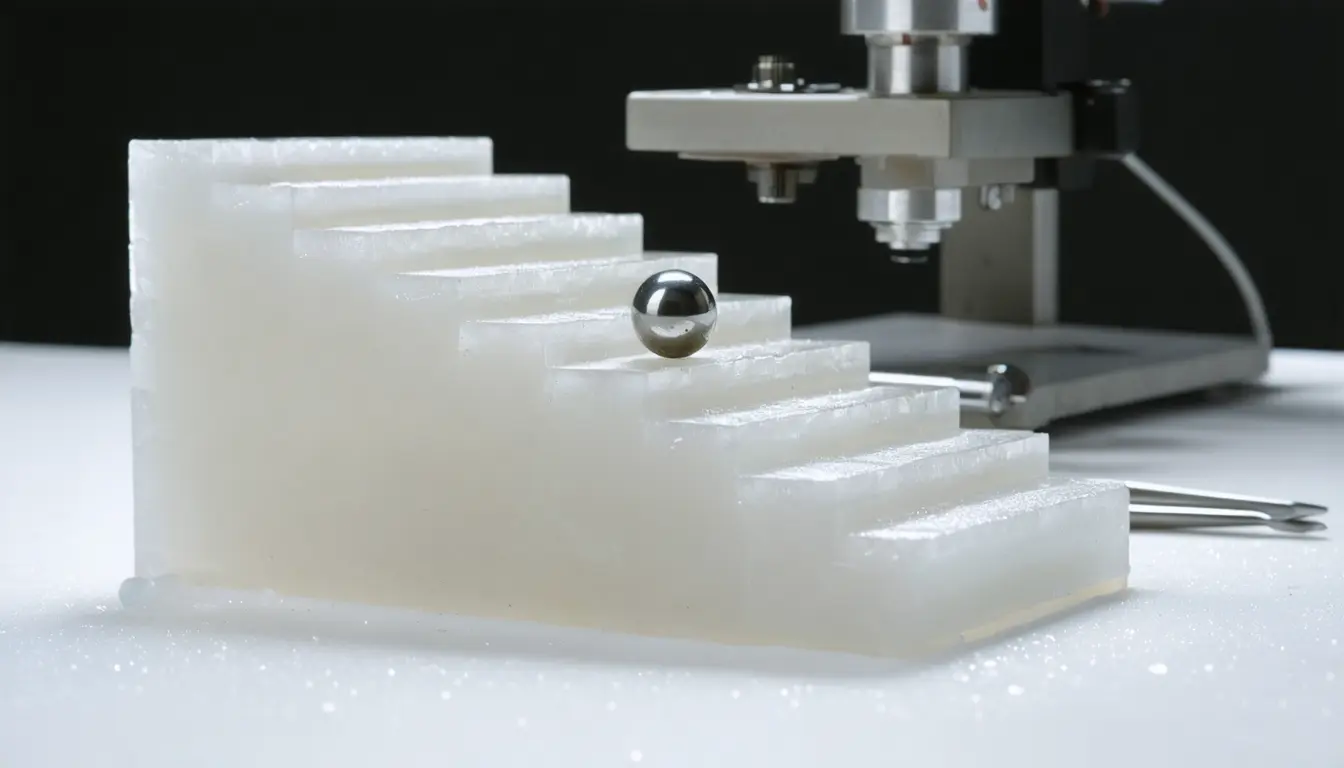
NIMS researchers found vortices in an ultrathin superconductor move over 1,000 times more easily along one-atom-high steps than across them. Temperature and magnetic field tune the effect, and MANA says it could eventually help build lower-energy superconducting electronics.
The Scientist · Science desk
What happened
- Four-terminal resistance measurements gave the 1,000-fold directional difference at intermediate magnetic fields.
- Between roughly 0.10 and 0.20 tesla, vortices flowed along the steps without being trapped by imperfections, which the team calls one-dimensional pinning-free flow.
- At the lowest temperatures, quantum tunneling governed how the vortices moved.
- The results appeared in Physical Review B.
Why it matters
- What's now possible capability A single surface step gives vortices a fixed direction of travel in a class of films where steering them has been difficult.
- What it limits constraint Moving vortices produce resistance, so in our view rails that ease their motion suit devices that steer vortices and work against ones that need a loss-free supercurrent.
- Who has to decide decision Anyone designing around the steps would have to pick an operating point, because the ratio is reported for intermediate fields and the unpinned flow only inside a bounded field window.
The design pairs two kinds of evidence. Scanning tunneling microscopy images a surface at the atomic level, so it shows where things sit [5]. The team used it to confirm that the steps ran parallel and to see vortices positioned along them [5]. Four-terminal resistance measurements supplied the other half: how easily vortices moved in each direction [6].
The summary names no material and includes no comparison film without steps. That control is what would isolate the steps as the cause. Until the paper's methods are checked, we'd call the steps the likely cause.
The ratio alone cannot show which side changed. A difference of more than 1,000 times [2] can come from vortices that glide along the steps, from vortices held back across them, or from some of each. The pinning-free flow the team reports speaks to the first possibility [7].
Tunneling is the process by which quantum objects pass through energy barriers that classical physics would not let them cross [13]. In our view the coldest-temperature behavior deserves as much attention as the headline ratio, because there the vortices are not climbing over barriers at all [8].
The summary reports a measurement on a film. MANA frames the electronics as a possible later outcome [14]. Takashi Uchihashi, who led the MANA team [4], described the finding this way: "Our study shows that atomic-scale steps can act as effective rails that guide superconducting vortices, and that this guiding effect can be tuned simply by changing the temperature or magnetic field," said Uchihashi [12].
What to watch
- Whether the full Physical Review B paper reports a comparison film without steps, and which material and temperatures were used.
- Whether other groups reproduce the directional ratio in other ultrathin superconductors.
- Whether any device is built that uses the steps to steer vortices on purpose.
Clarity's read
What the record supports and how the coverage leans. The claims behind it follow.
Reality
- Evidence62
- Adoption
- Not scored
- Hype gap+35
- Incentives
- Not scored
- Confidence58
Claim ledger
Ranked by verification strength, evidence, and original report placement.
- [1]
Researchers at the Research Center for Materials Nanoarchitectonics (MANA), part of Japan's National Institute for Materials Science (NIMS), found that atomic steps one atom high guide the movement of quantum vortices in an ultrathin superconductor.
- [2]
Under certain conditions, the vortices moved more than 1,000 times more easily along the steps than across them.
- [3]
The researchers could adjust the effect by changing the temperature or the magnetic field.
- [4]
A team led by Takashi Uchihashi at MANA studied an ultrathin superconductor whose surface contained a series of regularly spaced atomic steps.
- [5]
Using scanning tunneling microscopy, a technique capable of imaging surfaces at the atomic level, the researchers confirmed that the steps ran parallel to one another and directly observed vortices positioned along them.
- [6]
Using four-terminal resistance measurements, the team found that vortices traveled more than 1,000 times more easily along the atomic steps than across them when exposed to intermediate magnetic fields.
- [7]
When the magnetic field ranged from approximately 0.10 to 0.20 T, vortices could flow freely along the steps without becoming trapped by imperfections in the material, a behavior known as one-dimensional pinning-free vortex flow.
- [8]
At the lowest temperatures, vortex motion was governed by quantum tunneling.
- [9]
The findings were published in the journal Physical Review B.
- [10]
Vortices form where magnetic fields penetrate a superconductor, and when they move they can generate electrical resistance and affect the performance of the superconductor.
- [11]
Directing the movement of vortices in extremely thin, two-dimensional superconductors has been particularly difficult until now.
- [12]
"Our study shows that atomic-scale steps can act as effective rails that guide superconducting vortices, and that this guiding effect can be tuned simply by changing the temperature or magnetic field," said Uchihashi.
- [13]
Quantum tunneling is a phenomenon in which quantum objects can pass through energy barriers that would normally prevent their movement under classical physics.
- [14]
The summary says the findings could eventually help engineers develop superconducting electronics that use far less energy while processing information more efficiently.
Get this ledger inside ChatGPT. Ask about any of our stories and the answer brings its figure, each claim’s verdict and the sources. Free, no account.
Sources
1 independent publisher whose own reporting we read for this story.
- sciencedaily.comA quantum highway just one atom high could transform superconductors
1 article · October 15, 2026
Topics and entities
Follow any of these and your For You feed starts watching them — no settings page required.
Topics
- Quantum MaterialsFollow
- SuperconductivityFollow
- Low-power electronicsFollow