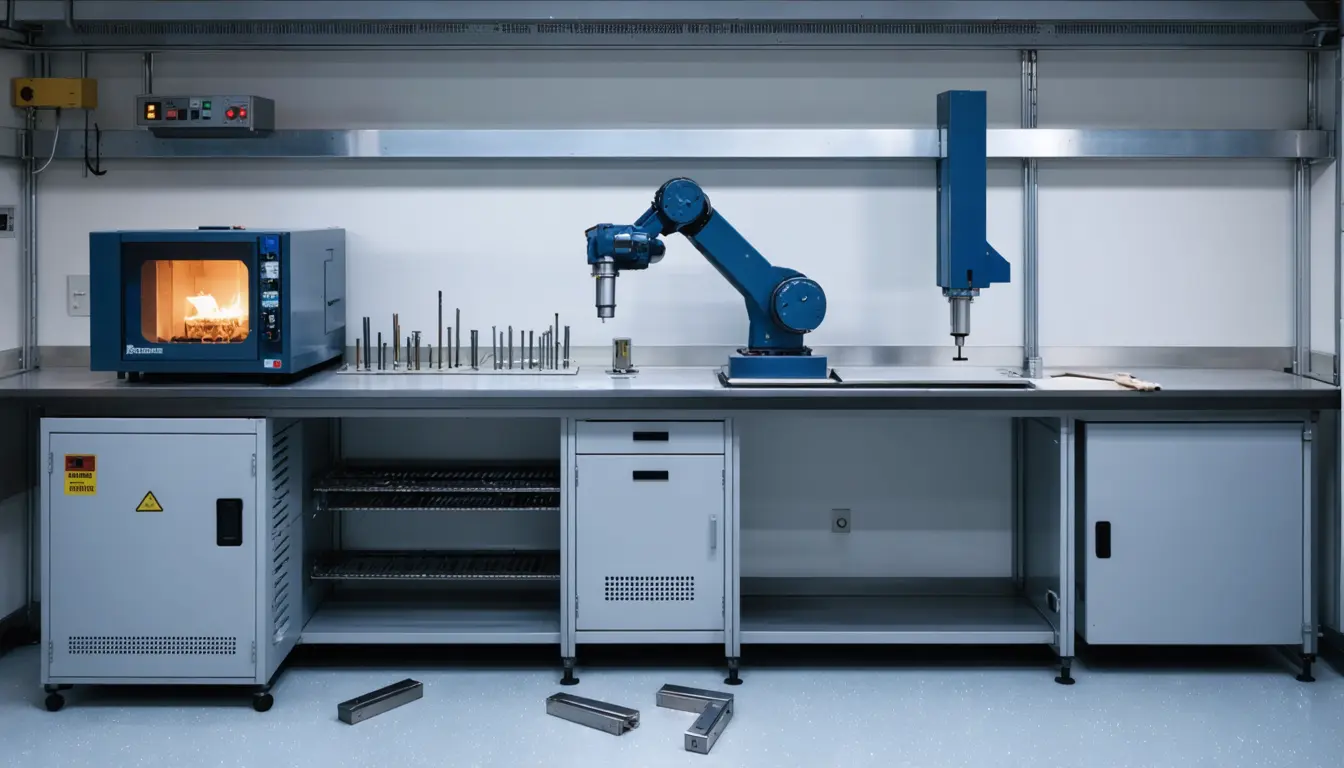
Robot arm links furnace, X-ray and impact tester for hands-free steel tempering tests
Tohoku University and NIMS researchers automated steel tempering tests, so handling, X-ray and impact testing take about 800 seconds a sample. The AI-directed search for the next heat treatment is described as a future step.
The Scientist · Science desk
Two values: the implied manual sequence takes more than 8,000 seconds per sample, and the automated sequence takes about 800 seconds per sample, excluding heat treatment, as the system is more than 10 times faster.
| Measure | Value | As of | Claim |
|---|---|---|---|
| Implied manual run, over | 8,000 seconds a sample | 12 | |
| Automated run, about | 800 seconds a sample | 4 |
What happened
- A robotic arm moves specimens between an induction heating furnace, an X-ray diffractometer and a micro-impact testing machine, with no person handling them in between.
- The team demonstrated the line on one- and two-step tempering of JIS SCM435H, a commercial low-alloy steel.
- Its mechanical-property accuracy is described as comparable to manual measurements by researchers, with the experimental sequence running more than 10 times faster.
- Solid specimens are harder to automate than liquids, powders or thin films, so the team built dedicated specimen-handling tools and put the instruments under unified computer control.
Why it matters
- What's now possible capability Each specimen yields processing, structure and property data together, the kind of dataset the authors call essential for applying AI to materials development.
- What it limits constraint The demonstration covers one commercial steel and two tempering schedules, and the handling tools are purpose-built, so performance on other alloys is not reported.
- What it sets up precedent Bulk solids are the hard case for lab automation, and a working three-instrument chain for them gives other groups building autonomous metals labs a concrete example.
The 800-second figure covers specimen handling, X-ray diffraction, impact testing and specimen recovery. It leaves out the heat treatment itself [4]. That works out to about 13 minutes per sample [11]. The thing this doesn't tell you is how long the heating step takes, so the number cannot stand in for the full cycle time of a tempering campaign.
The speed comparison is against measurements performed manually by researchers [5]. If the ratio holds for the same sequence, a manual run would take more than 8,000 seconds, about 2.2 hours [12]. Phys.org's account of the study does not include the manual timing or any error figures for the accuracy comparison.
The AI work shown so far is narrower than the closed loop the team describes. A tool inside the NIMS Orchestration System, known as NIMO, optimized furnace control parameters automatically [6]. In the future system the source outlines, AI would analyze each result and propose the next heat-treatment conditions. The platform would then run them and return the new data [7].
Goro Miyamoto of Tohoku University's Institute for Materials Research said: "This work demonstrates that the entire experimental workflow can be automated, even for tricky bulk structural metallic materials." He added: "By combining this platform with AI that proposes the next experimental conditions, we aim to accelerate the autonomous discovery of innovative processing routes and structural materials." [8]
We'd call it a working data generator for tempering experiments on one steel [3]. Whether it removes the bottleneck for AI-driven alloy development depends on the closed loop, and the source places that loop in the future [7].
What to watch
- A demonstration of the closed loop, with AI proposing the next heat treatment and the line running it unattended.
- Published error figures for the automated versus manual property measurements, and the heat-treatment time per sample.
- Runs on alloys other than JIS SCM435H, which would show whether the handling tools carry over.
Clarity's read
What the record supports and how the coverage leans. The claims behind it follow.
Reality
- Evidence50
- Adoption
- Not scored
- Hype gap+20
- Incentives
- Not scored
- Confidence55
Claim ledger
Ranked by verification strength, evidence, and original report placement.
- [1]
A team led by Yulin Xie, Sayaka Sekida and Goro Miyamoto at the Institute for Materials Research (IMR), Tohoku University, and Tadashi Furuhara (formerly at IMR) at the National Institute for Materials Science (NIMS), working with TsubameLab, developed an automated experimental system integrating heat treatment, structural characterization and mechanical testing of bulk metallic materials.
- [2]
The system combines an induction heating furnace, an X-ray diffractometer and a micro-impact testing machine, using a robotic arm to transfer specimens automatically between each process.
- [3]
The team demonstrated automated experiments on one- and two-step tempering of a commercial JIS SCM435H low-alloy steel.
- [4]
Excluding the heat-treatment time itself, the complete sequence of specimen handling, XRD measurement, mechanical testing and specimen recovery can be completed in approximately 800 seconds per sample.
- [5]
The automated system evaluates mechanical properties with accuracy comparable to conventional measurements manually performed by researchers, while conducting the experimental sequence more than 10 times faster.
- [6]
The researchers implemented an AI optimization tool within the NIMS Orchestration System (NIMO), demonstrating automated optimization of furnace control parameters and establishing the technological basis for future closed-loop materials exploration.
- [7]
In a future autonomous system, AI will analyze the results of each experiment and propose the next heat-treatment conditions; the platform will then automatically perform the treatment, characterize the structure and properties, and return the new data to the AI.
- [8]
"This work demonstrates that the entire experimental workflow can be automated, even for tricky bulk structural metallic materials," said Miyamoto. "By combining this platform with AI that proposes the next experimental conditions, we aim to accelerate the autonomous discovery of innovative processing routes and structural materials."
- [9]
Bulk structural metals are harder to automate than liquids, powders and thin films because solid specimens must be reliably transported, positioned, heated, characterized and mechanically tested; the researchers designed dedicated specimen-handling tools and integrated the instruments under unified computer control.
- [10]
The system simultaneously generates processing, structure and property data, and such process-structure-property datasets are essential for applying artificial intelligence to materials development.
- [11]
About 800 seconds per sample is roughly 13 minutes per sample.
- [12]
If the automated sequence is more than 10 times faster than the manual one, the manual sequence would take more than 8,000 seconds, about 2.2 hours, per sample.
Get this ledger inside ChatGPT. Ask about any of our stories and the answer brings its figure, each claim’s verdict and the sources. Free, no account.
Sources
1 independent publisher whose own reporting we read for this story.
- phys.orgFully automated testing of bulk metals paves the way for AI-driven materials development
1 article · October 16, 2026
Topics and entities
Follow any of these and your For You feed starts watching them — no settings page required.