Product2 publishersIndependently confirmed3 min readPublished
AstraZeneca and Teradyne back Multiply Labs robots built to copy the manual steps in cell therapy
Multiply Labs raised $75M in a Series B led by Patrick Soon-Shiong, with AstraZeneca and robot maker Teradyne among its backers. Plant teams weighing the robots have to test the startup's claim that they copy staff closely enough to need no new regulatory approval.
The Product Desk · Product desk
Drafted by a language model from the sources cited here and checked against its claim ledger before publication. How we use AISend a correction
What happened
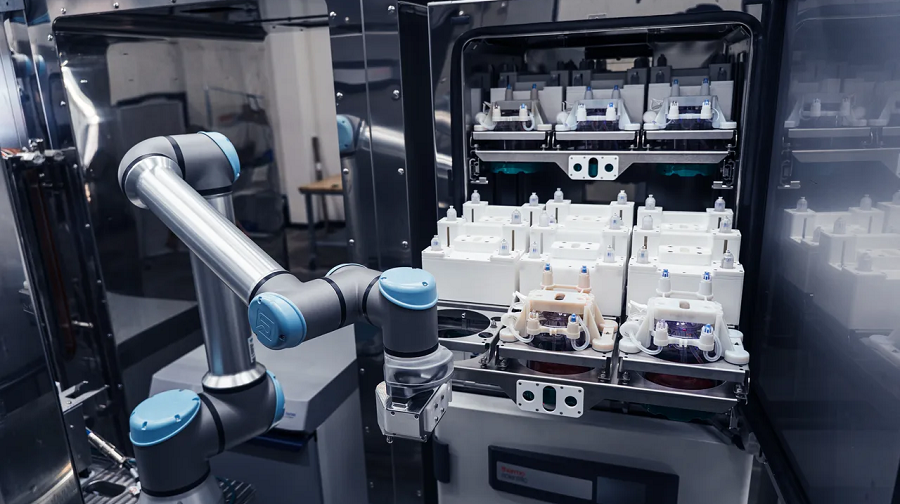
- Multiply Labs builds robotics clusters that house each piece of manufacturing equipment in its own enclosure, with robotic arms moving materials between them.
- The arms also do some manufacturing work themselves, stirring vials of medical ingredients and mixing the contents of different containers.
- The company says its system raises manufacturing throughput 100-fold and lowers cost per dose by 74%.
- Multiply Labs plans to spend the money adding support for more types of therapies and expanding its production capacity.
Compiled by The Product DeskSomething wrong?How this is made
Why it matters
- decision Each drugmaker has to decide whether a robot copying its approved manual step counts as an unchanged process, and Multiply Labs' route around a new approval depends on that answer.
- exposure A plant that signs on feeds its process data into the vendor's AI model, so who may use that data belongs in the contract next to the service terms for the arms.
- constraint Plants making anything other than cell and gene therapies are waiting on a roadmap item, since support for more therapy types is what this round is meant to fund.
A scientist loads materials into a machine and waits for it to finish. Then the output goes by hand into a second machine, and the cycle repeats over weeks or months [4]. In cell and gene therapy, where Multiply Labs is concentrating, the drug that comes out at the end is personalized to each patient [10].
Those hand-offs have stayed manual for a regulatory reason. A drugmaker can change a manufacturing step only with regulatory approval, and that has made it hard to replace a person with a robot [12]. Multiply Labs says its clusters get around this by closely imitating how a drugmaker's employees carry out each task, so the workflow effectively stays the same and no new approval is needed [15].
The hardware is designed around that imitation. Tactile sensors on the arms measure the pressure they apply to a vial [7]. The arms ride a rail between machines, with a built-in elevator for extra vertical reach [8]. They come from a startup called Universal Robotics Inc. and are much lighter than typical warehouse automation, so a broken arm is easier to swap out [6].
The pitch is bigger than the first job a plant would hand over. Taken at face value, the company's 74% figure would leave a dose at about 26% of its current cost [14][16]. That figure comes from Multiply Labs itself [14]. The first job is narrower: an arm doing what a scientist does between two machines, close enough to the written procedure that no new approval is needed [15].
AstraZeneca's investment shows a drugmaker wants the option [3]. Multiply Labs does have pharmaceutical customers, since it trains its AI model on their data [11]. The report does not name any of them, AstraZeneca included, or say how many clusters are running in production.
For an operations lead choosing where to pilot, two axes sort the candidate steps. One is whether the step is a transfer between machines or a manipulation, such as stirring a vial or mixing containers [9]. The other is whether the quality team can match the robot's motions to the approved manual procedure line by line. A transfer that matches is the case the company's regulatory argument is built for [15]. A manipulation that matches is plausible, but those steps run under the company's AI model [11], and the quality team will want to know what the model is allowed to vary between runs. A step that does not match is a process change with a robot attached, and it needs approval like any other change [12].
I'd start in the transfer-and-match box. The tradeoff is that a robot copying the approved human method also copies its slow parts, so early gains are limited to what a copy of that method can deliver. The forcing question before signing is whether the quality lead will put a name on a document saying the robotic step and the written manual procedure match.
What to watch
- A named drugmaker, AstraZeneca or another, disclosing a Multiply Labs cluster running in a production plant.
- A case where replacing a manual step with a Multiply Labs cluster went through without a new regulatory approval, or was refused one.
- Support for a therapy type beyond cell and gene therapy, the first stated use of the new money.