Invest2 publishers3 min readPublished
South Korea funds about 69% of Doosan Robotics' 98.9 billion won plan for AI chips and nuclear welding robots
South Korea is putting 68.1 billion won into Doosan Robotics' AI chip and nuclear welding robot projects, about 69% of their 98.9 billion won cost. Until sales start in 2030, the government carries most of the cost of testing whether robots can halve nuclear welding time.
The Investor · Invest desk
Drafted by a language model from the sources cited here and checked against its claim ledger before publication. How we use AISend a correction
What happened
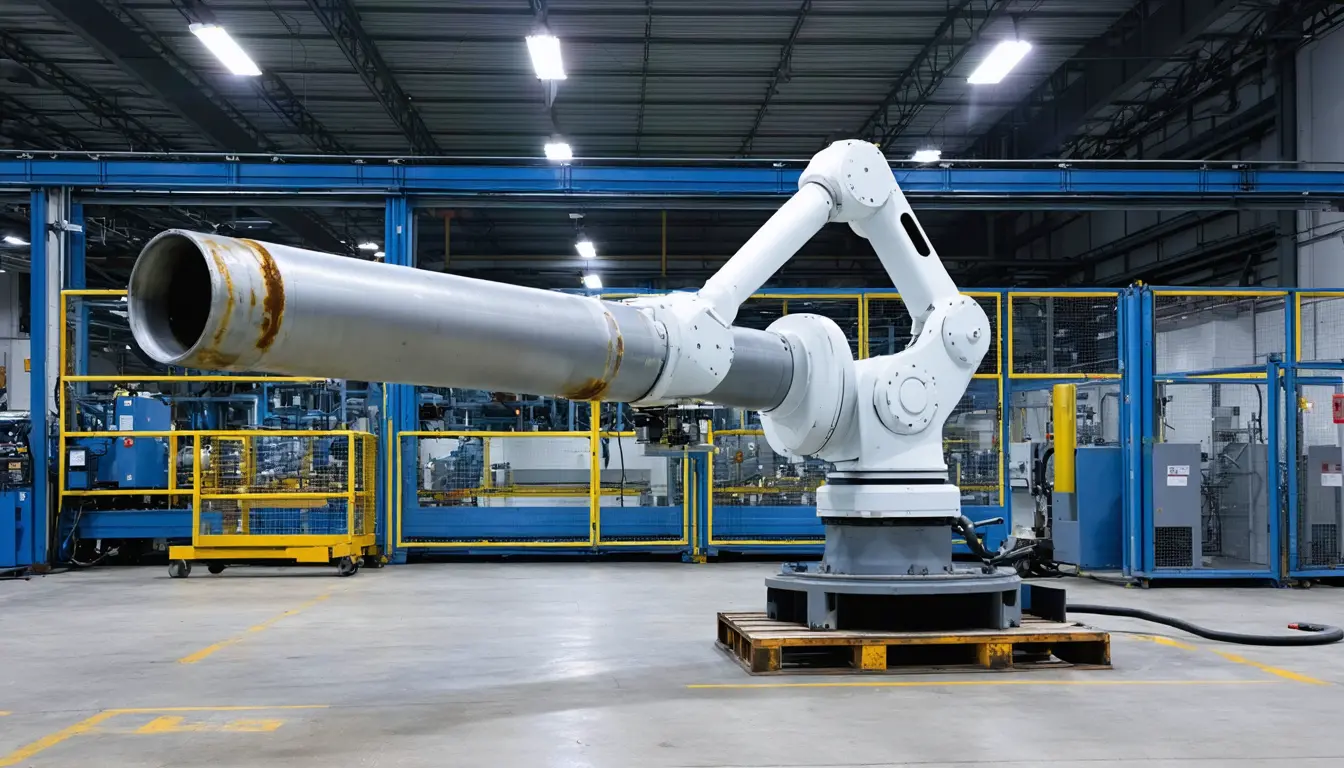
- DeepX, SAGE and Changwon National University's industry-academic foundation join Doosan Robotics under the Industry Ministry's 2026 robot program to address a shortage of skilled welders.
- The 45-month welding project aims for robots that match human welders' motions 95% of the time and cut production time in half.
- Field trials at Doosan Enerbility's nuclear equipment plants cover tack welding, preheating and main welding, with nuclear quality assurance certification as the goal.
- The partners aim to finish quality verification for nuclear power equipment in 2029 and begin commercialization in 2030.
- A companion 4.5-year project has Doosan building its own on-device AI chip, three cobots and a dual-arm humanoid, with commercialization targeted by 2031.
Compiled by The InvestorSomething wrong?How this is made
Why it matters
- cost Doosan risks 30.8 billion won against 68.1 billion of public money. If the 2029 verification fails, the state absorbs more than twice the company's loss.
- exposure DeepX supplies the welding cell's neural processing hardware while Doosan builds a chip of its own. Doosan's choice of silicon may decide DeepX's role in the commercial welder.
- precedent Whether Doosan can sell into two more markets depends on the 2029 verification: a nuclear quality certificate is the credential it plans to take into shipbuilding and defense.
Of the 98.9 billion won, 68.1 billion is government subsidy routed through the Industry Ministry and 30.8 billion is Doosan's own money [3][11]. That puts the state's share at about 69%, or roughly 2.2 won of public money for every won Doosan commits [12][13]. The totals cover both deals, the chip-and-robot program and the welding cell, and the budget for each was not broken out [1][7].
Welding is the shorter bet. Its 45 months run nine months under the four and a half years given to Doosan's on-device chip [14]. If the 50% cut in production time held across a whole job, one cell would turn out twice the welds in the same hours [17]. That figure is a target. The first real measurements come from the trials at Doosan Enerbility's nuclear equipment plants [2].
In one version, the cell passes verification on schedule [6], moves into shipbuilding and defense [16], and the nuclear certificate becomes Doosan's sales credential in two more industries [2]. In another, the chip is the product and welding is where it gets tested. DeepX described the project in close to those terms. "This project will be a concrete case of physical AI, in which ultra-low-power AI chips are combined with robots and used at actual manufacturing sites," DeepX said [8].
In a third, DeepX's neural processing unit and Doosan's own chip end up competing for the same on-device job. DeepX builds the welding cell's edge AI hardware on a domestic neural processing unit, plus a three-channel vision pipeline and thermal-imaging models [5]. Doosan's other project develops its own system-on-chip with a neural processing unit and real-time control [7]. By the 2031 date set for its new cobots and humanoid, Doosan expects to sell a chip of its own built for the same on-device work [7].
Doosan's spending follows its chief executive's diagnosis. "Industrial labor shortages and aging skilled workforces cannot be solved by scaling up traditional automation," Doosan Robotics CEO Park In-won said [9]. So the company's 30.8 billion won goes into domestic chips and cobots [1][3]. Processing stays on the robot, without cloud servers or PCs, to remove latency and security risk at nuclear and defense sites [10].
I think the welder shortage [4] is the case for the grant, and until commercial sales start in 2030 the paying customer is the state [3][6]. If the Enerbility trials come near halving production time on nuclear parts, the shortage becomes a reason for shipyards to pay full price, and 68.1 billion won will have been a cheap way for the state to get there [3][15][16]. A purchase order from a shipbuilder or defense buyer before 2030 would prove me wrong [6][16].
What to watch
- Production-time results from the phased trials at Doosan Enerbility's plants, measured against the 50% target.
- Whether nuclear equipment quality verification closes in 2029 as planned or slides toward the 2031 date set for Doosan's own chip and humanoid.
- Whether the 2030 commercial welder ships on DeepX's neural processing unit or on Doosan's in-house system-on-chip.