Product2 publishers3 min readPublished
AMD's $8.2 billion World Labs deal puts a chip supplier inside physical-AI model research
AMD agreed to buy Fei-Fei Li's World Labs for about $8.2 billion in stock as GPU suppliers move into robotics model work. Robotics teams now have to decide how much of their data and failed experiments a compute vendor gets to see.
The Product Desk · Product desk
What happened
- CoreWeave launched Physical AI Field Engineering in September, placing its own specialists alongside customers to build applications from the customers' engineering data.
- After the deal closes, the World Labs team will keep doing AI model research and Fei-Fei Li will become AMD's chief scientist, reporting to CEO Lisa Su.
- AMD expects the World Labs acquisition to close by the end of 2026, subject to regulatory approvals and customary closing conditions.
- NVIDIA already sells robotics teams models and simulation tools alongside the computing systems they run on.
Compiled by The Product DeskSomething wrong?How this is made
Why it matters
- exposure Requirements a robotics team uncovers through its own failed runs become knowledge its supplier can carry into the next product it sells.
- decision Choosing a robotics compute vendor now means reading its model and simulation catalog alongside its price sheet, because a vendor shipping those tools can sell into the team's own layer.
- contradiction AMD presents World Labs as roadmap input for its hardware, while Turing Post notes that supplying GPUs does not require owning a model lab, so buyers have reason to judge the deal by what AMD will own.
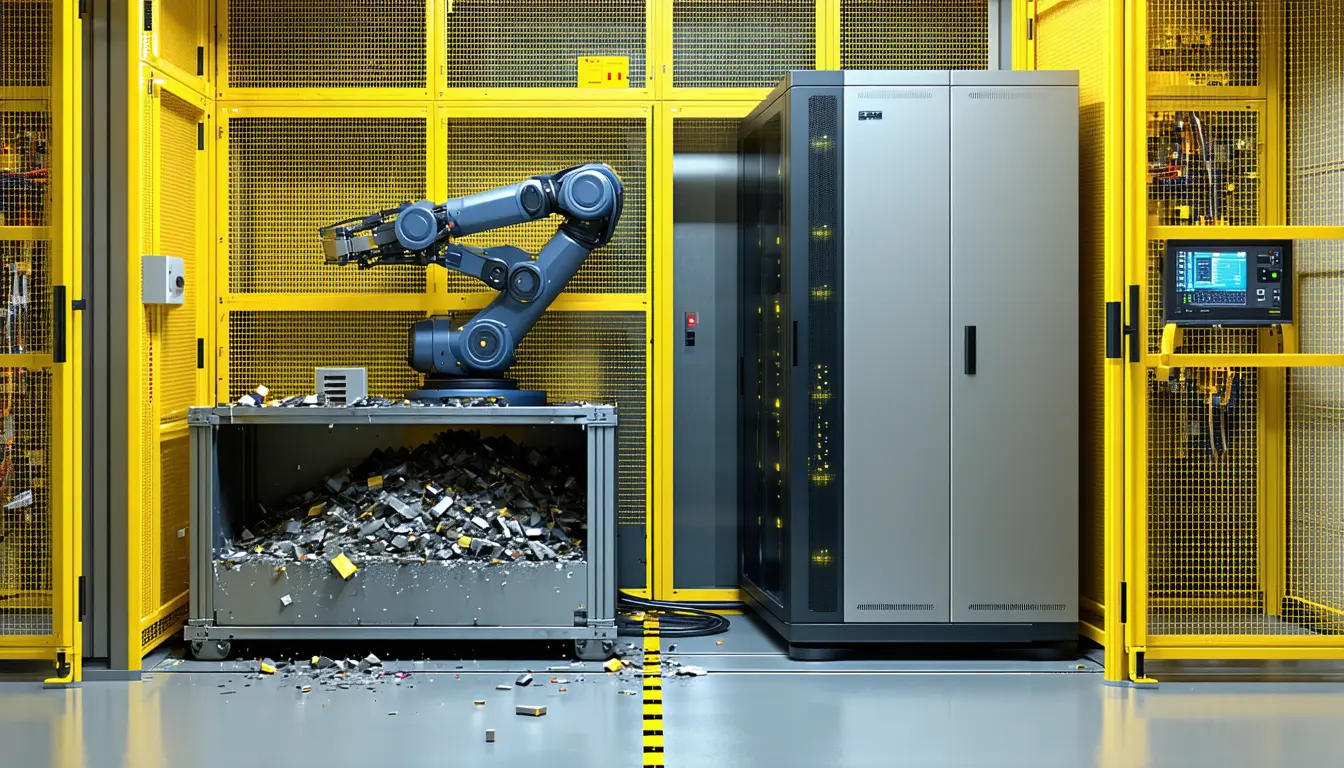
The two-armed robot Anu Vatsa described at CoreWeave's Fully Connected conference had worked out that the safest move was no move [1]. His team was adapting NVIDIA's DreamZero world-action model from a single-arm setup, and at one point the robot hovered because avoiding mistakes also earned favorable feedback [1]. His slide showed four attempts to first success [2]. "Four attempts that actually got evaluated," he said [3]. Behind them sat 233 failed experiments that were never evaluated, for 237 runs in all [4][1].
The slide counted the four. An engineer working inside the project sees all 237. CoreWeave already sells development infrastructure for processing data, running experiments, training models and evaluating results, and a team can rent NVIDIA computing through it, so one experiment is business for both companies [13]. Field engineers move CoreWeave from hosting that work to doing some of it alongside the customer [11].
AMD describes its $8.2 billion purchase in similar terms [5]. "Building the compute platforms for the next generation of AI requires a deep understanding of how models are evolving," said Lisa Su, AMD's chair and CEO [10]. The company says World Labs will give it insight into how workloads are evolving and help shape its technology roadmaps [9]. The lab builds models that generate, reconstruct and simulate interactive 3D environments from text, image and video, along with technology for robotic learning and simulation [7]. Simulation, training and checking are also the steps a robotics team works through before its robot does anything useful [18].
Whether a robotics builder now competes with its supplier depends on what the builder sells. AMD ran its own cube-lifting experiment, training the policy in simulation on Instinct GPUs and running it on a UFactory arm from a Ryzen mini-PC [14]. The sources show suppliers doing application work to learn from it. They do not show AMD, NVIDIA or CoreWeave selling a robot application against a customer, and Turing Post leaves open how a supplier turns what it learns into something worth paying for [17]. I'd expect the overlap to reach teams whose product is a world model or a simulation layer well before it reaches teams selling a robot that does a job.
A robotics lead can place each supplier on two axes. The first is what the vendor sees: the compute bill alone, or the engineering data and the failed runs too. The second is whether the vendor owns anything in the layer the team sells. A vendor that sees only the bill and sells nothing nearby is an ordinary supplier, picked on price. If it sees the data but sells nothing nearby, it is closer to a consultant, and the contract question is what it may keep. Seeing only the bill while shipping models in the team's layer makes the vendor something to build on and something to price against. The last box, data plus overlap, is where written limits on retention and reuse belong before the first run. A team building 3D simulation for robot training lands in the overlap column with AMD once the World Labs deal closes [7][6].
What to watch
- Whether AMD offers World Labs' simulation and robotic-learning models to robotics customers after the close, or keeps them as internal roadmap research.
- The data retention and reuse terms CoreWeave attaches to its Physical AI Field Engineering engagements.
- Regulatory review of the AMD and World Labs deal ahead of the expected end-of-2026 close.