ProductNot yet confirmed elsewhere1 publisher3 min readPublished
Army spreads $4.15 billion of Domestic Shield counter-drone awards across 10 vendors
US Army awarded $4.15 billion in Domestic Shield counter-drone contracts to 10 companies, within a $7 billion ceiling. The Army requires open architecture, so the test is whether one firm's radar and another's camera work on one base network.
The Product Desk
Key figures: the arrangement's maximum value across all awards is $7 billion. Each of seven firms received a $500 million base award, and those seven base awards total $3.5 billion. Echodyne and PVP Advanced EO Systems received $250 million each.
| Figure | Value | Note | Claim |
|---|---|---|---|
| Maximum value across all awards | $7 billion | 4 | |
| Each of seven firms | $500 million base | 2 | |
| Echodyne and PVP, each | $250 million | 3 | |
| Seven base awards, total | $3.5 billion | 19 |
What happened
- Seven companies got a $500 million base award apiece: Allen Control Systems, Digital Force Technologies, DroneShield and L3Harris WESCAM, along with Napatree Technology, RADA Technologies and SRC.
- Echodyne and PVP Advanced EO Systems got $250 million each, and Smart Shooter received a $150 million contract.
- Military services, federal agencies and allied partners can obtain commercially available counter-drone equipment through the common procurement framework.
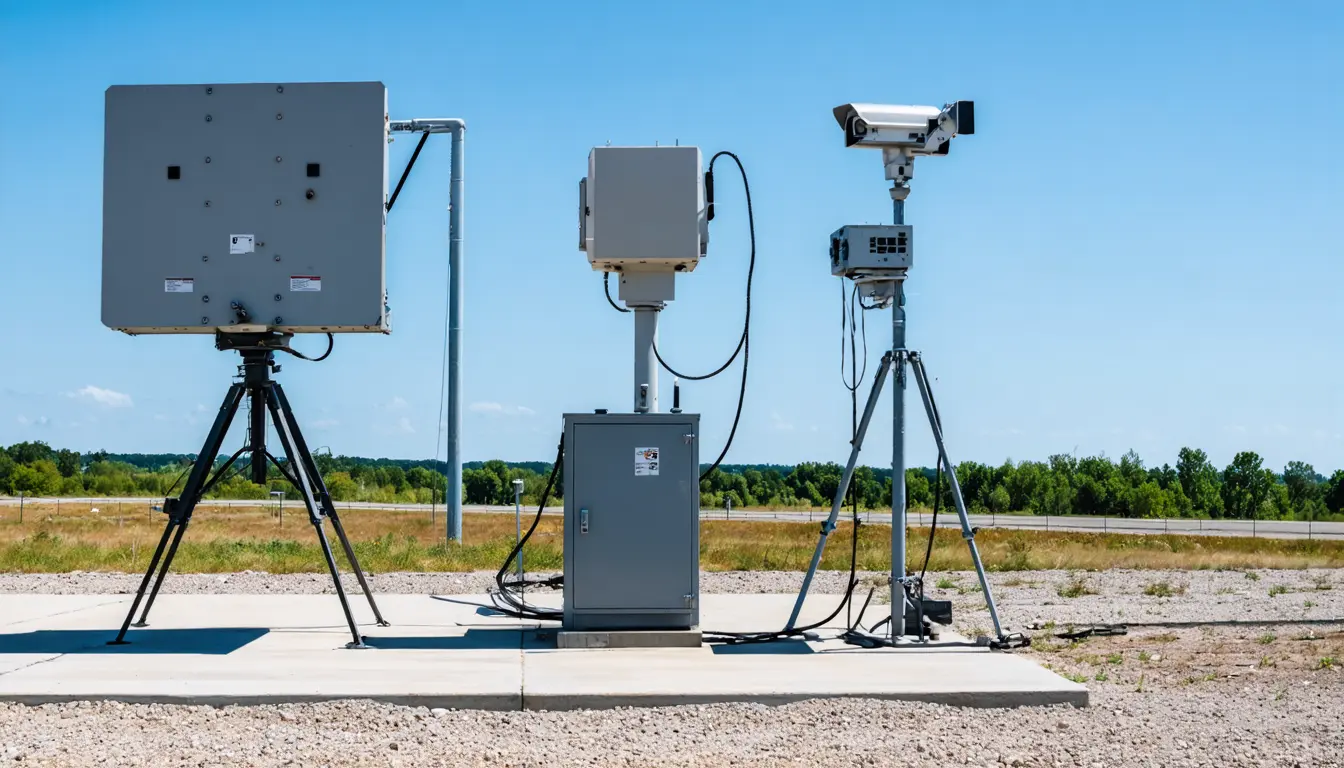
- The equipment under contract covers compact radars, cameras that track targets at long range, optical sights for rifles, weapon stations operated robotically, and software for command and control.
- Officials expect further awards before the end of October 2026, which keeps additional suppliers eligible to join.
Why it matters
- constraint Open architecture binds the awardees, but each installation still connects new gear to a network it already runs, so the integration work and its schedule risk sit with the buyer.
- exposure A base whose preferred supplier is absent from the ten should not treat the roster as closed, because more awards are expected before the end of October 2026.
- capability Services, agencies and allied partners ordering off one framework can field compatible gear without negotiating separate purchasing arrangements for each.
The test of this framework comes at one desk. Someone orders a compact radar from one awardee and a long-range tracking camera from another, and needs both to show up in the same command-and-control software [9]. The Army's answer is a requirement that equipment from different suppliers connect to existing defense networks through open architecture standards [11]. Brent Ingraham, assistant secretary of the Army for Acquisition, Logistics and Technology, said: "This multi-vendor marketplace enforces strict open architecture standards, breaking proprietary vendor lock, and ensuring new technologies can immediately integrate into our existing defense networks." [12]
The Army calls it a marketplace. On paper it is ten contracts on one common procurement framework [1][6], administered with Joint Interagency Task Force 401, the Pentagon unit that coordinates efforts against unmanned aerial threats [8]. TechRadar describes the purpose as maintaining competition and reducing dependence on technologies controlled by individual vendors [13].
The seven largest awards total $3.5 billion [19], or 84 percent of the $4.15 billion awarded [20]. Each of them is about 12 percent of the total [21]. The other three awards make up the remaining 16 percent [23]. The technologies handle different tasks, among them detecting and tracking aerial threats [10]. We'd expect the ten awardees to overlap only in part. A buyer then picks by function first and vendor second.
TechRadar, which credits The Drone Front, is the source for these figures [18]. It does not say how much of the $4.15 billion the Army has obligated or how compliance with the open architecture standards will be tested. The $7 billion ceiling leaves $2.85 billion of room [22].
The case for the spend rests on attacks abroad. Two Iranian drones that struck the US Embassy in Riyadh on March 3 2026 caused damage estimated at about $11.5 million [14], and drones also hit a fuel tank and a US Army asset in Kuwait [15]. The Congressional Research Service estimated that 81 American aircraft and drones were destroyed or damaged in the conflict, with potential losses reaching $3.3 billion [16]. Iran carried out many of the attacks with swarms of cheap drones and bombs [17]. The awards themselves are meant for military installations and critical infrastructure across the country [1].
The framework suits whoever has to fit several kinds of gear into one network. We think that buyer should treat the open architecture requirement as a claim to test before paying. Two points sort each purchase: whether a second awardee can supply the same function, and whether the connection to your own network has been demonstrated. Where both are true, order freely. If a second source exists but nothing has been shown on your network, run a short trial with two vendors. A single-source part with a demonstrated connection is safe to buy and should be logged as a dependency. A single-source part with no demonstration is the proprietary lock Ingraham says the framework breaks [12], and we would hold it until the vendor shows it working. The tradeoff is fielding time: a held part is a gap in coverage until that demonstration happens.
What to watch
- Which firms receive the further awards expected before the end of October 2026, and at what values, since each addition dilutes the seven $500 million awardees' 84 percent share.
- Whether the Army or Joint Interagency Task Force 401 publishes how open architecture compliance is tested, and any case where an awardee's gear fails to connect.
- How much of the $4.15 billion is actually obligated through orders, as opposed to awarded as base values.
Clarity's read
What the record supports and how the coverage leans. The claims behind it follow.
Reality
- Evidence45
- Adoption
- Insufficient
- Hype gap+15
- Incentives
- Insufficient
- Confidence50
Claim ledger
Ranked by verification strength, evidence, and original report placement.
- [1]
The US Army has awarded contracts worth $4.15 billion to 10 companies developing technologies against cheap drones threatening military installations and critical infrastructure across the country.
- [2]
Seven companies, Allen Control Systems, Digital Force Technologies, DroneShield, L3Harris WESCAM, Napatree Technology, RADA Technologies and SRC, each received contracts with $500 million base values under the Domestic Shield initiative.
- [3]
Echodyne and PVP Advanced EO Systems secured awards worth $250 million apiece, while Smart Shooter received a contract valued at $150 million.
- [4]
The multi-vendor arrangement has a maximum value of $7 billion across all awards.
- [5]
Domestic Shield is a Department of Defense initiative intended to strengthen protection against unmanned aircraft without restricting procurement to individual suppliers.
- [6]
The contracts allow military services, federal agencies and allied partners to obtain commercially available counter-drone equipment through a common procurement framework rather than relying on separate purchasing arrangements.
- [7]
Officials expect further awards below the established contract threshold before the end of October 2026, keeping additional suppliers eligible to participate as procurement continues.
- [8]
The Army is working with Joint Interagency Task Force 401, the Pentagon unit responsible for coordinating efforts against unmanned aerial threats, to administer the initiative.
- [9]
The contracted technologies include robotic weapon stations, optical rifle sights, compact radars, long-range tracking cameras, and command-and-control software.
- [10]
The contracted systems handle different tasks, including detecting aerial threats, tracking their movements and supporting responses, making coordination between equipment an important consideration.
- [11]
The Army is requiring open architecture standards that allow equipment from different suppliers to connect with existing defense networks.
- [12]
"This multi-vendor marketplace enforces strict open architecture standards, breaking proprietary vendor lock, and ensuring new technologies can immediately integrate into our existing defense networks," said Brent Ingraham, assistant secretary of the Army for Acquisition, Logistics and Technology.
ReportedSupportedSource: Brent Ingraham, assistant secretary of the Army for Acquisition, Logistics and Technology, as quoted by TechRadarView cited source - [13]
TechRadar says the arrangement uses multiple suppliers to maintain competition and reduce dependence on technologies controlled by individual vendors.
- [14]
On March 3 2026, two Iranian drones struck the US Embassy in Riyadh, Saudi Arabia, causing physical damage estimated at approximately $11.5 million.
- [15]
Iranian drones also struck a fuel tank and damaged a US Army asset in Kuwait.
- [16]
The Congressional Research Service estimated that 81 American aircraft and drones were destroyed or damaged during the conflict, with potential losses reaching $3.3 billion.
- [17]
Iran carried out many of these attacks with swarms of cheap drones and bombs.
- [18]
TechRadar's report credits The Drone Front as the origin of the account.
- [19]
The seven $500 million base awards total $3.5 billion.
- [20]
The seven $500 million awards are about 84 percent of the $4.15 billion awarded.
- [21]
Each $500 million award is about 12 percent of the $4.15 billion awarded.
- [22]
The $7 billion ceiling leaves $2.85 billion of room above the $4.15 billion awarded.
- [23]
The three smaller awards ($250 million, $250 million and $150 million) total $650 million, about 16 percent of the $4.15 billion awarded.
Sources
1 independent publisher whose own reporting we read for this story.
Topics and entities
Follow any of these and your For You feed starts watching them — no settings page required.
Topics
- Counter-Drone and Base DefenseFollow
- Open architecture standardsFollow
- Defense Procurement ContractingFollow