Celiac patients given FB102 kept more intestinal lining under gluten challenge, argenx reports
argenx says its intravenous drug FB102 preserved more intestinal lining than placebo in a 126-patient phase 2 celiac disease trial. The readout is topline and not yet peer-reviewed, and ScienceAlert's report does not say how large the difference was.
The Scientist · Science desk
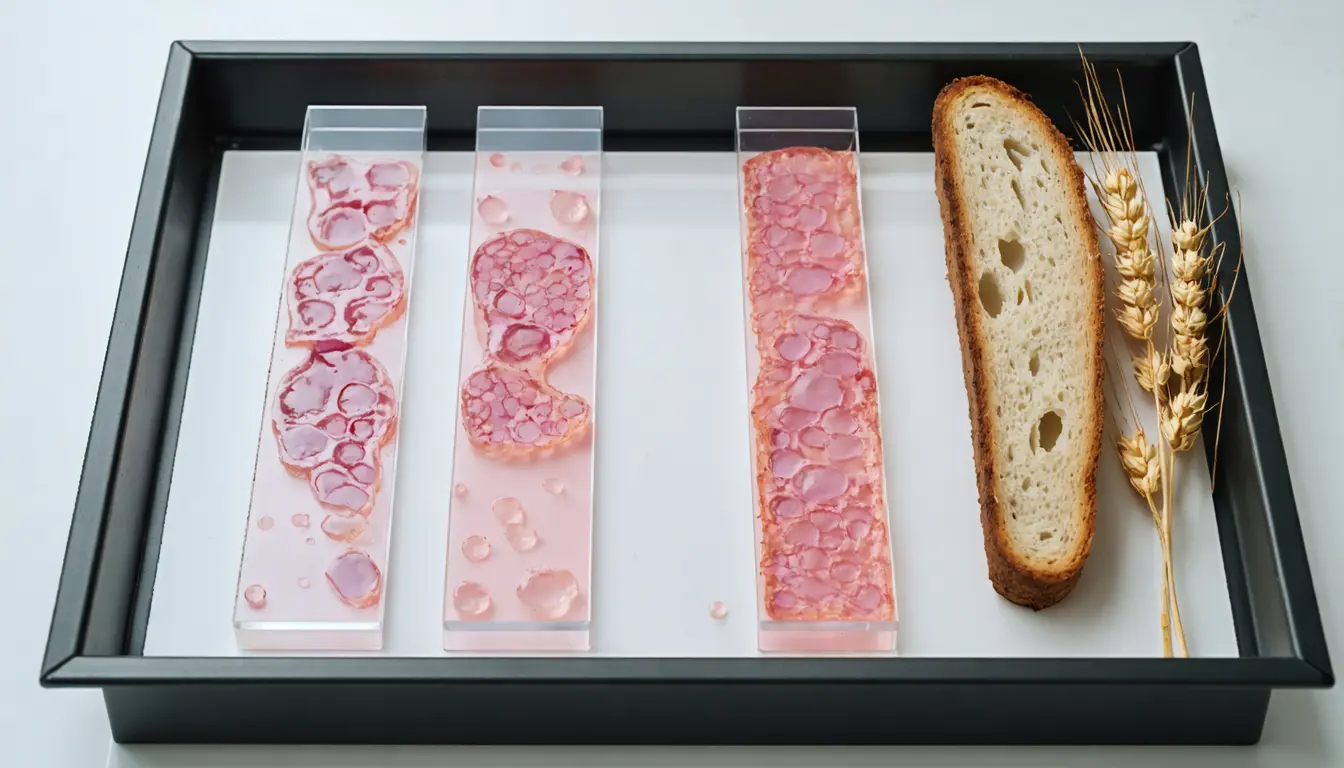
FDA draft guidance says a chronically administered drug like FB102 must show efficacy in trials for at least 52 weeks, and without a gluten challenge. This trial's controlled oral gluten challenge lasted eight weeks; the 52-week period is 6.5 times that challenge.
| Figure | Value | Note | Claim |
|---|---|---|---|
| Efficacy period in FDA draft guidance, at least | 52 weeks | 9 | |
| Trial's gluten challenge | 8 weeks | 4 | |
| Guidance period vs the challenge | 6.5 times | 52-week period, eight-week challenge | 20 |
What happened
- Participants were randomized to placebo or infusions of FB102 during an oral gluten challenge, and neither they nor the researchers knew who received which.
- At day 78, researchers compared gluten-induced damage in the mucosal lining with the start of the trial.
- FB102 recipients showed fewer signs of injury from eating gluten and a smaller inflammatory immune response in the mucosal lining.
- FB102 is designed to block the CD122 receptor on only some disruptive T cells and to preserve it on others.
Why it matters
- What it limits constraint The enrolled patients were symptom-free after a year or more on a strict diet, so the result says little yet about the patients whose symptoms persist despite one.
- Who has to decide decision A phase 3 built to meet the FDA's draft guidance cannot simply repeat this design, because it must show efficacy over a longer period and without a gluten challenge.
- What's now possible capability If later trials confirm the effect, people with celiac disease would have a drug to set beside the gluten-free diet, which is the only protection available now.
The case for CD122 starts in mice. In 2009, researchers showed that blocking the receptor in mice with gut autoimmune problems reversed intestinal damage [12]. From that work came the idea that CD122, and the way it interacts with inflammatory signals, is key to how celiac disease starts and keeps going [13]. Forte Biosciences, later acquired by argenx, developed FB102 to test it [14].
Luc Truyen, argenx's chief medical officer, framed the result around the lack of options. "These positive Phase 2 results strengthen our conviction in the potential of FB102 to address a significant unmet need for people living with celiac disease, where there are currently no approved therapies," he said [7]. argenx is not the only company in the field. ScienceAlert says several other pharmaceuticals are under investigation by drug companies [19].
ScienceAlert describes gluten damage in celiac disease as shortened projections on the intestinal wall and deeper grooves between them [15]. The fewer signs of that injury in treated patients come from a placebo comparison in which neither participants nor researchers knew who got FB102 [4]. In our view, that makes the lining result a credible signal at phase 2.
The thing this doesn't tell you is how the drug behaves outside the trial. ScienceAlert notes the drug was given under controlled conditions, that it is unclear whether the protection holds in a real-world setting, and that the result does not mean patients could eat gluten without care [8].
The regulatory bar is longer. According to ScienceAlert, the FDA's draft guidance says a chronically administered compound like FB102 would need to show efficacy for at least 52 weeks, and without a gluten challenge [9]. Against the trial's eight-week challenge [4], 52 weeks is 6.5 times as long [20]. The comparison is rough, since one figure is a trial duration in the guidance and the other is a challenge window here. ScienceAlert says researchers at argenx are still working up to that standard [18].
Truyen said the findings support the next step. "Combined with the consistent safety profile observed across studies," he said, "these findings support advancing FB102 into Phase 3 development and further exploring its broader potential across immune-mediated diseases" [17].
What to watch
- Peer-reviewed publication of the phase 2 data, with the size of the difference between arms and the number of participants in each.
- The design of argenx's phase 3 trial: whether it runs at least 52 weeks and tests efficacy without a gluten challenge.
Clarity's read
What the record supports and how the coverage leans. The claims behind it follow.
Reality
- Evidence35
- Adoption
- Not scored
- Hype gap+20
- Incentives70
- Confidence55
Claim ledger
Ranked by verification strength, evidence, and original report placement.
- [1]
argenx SE, which owns FB102, announced positive topline results from its phase 2 clinical trial of the intravenous drug in celiac disease.
- [2]
The results are not yet peer-reviewed, but patients with celiac disease treated with FB102 showed better preservation of the intestinal lining during gluten exposure compared with a placebo.
- [3]
The trial enrolled 126 patients with confirmed celiac disease who were symptom-free and had been on a strict gluten-free diet for at least the past year.
- [4]
Participants underwent a controlled, eight-week oral gluten challenge. Some were randomized to receive a placebo, others received intravenous infusions of FB102. Neither participants nor researchers knew who was receiving what.
- [5]
At day 78, researchers analyzed how much gluten-induced damage had occurred in the mucosal lining compared with the start of the trial.
- [6]
Participants who received FB102 showed fewer signs of injury from eating gluten and a smaller inflammatory immune response in the mucosal lining.
- [7]
"These positive Phase 2 results strengthen our conviction in the potential of FB102 to address a significant unmet need for people living with celiac disease, where there are currently no approved therapies."
- [8]
The result does not mean FB102 will allow patients with celiac disease to eat gluten without care. The drug was given under controlled conditions, and it is unclear whether its protective effects work in a real-world setting.
- [9]
According to the FDA's draft guidance, a chronically administered compound like FB102 would need to show efficacy in clinical trials for at least 52 weeks, and would need to demonstrate efficacy without a gluten challenge.
- [10]
FB102 was designed to target CD122, a receptor on immune cells, and to block it on only some disruptive T cells while preserving the receptor on other ones.
- [11]
Even when foods are carefully scrutinized, accidents happen, and symptoms can persist in up to 40 percent of patients with celiac disease.
- [12]
In 2009, researchers showed that blocking the CD122 receptor in mice with gut autoimmune issues led to a reversal of intestinal damage.
- [13]
The 2009 mouse finding led to the hypothesis that CD122 and its interaction with inflammatory signals are critical in the development and maintenance of celiac disease.
- [14]
Drug researchers at Forte Biosciences Inc, later acquired by argenx, developed FB102.
- [15]
When people with celiac disease eat gluten, it tends to shorten the tiny projections that stick out from their intestinal walls and deepen the grooves between them.
- [16]
The only available solution for celiac disease is a strict gluten-free diet, and no approved drug can currently protect the gut against accidental gluten exposure.
- [17]
"Combined with the consistent safety profile observed across studies, these findings support advancing FB102 into Phase 3 development and further exploring its broader potential across immune-mediated diseases."
- [18]
Researchers at argenx are still working up to the FDA draft guidance requirements of 52 weeks of efficacy and efficacy without a gluten challenge.
- [19]
Several new pharmaceuticals for celiac disease are being investigated by drug companies.
- [20]
The FDA draft guidance's 52-week efficacy period is 6.5 times the trial's eight-week gluten challenge.
Get this ledger inside ChatGPT. Ask about any of our stories and the answer brings its figure, each claim’s verdict and the sources. Free, no account.
Sources
1 independent publisher whose own reporting we read for this story.
- sciencealert.comNew Drug Protects People With Celiac Disease From Gluten Damage in Clinical Trial
1 article · October 16, 2026
Topics and entities
Follow any of these and your For You feed starts watching them — no settings page required.
Topics
- Autoimmune therapeuticsFollow
- Celiac diseaseFollow
- Clinical trialsFollow
Entities
- argenxFollow
- ScienceAlertFollow
- Luc TruyenFollow
- Food and Drug AdministrationFollow
- FB102Follow
- Forte BiosciencesFollow