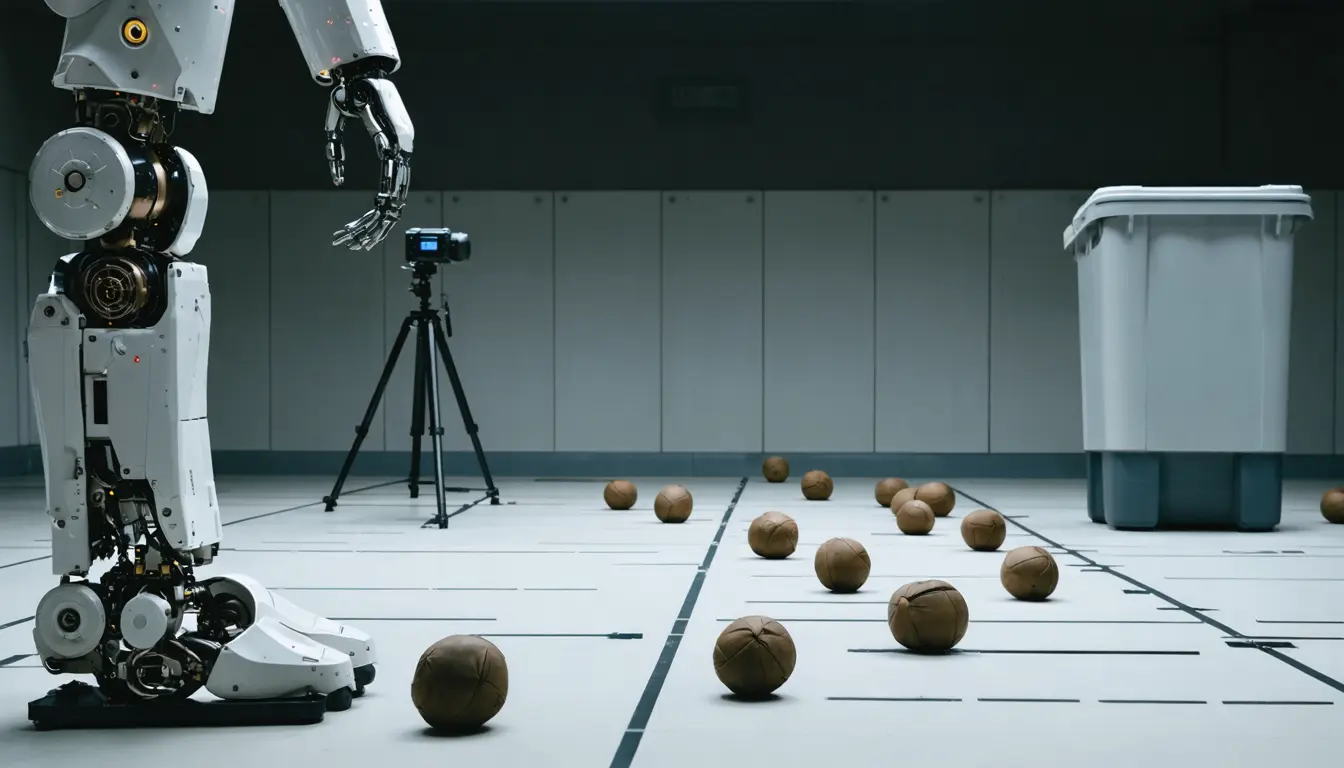
Apptronik's Apollo made seven straight throws from a simulation Gemini 4 Argon built out of video
Google says Gemini 4 Argon turned a video of a person throwing into a calibrated MuJoCo simulation, cutting setup from weeks to hours in an internal workflow. The speedup is Google's own measurement, as relayed by dev.to.
The Engineer · Build desk
What happened
- Google transferred the resulting workflow to Apptronik's Apollo humanoid, which completed seven consecutive successful throws in a real-world trial.
- Argon watched a raw video of a cornhole-like throwing task, modeled the environment and the participant's kinematics, and generated the simulation code.
- The workflow went beyond the simulator: the task was modeled well enough to produce a control workflow for a humanoid robot.
- Google's related developer material describes more than 4,500 domain-randomized episodes generated to improve real-robot performance.
Why it matters
- decision A team weighing this has to price its own weeks first. Manual modeling of objects, surfaces and trajectories is the cost Argon targets, and only teams paying it get the saving.
- constraint Hardware integration, safety testing and validation against the specific workplace stay with the adopting team. Google's demonstration does not replace them.
- capability A recorded task can become a starting point for experiments, and generated scenarios let a team test variations before it spends scarce robot time.
The weeks-to-hours figure is Google's, taken on what the company calls an internal robotics workflow [11]. For it to transfer to another team, that team's task would have to look like this one: a throwing task with one participant, clear enough in video for a model to read and simple enough for a physics simulator to represent. The baseline would have to match too. Your manual setup would need to take weeks for the same reasons Google's did.
The write-up lists the dependencies itself: quality of the input, accuracy of the simulation, the target hardware, and testing in real conditions [7].
The calibration step is where we would look first. The simulator holds the environment and the participant's kinematics [2], and every training episode inherits whatever error sits in that model. Domain randomization varies the simulated conditions so training does not depend on one fixed scene [5]. In our view, that can absorb small calibration errors. A simulation that misrepresents the scene itself would still train the wrong behavior.
The 4,500-episode figure needs care. The dev.to write-up attributes it to Google's related developer material, not to the announcement [4]. It does not connect that count to the Apollo trial, so a reader cannot tell how many episodes sat behind the seven throws.
The hardware result is one trial [3]. A streak of seven is compatible with any number of earlier misses. Turning it into a success rate would take the attempt count, the throw distance and the scoring rule.
The write-up draws the same boundary. The verified material covers an internal demonstration, and performance across other environments, robot types, objects or safety-critical tasks is outside what it shows [6]. The primary source is Google's Gemini 4 Argon announcement, which the write-up summarizes [9].
What to watch
- Whether Google publishes the attempt count, throw distance and scoring rule behind the seven Apollo throws.
- Whether anyone outside Google reproduces the video-to-simulation step on a task that is not throwing, or on a robot that is not Apollo.
- Whether Google ties the 4,500-episode developer figure to the Apollo trial or to a separate workflow.
Clarity's read
What the record supports and how the coverage leans. The claims behind it follow.
Reality
- Evidence30
- Adoption
- Insufficient
- Hype gap+25
- Incentives70
- Confidence55
Claim ledger
Ranked by verification strength, evidence, and original report placement.
- [1]
Google has demonstrated Gemini 4 Argon turning a video of a person performing a physical task into a physics-enabled robotics simulation, simulation code, and a training workflow that can transfer to real hardware.
- [2]
In the example, Argon observed a raw video of a cornhole-like throwing task, constructed a calibrated MuJoCo simulation of the environment and the participant's kinematics, then generated the relevant simulation code.
- [3]
Google transferred the resulting workflow to Apptronik's Apollo humanoid platform, which completed seven consecutive successful throws in a real-world trial.
- [4]
Google's related developer material describes generation of more than 4,500 domain-randomized episodes to improve real-robot performance.
- [5]
Domain randomization creates varied simulated conditions, helping training move beyond a single fixed scene.
- [6]
The verified material describes an internal demonstration, not a guarantee of performance across every environment, robot type, object, or safety-critical task.
- [7]
Physical deployment still depends on the quality of the input, the accuracy of the simulation, the target hardware, and testing in real conditions.
- [8]
Based on Google's demonstration, the capability is not a substitute for hardware integration, safety testing, and validation against the specific workplace.
- [9]
Google details the workflow in its official Gemini 4 Argon announcement and presents the robotics work as part of Argon's broader capabilities across coding, research, cybersecurity, legal work, and other data-driven tasks.
- [10]
The workflow modeled the task well enough to produce a control workflow for a humanoid robot.
- [11]
Google says its Video-to-Sim-to-Real approach compressed the process of building simulation environments and task data from weeks to hours in an internal robotics workflow.
- [12]
Simulation creation can become a bottleneck when every object, surface, trajectory, and environment must be manually modeled and programmed.
- [13]
A recorded task can become a starting point for experimentation rather than a reference that engineers must manually translate into a simulation from scratch, and generated scenarios may allow teams to test variations before using scarce robot time.
Sources
1 independent publisher whose own reporting we read for this story.
- dev.toGemini 4 Argon Turns Human Video Into Robotics Simulations and Training Data
1 article · October 13, 2026
Topics and entities
Follow any of these and your For You feed starts watching them — no settings page required.