Invest1 publisher3 min readPublished
Amazon puts Prime Air in nearly 500 cities, and the arithmetic does not tidy up
Amazon says drone delivery reaches nearly 500 US cities and towns by end-2026, from 11 sites today. Uber and DoorDash are now committing too, on volumes that remain rounding errors.
The Investor · Invest desk
Drafted by a language model from the sources cited here and checked against its claim ledger before publication. How we use AISend a correction
What happened
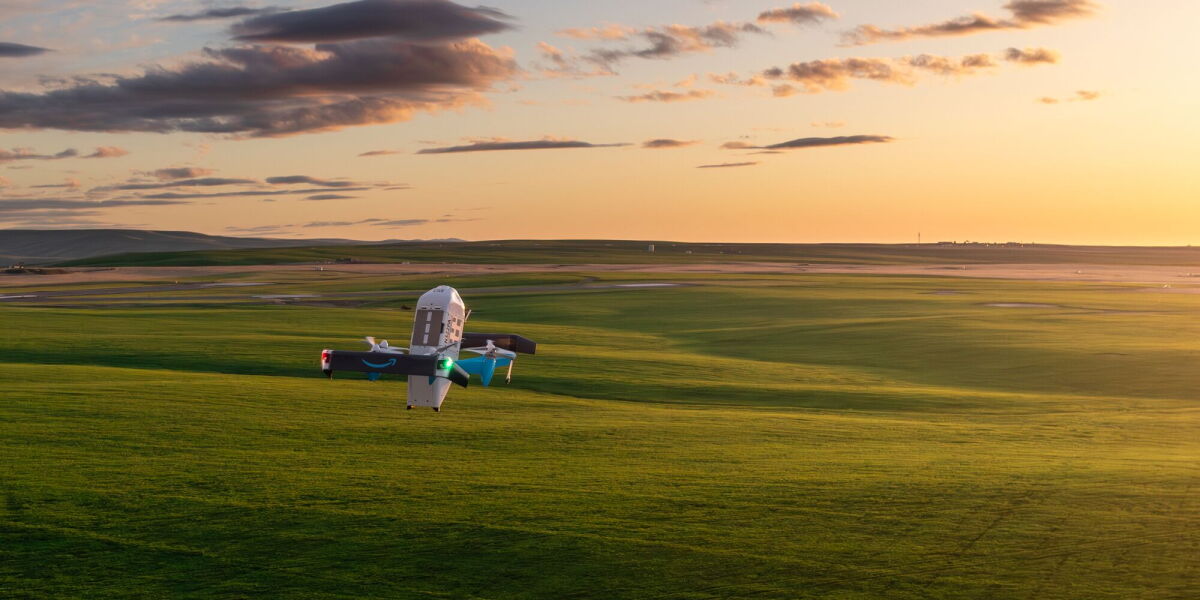
- Amazon said Wednesday its Prime Air service will expand to nearly 500 U.S. cities and towns by the end of 2026, described as a sixfold increase from its current footprint.
- Amazon, Uber, DoorDash and Walmart are among America's biggest delivery companies making bigger bets on drone delivery, per Fortune.
- Amazon currently operates drone delivery from 11 locations and plans to add markets including Chicago, Atlanta, Cleveland, and Syracuse, N.Y.
- Going from 11 drone delivery locations to nearly 500 cities and towns is roughly a 45-fold increase.
- For a sixfold increase to nearly 500 cities, the starting base would be about 83 cities or towns.
Compiled by The InvestorSomething wrong?How this is made
Why it matters
Amazon said Wednesday that Prime Air will reach nearly 500 US cities and towns by the end of 2026, which it describes as a sixfold increase on its current footprint [1]. That converts drone delivery from a decade-long demo into a capital and operating commitment, and it forces Uber, DoorDash and Walmart to decide how much to spend answering it [2].
Start with the numbers Amazon put out, because they do not reconcile cleanly. The company currently operates drone delivery from 11 locations, adding markets including Chicago, Atlanta, Cleveland and Syracuse, New York [3]. Going from 11 sites to nearly 500 cities is roughly a 45-fold increase [4], not sixfold; for "sixfold" to hold, the base has to be something like 83 places already served [6], which implies each launch site covers multiple towns. Operators evaluating this should ask which unit is being multiplied before they benchmark against it.
The volume base is smaller still. Prime Air vice president David Carbon said Amazon has delivered hundreds of thousands of packages by drone this year [5], against the nearly 20 million packages a day Amazon delivers in the US, per ShipMatrix [7]. That daily figure works out to about 833,000 packages an hour [21], so a year of drone flying is worth well under an hour of the ground network. The service moves items up to five pounds in as little as 30 minutes [8], which is a genuine capability and a narrow one. The vision itself is old: Jeff Bezos showed the drones on 60 Minutes in 2013 and predicted deliveries within four to five years, before regulatory hurdles, technical setbacks and noise complaints intervened [9].
DoorDash has taken a different structural step, obtaining FAA certification to run its own commercial drone service rather than depending solely on partners [10]. Harrison Shih, who heads DoorDash Air, said becoming a certified air carrier "accelerates everything we're building" [11]. The company has completed tens of thousands of drone deliveries against more than 10 billion orders across its network [12], roughly five ten-thousandths of one percent [22], and told Fortune that Dashers still handle the vast majority of deliveries, with drones sitting alongside its Dot robot and other autonomous partners [13].
Uber is buying rather than building, taking an undisclosed stake in Zipline, last valued at $7.6 billion, under a partnership announced Monday that brings drones to Uber Eats later this year [14]. The stated target is 1 million drone deliveries a day by the end of 2029 [15]. Zipline says it currently completes a delivery somewhere in the world every 20 seconds [16], which is about 4,320 a day [23], so the target is roughly 230 times today's global rate [24]. Zipline operates in Dallas, Houston, Cleveland and Northwest Arkansas, with Phoenix and Austin expected later this year, and says merchant count grew 13-fold in the first half of 2026 [17]. It sizes the US market at 5.5 billion instant deliveries a year excluding Amazon, UPS and FedEx [18], about 15 million a day [25], making the 2029 target near 7 percent of that pool [26].
Missing from all of it, as reported, is a cost per delivery. Also missing is reliability disclosure: in Richmond, Texas, Lindsey Austen watched an Amazon drone drop her package into her backyard pool on Monday and told Storyful, "I don't think I'll be wanting drone deliveries anymore" [19].
Watch whether Amazon clarifies what "sixfold" counts, whether Zipline hits Phoenix and Austin on schedule, and whether any of the three ever publishes a per-delivery economic figure. Walmart, named in Fortune's framing of this fight [20], has yet to show its number.