Product11 publishers3 min readPublished
DoorDash sized its new delivery drone around its own order history
DoorDash built its drone service around the 80% of restaurant orders it says fit the aircraft, designing the kitchen handoff before the drone. The order data and dispatch software behind it now have to work inside an FAA certificate that keeps every flight within line of sight.
The Product Desk · Product desk
What happened
- DoorDash's Autonomous Delivery Platform software weighs weather, flight range and ground traffic to decide which orders should go by air.
- In early tests, DoorDash says, deliveries averaged under five minutes from the restaurant to the customer's door.
- DoorDash took a Part 135 air carrier certificate from the FAA in July, becoming the eighth US operator to hold one.
- Manna, Europe's largest drone delivery company, flew more than 300,000 deliveries in Ireland, paused in June and is building a factory in Tulsa.
Compiled by The Product DeskSomething wrong?How this is made
Why it matters
- cost A restaurant in the pilot keeps its courier handoff for at least one order in five and runs a separate drone handoff beside it.
- exposure The five-minute figure covers only the trip from restaurant to door and is not guaranteed, so support teams are exposed to complaints from customers who took it as their total wait.
- decision Restaurants agreeing to the pilot commit staff time before DoorDash has named a consumer launch date or the communities it will serve.
Somebody behind the counter at a Chipotle, a Popeyes or Momo N Curry in Northern California will be among the first to hand an order to a DoorDash drone [16]. The aircraft collects it with a winch [17]. DoorDash says loading and packaging got attention before the airframe did [2].
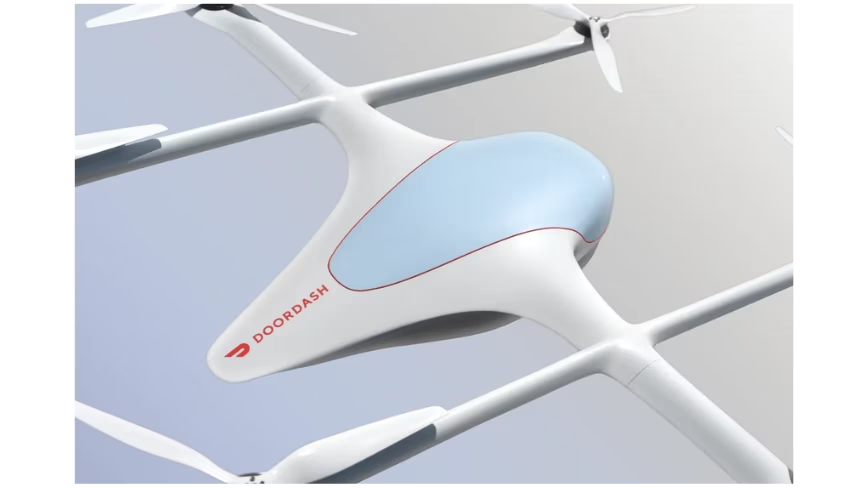
At Dash Forward the company showed off the aircraft: six propellers, and about as loud as a passing car at delivery height, according to the company [1][18]. The same DoorDash Labs team that built the Dot sidewalk robot also wrote the dispatch software that coordinates human couriers, sidewalk robots and drones [3]. "We didn't start with a drone and ask what would fit," Harrison Shih, who heads DoorDash Air, said in a statement. "We started with what people order and how local businesses actually operate, then built the entire system from there." [7]
"Any local business should be able to reach consumers by air," Shih said [19]. Customers order meals of a given weight, to addresses a given distance away. DoorDash says it sized the whole system around those historical orders, including what they weigh and how far they usually travel [6]. TechCrunch puts the history behind that at 13 years of merchant and customer data, on a marketplace DoorDash has said lists more than 500,000 restaurants [5].
The 80% figure that came out of that sizing is an eligibility count [8]. Size and weight are the first filter. The routing software is the second [4]. The third is the certificate, which does not cover flights beyond visual line of sight [12]. DoorDash did not say what share of orders clears all three. The under-five-minute average came from tests over limited distances and sample periods, The Next Web reported [10].
The record supports part of the case that DoorDash's advantage is coordination and data. The company says it has completed hundreds of thousands of autonomous deliveries across Dot and drone partners including Alphabet's Wing and Israel's Flytrex [20]. Its order flow already moves on aircraft it did not build. Manna's record limits the case. It had the volume, and its chief executive, Bobby Healy, said Ireland had no clear national policy and the company could not scale without one, according to The Next Web [14]. "The aircraft was not the part that failed," the publication wrote [15].
For a restaurant operator or a delivery lead weighing a drone pilot, every order sits on two axes. One is whether it fits the aircraft by size and weight [8]. The other is whether the route can be flown that day, given weather, range and a certificate limited to line of sight [4][12]. An order that fits both flies. One that fits the aircraft but not the route sits in the pool waiting on the FAA. Anything that misses on size goes by courier whatever the regulator decides. When a vendor quotes a share of orders that can fly, the useful check is which axis the number measures. DoorDash's 80% measures the first [8].
What to watch
- An FAA grant of beyond-visual-line-of-sight rights to DoorDash would widen the routes its dispatch software can pick from.
- A pilot-stage figure from DoorDash for the share of eligible orders that actually fly, set against its 80% eligibility estimate.
- Any move to put drones on Deliveroo or Wolt in Europe, where Manna paused for lack of a national policy.