InvestNot yet confirmed elsewhere1 publisher2 min readPublished
AI-linked borrowers have drawn up to $500B from the investors who also buy Treasuries
AI-linked corporate debt issuance reached about $450-500B in the first nine months of 2026, more than double prior years' pace, cryptobriefing reported. Goldman Sachs projects hyperscaler issuance could run toward $1T in 2027, tapping pension funds and insurers that also buy Treasuries.
The Investor · Invest desk
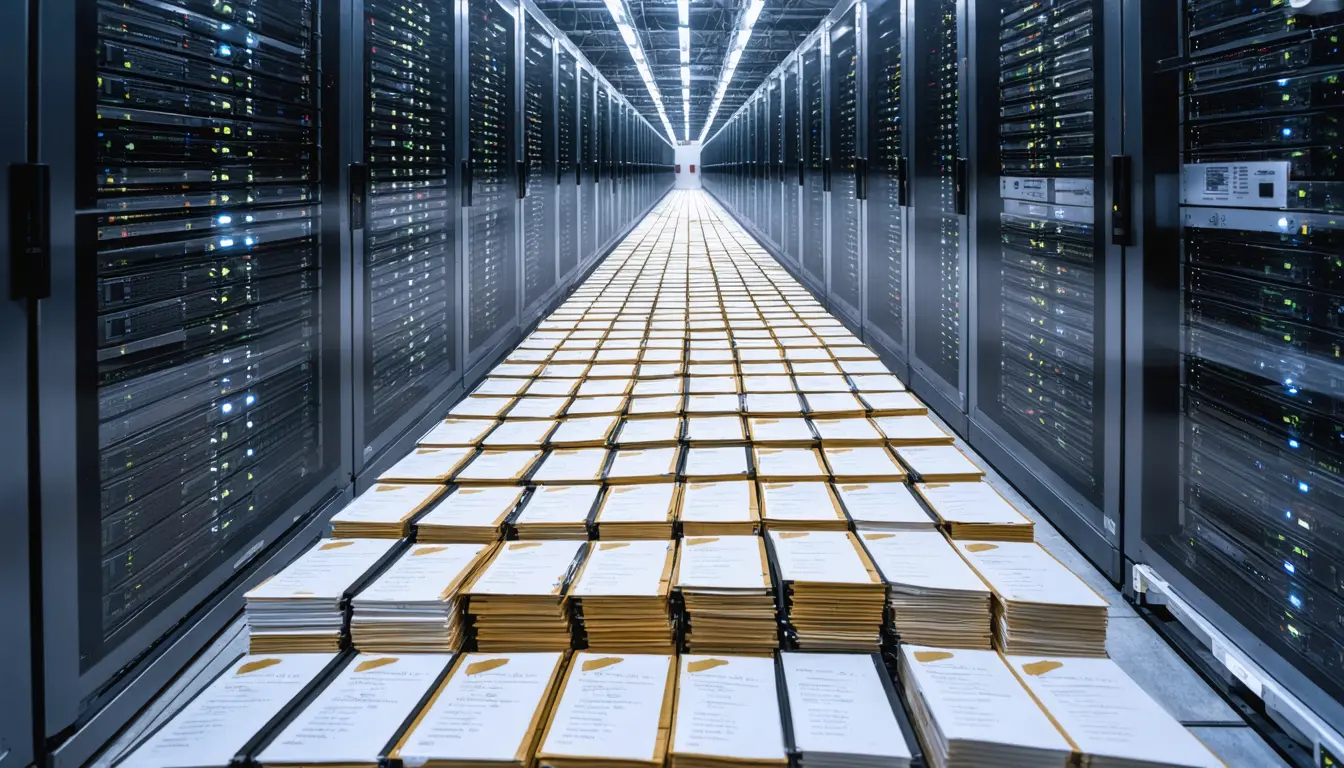
Major hyperscalers' undisclosed lease and purchase commitments exceed $1.5 trillion. Tech firms moved more than $120 billion of AI data center spending off their books. Oracle's implied 5-year default risk, from credit default swap spreads, is above 20%.
| Figure | Value | Note | Claim |
|---|---|---|---|
| Undisclosed hyperscaler lease and purchase commitments | $1.5 trillion over | 15 | |
| AI data center spending moved off tech firms' books | $120 billion over | via special purpose vehicles and leases | 14 |
| Oracle's implied 5-year default risk | 20% above | from credit default swap spreads | 17 |
What happened
- Planned 2026 AI infrastructure spending at four of the biggest US tech companies comes to about $650 billion, according to the source.
- More than $120 billion of AI data center spending has been shifted off tech firms' balance sheets using special purpose vehicles and leases.
- Aggregate undisclosed lease and purchase commitments for major hyperscalers exceed $1.5 trillion.
- Oracle's implied five-year default risk, derived from recent credit default swap spreads, has moved above 20%.
- Global debt hit a record $365.5 trillion in the first half of 2026, with the US still running high fiscal deficits.
Why it matters
- cost At the 7%-plus yield investors demand from Meta, each $100 billion of new debt carries about $7 billion a year in interest, cash that does not go into data centers.
- exposure Bondholders in these names price the credit without sight of the full off-balance-sheet obligations, and the source says such figures tend to matter most when sentiment turns.
- contradiction The source's headline asserts competition with governments, but its own closing test calls that theory until Treasury auctions weaken, and it cites no auction results.
Divide issuance by capex and you get 69% to 77%: $450 billion to $500 billion raised [1] against $650 billion of planned 2026 spending at four companies [2] [8]. The ratio mixes populations. The numerator counts AI-linked corporate debt, the denominator counts four firms, and the source names five borrowers: Amazon, Alphabet, Meta, Microsoft and Oracle [5].
Time is the second mismatch. Nine months of issuance annualizes to $600 billion to $667 billion [9], so a path to $1 trillion in 2027, which is Goldman Sachs's projection [12], needs a pace 1.5 to 1.7 times higher [10]. Goldman's figure covers hyperscaler AI debt and the 2026 pace covers AI-linked debt generally, so the multiple is approximate. Goldman and Morgan Stanley analysts both expect the trend to escalate, according to the source [13].
We think any strain appears first in the borrowers' own credit pricing, the only market signals the source offers, and reaches Treasury auctions later, if at all. The source's own test would prove us wrong: government debt sales drawing weaker interest while tech issuance stays strong [6].
It could also go another way. Clean auctions alongside wider spreads for weaker credits such as Oracle would make this a story about individual borrowers, and issuance that stays near the $600 billion to $667 billion annualized pace [9] would leave Goldman's path too high.
What to watch
- Treasury auction demand: weaker interest in government debt sales while tech issuance stays strong would be the source's own proof of competition.
- Credit rating actions on the major hyperscalers, since the source says downgrades could move both bond and stock prices.
- Oracle's credit default swap spreads against the 20% implied default risk, as a live read on lender nerves.
Clarity's read
What the record supports and how the coverage leans. The claims behind it follow.
Reality
- Evidence30
- Adoption
- Insufficient
- Hype gap+20
- Incentives
- Insufficient
- Confidence35
Claim ledger
Ranked by verification strength, evidence, and original report placement.
- [1]
AI-linked corporate debt issuance is reported to have reached approximately $450-500 billion in the first nine months of 2026, more than double the pace of previous years.
- [2]
Four of the largest US tech companies plan to spend about $650 billion on AI infrastructure in 2026.
- [3]
Global debt hit a record $365.5 trillion in the first half of 2026, and the US is still running high fiscal deficits.
- [4]
When hyperscalers issue hundreds of billions in new bonds, they court many of the same pension funds, insurers and asset managers that buy Treasurys and other sovereign debt.
- [5]
Amazon, Alphabet, Meta, Microsoft and Oracle are borrowing heavily to fund artificial intelligence infrastructure.
- [6]
If government debt sales start drawing weaker interest while tech issuance stays strong, the competition for capital will move from theory to measurable fact.
- [7]
Investors pricing a hyperscaler's bonds may not see the full scope of its commitments, and such figures tend to matter most when sentiment turns.
- [8]
Reported AI-linked issuance equals 69% to 77% of the four firms' planned 2026 capex, though the two figures cover different populations.
- [9]
Nine months of issuance annualizes to about $600 billion to $667 billion for a full year.
- [10]
Reaching $1 trillion in 2027 requires a pace about 1.5 to 1.7 times the 2026 annualized pace.
- [11]
At a 7% yield, each $100 billion of new debt carries about $7 billion a year in interest.
- [12]
Goldman Sachs is projecting that hyperscaler AI debt issuance could push toward or above $1 trillion in 2027.
- [13]
Analysts at Goldman Sachs and Morgan Stanley expect the trend of AI borrowing to escalate.
- [14]
Tech firms have moved more than $120 billion of AI data center spending off their books through special purpose vehicles and leasing arrangements.
- [15]
Aggregate undisclosed lease and purchase commitments for major hyperscalers exceed $1.5 trillion.
- [16]
Investors are demanding yields above 7% from Meta.
- [17]
Based on recent credit default swap spreads, Oracle's implied 5-year default risk has moved above 20%.
Sources
1 independent publisher whose own reporting we read for this story.
- cryptobriefing.comBig Tech’s AI debt binge puts it in competition with governments for capital
1 article · October 13, 2026
Topics and entities
Follow any of these and your For You feed starts watching them — no settings page required.