ProductNot yet confirmed elsewhere1 publisher3 min readPublished Updated
Cisco and NVIDIA move the AI buying argument from GPU count to who owns the slowdown
Rack-scale Secure AI Factory becomes orderable in September, with Supermicro compute from October. What is being sold is validated integration, and the loss line is idle capacity.
The Product Desk
What happened
- Cisco extended its Secure AI Factory with Nvidia to full rack scale through a Supermicro partnership, liquid-cooled, starting with Blackwell and moving to Vera Rubin.
- The configuration puts Cisco Silicon One switches on the front end and Nvidia Spectrum-X switches on the back end, managed through Cisco's Nexus One platform.
- The builds ship as Cisco Validated Designs compliant with the Nvidia Cloud Partner reference architecture, aimed at late-stage integration failures.
- Cisco also plans Validated Services to certify that a delivered installation matches the reference architecture it was designed against.
Why it matters
- decision The choice on the table is no longer component sourcing but whether to hand one supplier the seam between servers and network, on the vendors' own argument that the seam is where builds fail.
- exposure Buyers who customise away from the reference architecture step outside the performance guarantee that is the main thing this bundle sells, so deviation becomes a risk carried by the customer.
- cost Integration failure is billed as idle capacity against a facility already powered and plumbed, which is a revenue miss for the operator rather than a warranty claim against a vendor.
- precedent If certification against a vendor reference architecture becomes the accepted proof of a good build, a purchase record showing only GPU counts stops being enough to defend a deployment.
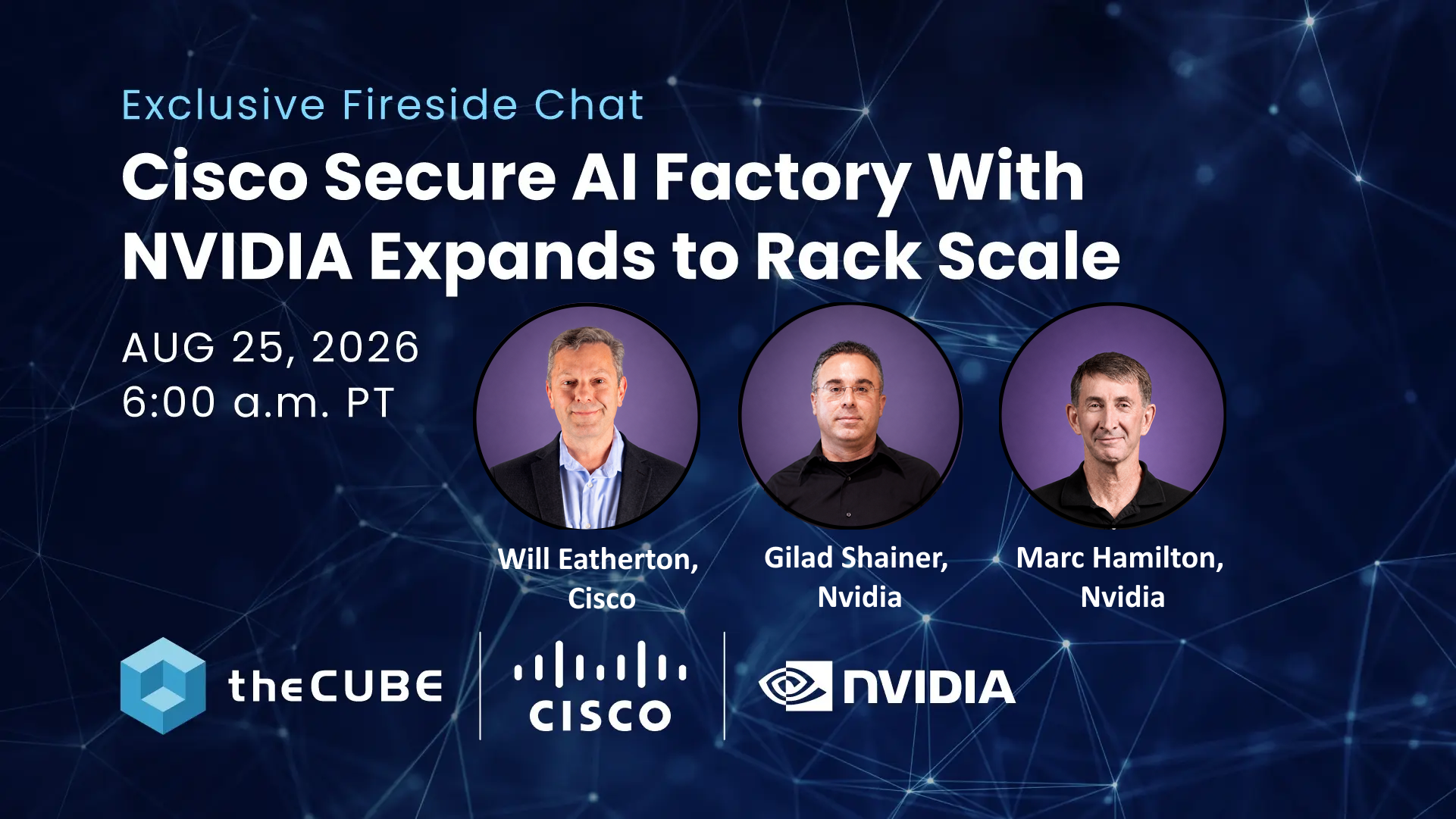
The pitch that actually lands comes from Marc Hamilton of NVIDIA, and it is a debugging question: an agent in a sandbox calls a tool sitting on the front-end network, something slows down, and nobody can say which layer owns the fault [14]. That is an on-call problem, not a purchasing one, and it explains why a reference architecture is being packaged and sold rather than published.
The sales logic is blunter than the engineering logic. Hamilton says the mistakes cluster where a customer orders networking from one vendor and servers from another, because server teams and network teams historically did not meet until very late in a build [12]. As engineering, that is fair. As procurement, it is an argument for buying the rack from one supplier, and NVIDIA's Gilad Shainer scopes the payoff accordingly: the performance guarantee is what comes with the reference architecture, and now with the Cisco AI Factory [15]. The hedge is real but narrow. Spectrum-X open interfaces let customers run their own technology on top, and Spectrum-X licensing lets Cisco Silicon One switches attach to the access network [21].
There is also a gap in the calendar worth noting. The full rack-scale solution becomes orderable through Cisco in September [6], while the Supermicro compute that makes it rack-scale begins rolling out in October [8], so at least a month separates the purchase order from the start of the compute rollout [24]. For a story whose entire premise is that neoclouds have end customers lined up the moment the GPU order goes in [1], the delta between orderable and deliverable is the number to ask about.
The most credible part of the announcement is the least quantified. Cisco's Will Eatherton concedes that industry attention stops at lighting up the cluster and getting the first token, and points to day-two monitoring, health, availability and software upgrades as Cisco's focus [13]. No availability figure or utilization number accompanies that. The single named buyer, Sharon AI's James Manning, describes confidence that NVIDIA Cloud Partner validation means the infrastructure is optimized from day one [22], which is a statement about expectation rather than measurement. All four accounts of this launch come out of theCUBE's event coverage, and theCUBE disclosed that it is a paid media partner for the event [23].
The physics is what gives the integration argument teeth. Rack-scale systems such as Vera Rubin NVL72 can exceed 200 kilowatts per rack, and Cisco is answering with liquid-cooled N9000 switches that interoperate with Supermicro's liquid-cooled compute [10]. Power and cooling loops at that density are committed before any workload proves out, which is precisely why a component that underperforms shows up as idle capacity and deferred revenue rather than a box you can send back [5].
What to watch
- Whether a September order yields hardware in September, or whether the October start of the Supermicro compute rollout is the real delivery date for rack-scale buyers.
- A measured time-to-first-token or utilization figure from a named customer other than Sharon AI, reported by someone with no commercial tie to the launch event.
- Whether Cisco Validated Services certification starts being treated as a precondition for Nvidia Cloud Partner compliance in designs that do not use Cisco networking.
Clarity's read
What the record supports and how the coverage leans. The claims behind it follow.
Reality
- Evidence35
- Adoption10
- Hype gap+40
- Incentives85
- Confidence60
Claim ledger
Ranked by verification strength, evidence, and original report placement.
- [1]
Eatherton said that when Cisco works with neoclouds, from the moment they put in the purchase order for GPUs they already have their end customers lined up, and that speed through final software deployment and bring-up is the challenge.
ReportedSupportedSource: Will Eatherton, Cisco3 sources— create a free account to open themView cited source - [2]
Eatherton said many enterprises are spending a large amount on tokens now and are under pressure to move from external API consumption to local inference, and that speed is either what is broken or the challenge.
ReportedSupportedSource: Will Eatherton, Cisco3 sources— create a free account to open themView cited source - [3]
Cisco President and Chief Product Officer Jeetu Patel said the industry is at the beginning of one of the largest datacenter buildouts in history, and that speed only counts if it comes with control of data, managed token costs and real return on investment.
ReportedSupportedSource: Jeetu Patel, Cisco3 sources— create a free account to open themView cited source - [4]
SiliconANGLE frames the AI infrastructure market as shifting from acquiring GPUs to building complete AI factories that generate tokens reliably, efficiently and at scale.
- [5]
An AI factory requires compute, networking, storage, cooling, software and operations to work together from Day 0 through continuous production; if one component fails to perform, expensive capacity sits idle and revenue slips away.
ReportedSupportedSource: SiliconANGLE / theCUBE Research2 sources— create a free account to open themView cited source - [6]
The full rack-scale Cisco Secure AI Factory solution will be orderable through Cisco in September.
- [7]
Cisco's Will Eatherton said the company has partnered with Supermicro to bring in full rack scale, liquid-cooled, starting with Blackwell and moving to Vera Rubin, across sovereign, enterprise and neocloud markets.
ReportedSupportedSource: Will Eatherton, SVP and head of networking engineering, Cisco2 sources— create a free account to open themView cited source - [8]
Supermicro compute solutions will roll out as part of the Cisco Secure AI Factory with Nvidia beginning October this year.
- [9]
The expanded portfolio features Cisco Silicon One-based switches for the front end and builds on Nvidia Spectrum-X-based switches on the back end, unified by Nexus One, Cisco's networking management platform.
- [10]
Cisco said modern rack-scale systems such as Nvidia Vera Rubin NVL72 can exceed 200 kilowatts per rack, and that its liquid-cooled Cisco N9000 Series Switches interoperate with Supermicro rack-scale liquid-cooled compute to deliver rack-to-fabric speeds.
- [11]
Cisco and Nvidia are building the rack-scale expansion around Cisco Validated Designs that comply with the Nvidia Cloud Partner reference architecture, a framework intended to reduce late-stage integration problems.
- [12]
Marc Hamilton of Nvidia said traditional enterprises had server teams and networking teams that did not come together until very late, and that there are many mistakes when customers order networking from one vendor and servers from another.
ReportedSupportedSource: Marc Hamilton, VP of solutions architecture and engineering, Nvidia2 sources— create a free account to open themView cited source - [13]
Eatherton said much of the industry focus has been up to the point of lighting up the cluster and getting the first token, and that Cisco has focused on day-two aspects including monitoring, health, availability and software upgrades.
ReportedSupportedSource: Will Eatherton, Cisco2 sources— create a free account to open themView cited source - [14]
Hamilton said that in the GenAI world you may call out to an agent in a sandbox or doing tool calling on the front-end network, and when something slows down the question of where to look, debug and optimize across the stack is what the reference architecture addresses.
ReportedSupportedSource: Marc Hamilton, Nvidia2 sources— create a free account to open themView cited source - [15]
Shainer said the reference architecture exists to make sure customers get the full performance of Nvidia components, and that this guarantee now comes with the Cisco AI Factory.
ReportedSupportedSource: Gilad Shainer, Nvidia2 sources— create a free account to open themView cited source - [16]
Cisco said new Cisco Validated Services, once delivered, will help customers certify that infrastructure is built, designed and aligned to the reference architecture.
- [17]
During operations, Nvidia AI Enterprise software and AgentOps delivered through the Cisco Cloud Control backend will allow customers to use their own tooling and utilities.
- [18]
Nvidia describes the AI factory as a five-layer cake covering the data center's land, power and shell; chips; infrastructure; models; and applications, with performance depending on optimizing across every layer.
- [19]
Hamilton said the real cost savings in an AI factory is not about cost savings but about token generation and driving revenue, with a repeatable way to do it.
ReportedSupportedSource: Marc Hamilton, Nvidia2 sources— create a free account to open themView cited source - [20]
The Secure AI Factory with Nvidia now integrates rack-to-fabric liquid cooling supporting systems beyond 200 kilowatts per rack for reasoning, agentic AI and trillion-parameter training, and pairs Nvidia Spectrum-X switch silicon with Cisco NX-OS or SONiC.
- [21]
Gilad Shainer of Nvidia said open interfaces in Nvidia Spectrum-X allow customers to run their own technologies on top of the platform, and Spectrum-X licensing allows Cisco Silicon One switches to connect to the access network.
- [22]
Sharon AI co-founder and CEO James Manning said that with Cisco Secure AI Factory with Nvidia the company no longer has to choose between performance, reliability or ease of management, and that NCP validation gives confidence the infrastructure is optimized from day one.
- [23]
theCUBE disclosed that it is a paid media partner for the 'Cisco Secure AI Factory With Nvidia Expands to Rack Scale' event.
- [24]
At least one month separates the September date on which the rack-scale solution becomes orderable from the October start of the Supermicro compute rollout.
- [25]
The rack sold as a single validated system combines parts from at least three suppliers: Supermicro liquid-cooled compute, Nvidia Spectrum-X switch silicon, and Cisco Silicon One silicon running Cisco network operating systems.
Sources
1 independent publisher whose own reporting we read for this story.
- siliconangle.comCisco and Nvidia take AI factories from rack to runtime
5 articles · August 26, 2026
Topics and entities
Follow any of these and your For You feed starts watching them — no settings page required.
Topics
- AI factoriesFollow
- Data center liquid coolingFollow
- AI networkingFollow
- Rack-scale AI infrastructureFollow
Entities
- James ManningFollow
- Cisco Secure AI Factory with NvidiaFollow
- Marc HamiltonFollow
- Cisco Nexus OneFollow
- Nvidia Cloud Partner reference architectureFollow
- NvidiaFollow
- SONiCFollow
- CiscoFollow
- Will EathertonFollow
- Gilad ShainerFollow
- Vera RubinFollow
- SiliconANGLEFollow
- Nvidia Spectrum-XFollow
- Jeetu PatelFollow
- Cisco Silicon OneFollow
- Sharon AIFollow
- SupermicroFollow