Ng's four AI skills came from 10,000 job reqs. The fight is over the fifth
The list reads like an engineering syllabus because it was built from engineering postings. What the critics add is the part that only surfaces after launch.
The Product Desk
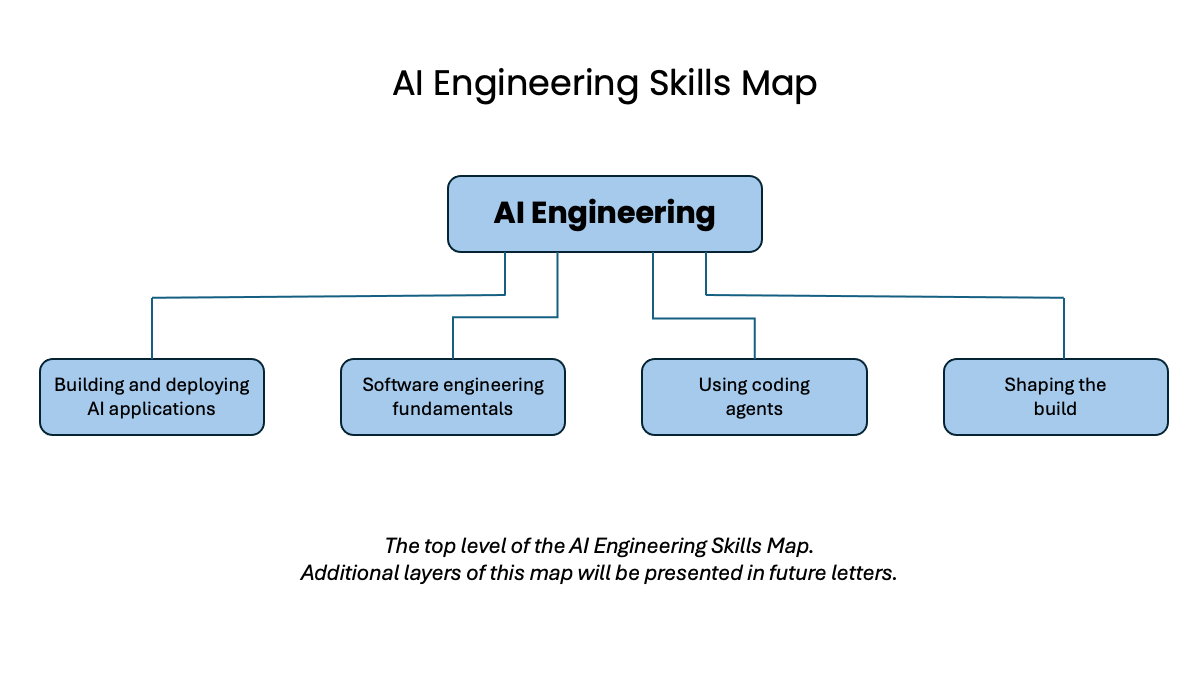
What happened
- Andrew Ng built a four-part AI development skills list from an analysis of more than 10,000 job postings plus interviews with experts, hiring managers and recruiters.
- The four areas: building and deploying AI applications, software engineering fundamentals, using coding agents, and shaping the build.
- Ng said every developer will need AI engineering skills, naming full-stack, data, DevOps and machine learning engineers alongside AI engineers.
- Andy Thurai of The Field CTO called the framework dangerously narrow for enterprise use and diagnosed a blind spot of builder bias.
- Deepika Sidana of American Express said the four areas are not enough alone, listing risk, compliance and the consequences of failure as gaps.
Why it matters
- contradiction Thurai says building the intelligence is no longer the hard part in enterprises, while Ng's list makes build competence the universal requirement.
- cost Runtime economics and AI FinOps sit outside the four areas, so a req drawn from the list hires nobody who owns the monthly inference bill.
- decision The choice is not which bullets to add but how to screen: Ng's four show up in a portfolio, Sidana's orchestration items only show up in someone's post-incident history.
- exposure Compliance and the consequences of failure land on whoever the posting names. Leave them unnamed and they default to the on-call rotation.
A job posting is a record of what someone believed they needed before the system was running. Ng assembled his four areas from more than 10,000 of them, plus interviews with experts, hiring managers and recruiters [2]. That method captures demand as employers articulated it, which is why the output looks like a build syllabus: LLMs, RAG, agentic workflows, architecture, testing, security, coding agents [6][7][8]. It is a survey of reqs, and reqs are written at the start of projects.
The arithmetic of the loudest complaint is off. One of the four items, "shaping the build," says engineers should no longer expect a pixel-perfect design to implement, and needs product sense plus an understanding of business context and customer goals [3]. So the reply calling the list "way too internally looking" and accusing it of failing to address the business problem [16] is quarrelling with a taxonomy that spends a quarter of itself on exactly that [13]. Problem framing is in there. What is not in there is anything about the second year.
That is where Andy Thurai of The Field CTO is more precise than the pile-on. His objection is temporal: the taxonomy covers Day 1 innovation, while in enterprise settings the hard part has moved to orchestrating, observing and paying for the thing, so the list optimises for the variable that matters least in production [4]. Set that against Ng's own claim that every developer, including data, DevOps and ML engineers, now needs AI engineering skills [9], and you have two people describing different halves of a lifecycle as the scarce one.
For anyone drafting a req this quarter, the usable contribution is Deepika Sidana's definition of orchestration: coordinating models, tools, data, evaluations, observability, human approvals and fallback paths [11]. Seven nouns [15], each of which becomes a line in a posting and a question with a checkable answer. Ask a candidate what their fallback path was when a tool call timed out in production. Ask who approved which class of action. Those are interviewable. Sidana's broader list of the business problem, customer workflow, risk, compliance requirements and the consequences of failure [10] is harder, because most of it is only demonstrable by someone who has already shipped and been on the hook when it broke.
The rest of the added vocabulary is weaker as hiring material. Deterministic governance, multi-agent orchestration, agent arbitration, AI FinOps, runtime economics and agentic observability [5] are terms a panel and a candidate would define differently on the same afternoon, which makes them unscreenable no matter how real the underlying work is. Cost ownership is the exception worth translating: someone has to be accountable for tokens per resolved ticket, and Ng's own framing already treats token waste as a competence question inside the coding-agent skill [8].
Sidana's closing condition is the one that does not belong in a skills matrix at all: accountability for measurable business outcomes [12]. That is scope and compensation, not a course.
What to watch
- Whether Ng publishes a breakdown of how many of the 10,000 postings mention evaluation, observability or cost ownership at all.
- Whether enterprise reqs start naming a runtime cost owner as a requirement rather than a preference.
- Whether the four areas get packaged as a Coursera credential, which would freeze the definition for recruiters and screening tools.
Clarity's read
What the record supports and how the coverage leans. The claims behind it follow.
Reality
- Evidence38
- Adoption
- Insufficient
- Hype gap+22
- Incentives62
- Confidence44
Claim ledger
Ranked by verification strength, evidence, and original report placement.
- [1]
Andrew Ng, founder of Coursera and lecturer at Stanford, formulated a list of essential skills for AI development.
- [2]
Ng based the list on his analysis of more than 10,000 job postings and interviews with AI experts, hiring managers, and recruiters.
- [3]
The fourth skill area is shaping the build: Ng says engineers should no longer expect to be given a pixel-perfect design and asked only to implement it, and that effective AI engineering requires product sense and understanding business context and customer goals.
- [4]
Thurai said Ng's taxonomy is entirely focused on "Day 1" innovation, that in enterprise environments the hardest part of AI is no longer building the intelligence but orchestrating, observing and paying for it, and that relying on this narrow set of skills "optimizes for the variable that matters least in production."
- [5]
Other key skills cited alongside orchestration include harnessing engineering and deterministic governance, multi-agent orchestration, agent arbitration, AI FinOps, runtime economics and agentic observability.
- [6]
The first skill area is building and deploying AI applications: understanding building blocks such as LLMs, context engineering, RAG, agentic workflows, machine learning and deep learning, plus using statistical techniques to measure, steer and govern AI systems so they behave more predictably.
- [7]
The second skill area is software engineering fundamentals: architecture, testing and security. Ng says this leads to much better outcomes than an inexperienced developer who vibe codes a solution without knowing the tradeoffs their coding agent is making.
- [8]
The third skill area is using coding agents: having a mental model for how agents work, understanding their limitations and workarounds, and knowing how much to intervene versus leave them alone so as to build robust software without wasting excessive time or tokens.
- [9]
Ng said all developers, including full-stack engineers, data engineers, DevOps engineers, machine learning engineers and AI engineers, will need AI engineering skills.
- [10]
Deepika Sidana, senior manager of software engineering at American Express and professional development director for NYSCD at the Society of Women Engineers, said the four areas are important but not enough on their own, and that engineers also need to understand the business problem, customer workflow, risk, compliance requirements and the consequences of failure.
- [11]
Sidana defined orchestration skills as coordinating models, tools, data, evaluations, observability, human approvals and fallback paths, and called them particularly critical to moving AI into enterprise environments.
- [12]
Sidana said the strongest AI engineers will combine software fundamentals with domain knowledge, product judgment, communication, and accountability for measurable business outcomes.
- [13]
One of Ng's four skill areas, 25 percent of the list, explicitly names product sense and business context.
- [14]
Ng said the process of building software has changed drastically with generative and now agentic AI, and that acquiring the right skills can be confusing in the hype-filled environment around AI.
- [15]
Sidana's orchestration definition names seven distinct components.
- [16]
One response to Ng's post said: "Yikes -- this is way too internally looking. It fails to address the business problem. This is why people hate software engineers."
- [17]
Andy Thurai, founder and AI advisor at The Field CTO, said Ng's recommendations constitute "a dangerously narrow framework for the enterprise, suffering from a massive blind spot of builder bias."
Get this ledger inside ChatGPT. Ask about any of our stories and the answer brings its figure, each claim’s verdict and the sources. Free, no account.
Sources
1 independent publisher whose own reporting we read for this story.
- zdnet.com4 AI development skills you need, according to Andrew Ng - and what experts say he's missing
1 article · August 26, 2026
Topics and entities
Follow any of these and your For You feed starts watching them — no settings page required.