ScienceNot yet confirmed elsewhere1 publisher3 min readPublished
A pangolin named in 1836 becomes a reference sample for scale seizures
DNA from a 190-year-old type specimen in London settles which name the Himalayan pangolin carries. Species-level matching of trafficked scales gets easier; region-level tracing does not, yet.
The Scientist · Science desk
What happened
- A Field Museum-led team confirmed Manis aurita as a valid pangolin species living in Nepal and northern India, reporting the work in Communications Biology.
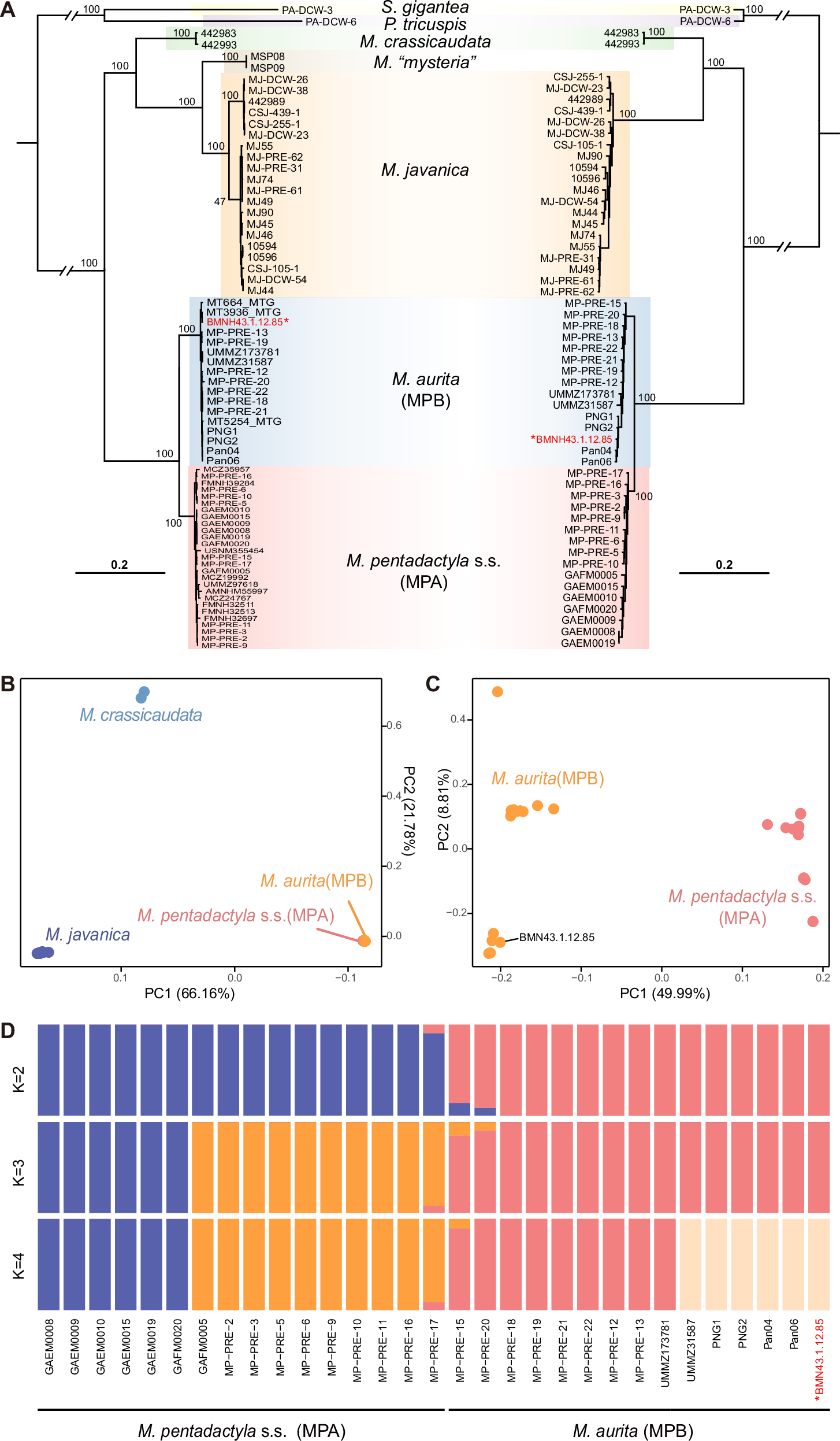
- Modern Himalayan samples matched that specimen, so the pangolin named Manis indoburmanica in 2025 is the same animal.
- Under the rule of priority, the earlier valid name wins, making aurita the correct name.
- Pangolins are considered the most trafficked mammals in the world, and their scales are what poachers want.
Why it matters
- capability A lab holding a seized scale can test against a lineage anchored to a dated, named specimen rather than an unresolved subspecies label.
- constraint Region-of-origin attribution stays out of reach until someone samples populations across the four-country range; the release only offers the possibility.
- cost Record custodians pay the relabelling bill: archives keyed to the Chinese pangolin subspecies or to the year-old 2025 name now point at the wrong taxon.
A forensic match needs something to match against, and the useful property of the animal the Natural History Museum in London sequenced is that it is the type specimen of aurita, the name published in 1836 [2]. Modern Himalayan pangolin samples came back matching it [3]. Because the type specimen carries the name and the older valid name has priority, sequencing that specimen converts a name into a genotype, and matching against the genotype is what decides which name an animal gets [1][15].
That is a species-level answer. The release goes further and says the work could let authorities trace traded scales back to species and to the regions poachers are working [16]. Those are two different tests. Assigning a scale to a species needs one reference lineage. Assigning it to a valley needs genetic structure within that lineage, sampled across a range that the 2025 study placed in the Himalayan foothills of Nepal, India, Bhutan and Myanmar [10]. Nothing in the release describes that within-species geographic sampling, and its own language on regional tracing is conditional [19]. Enforcement gets the species anchor now; provenance is a later paper.
The nomenclature has moved twice in two years. Animals in the Himalayan foothills were treated as a subspecies of the Chinese pangolin [9], were named as the separate species Manis indoburmanica in 2025 [10], and are now Manis aurita [3]. The 2025 name held for about a year before priority retired it [14]. Anyone whose seizure records, tissue archives or reference database uses either of the two earlier labels is now holding rows that point at the wrong name, and the fix is clerical rather than scientific.
The evidence chain here ran through a drawer, not a field site. The description and the genetic confirmation sit 190 years apart [13], and the question that separated them was answered by the London team sequencing an 1836 skin [2], after five-plus years of Nepali fieldwork raised the lineage question [11] and a decade-long study of pangolin relationships turned up the forgotten name [12]. Kai He of Guangzhou University, a co-corresponding author, described the unresolved problem as whether indoburmanica and aurita were the same species [4]. That is a question only the type material could close, which sets an expectation for the next contested Asian mammal: sequence the historical type before proposing a new name for the same animal. Narayan Koju of Nepal Engineering College, the first author, puts wildlife forensics in the same sentence as conservation planning [17]; the release quotes Anderson Feijo of the Field Museum saying that what is not known cannot be protected [18]. The narrower version of that claim is the operational one. A scale from a seizure could not previously be assigned to a species that had no accepted name, and now it can be.
What to watch
- Whether the published paper or a follow-up reports genetic structure within aurita fine enough for locality assignment.
- Whether wildlife authorities in the four range countries named in the 2025 study move their paperwork to aurita.
- Whether a forensic lab validates a scale-DNA assay keyed to the new reference sequence.
Clarity's read
What the record supports and how the coverage leans. The claims behind it follow.
Reality
- Evidence58
- Adoption
- Insufficient
- Hype gap+24
- Incentives68
- Confidence55
Claim ledger
Ranked by verification strength, evidence, and original report placement.
- [1]
Scientific naming follows a rule of priority: when the same species has been given more than one scientific name, the earliest valid name takes precedence.
- [2]
The Natural History Museum in London successfully sequenced DNA directly from the historical type specimen of the Nepalese subspecies aurita, a specimen dating to 1836.
- [3]
Modern Himalayan pangolin samples matched aurita, showing that animals described in 2025 as M. indoburmanica were members of the species first named M. aurita, so M. aurita is the correct scientific name.
- [4]
Kai He of the South China Biodiversity Research Center at Guangzhou University, a co-corresponding author, described the core taxonomic riddle as whether indoburmanica and aurita were the same species or different species.
ReportedSupportedSource: Kai He, quoted in the Field Museum release2 sources— create a free account to open themView cited source - [5]
A release dated August 26, 2026, from the Field Museum, carried by sciencedaily.com, reports that DNA from a nearly 190-year-old museum specimen helped scientists confirm a distinct Himalayan pangolin species in Nepal and northern India.
- [7]
Researchers confirmed that a previously unrecognized Asian pangolin species, Manis aurita, has been living in Nepal and northern India.
- [8]
Pangolins are considered the most highly trafficked mammals in the world, and their overlapping scales are a major reason they are heavily targeted by poachers.
- [9]
Manis aurita was described in 1836 and over time was reclassified as a subspecies of the Chinese pangolin.
- [10]
In 2025 another research team determined that animals grouped as Chinese pangolins were two species, naming the mountain-dwelling form Manis indoburmanica, which inhabits the Himalayan foothills across parts of Nepal, India, Bhutan and Myanmar.
- [11]
Narayan Koju of Nepal Engineering College at Pokhara University, the study's first author, says the finding is the culmination of more than five years of research that began in Nepal, where evidence first suggested Himalayan pangolins were a distinct evolutionary lineage.
- [12]
Feijo and colleagues were already conducting a decade-long investigation into pangolin evolution that combined DNA evidence with physical characteristics, and encountered the records of Manis aurita during that work.
- [13]
190 years separate the 1836 description of aurita from the 2026 genetic confirmation.
- [14]
Manis indoburmanica stood as a proposed species name for roughly one year, from its 2025 naming until the 2026 finding made aurita the valid name under priority.
- [15]
Sequencing the 1836 type specimen ties the name aurita to a genotype, so matching modern samples against that genotype is what determines which of the competing names applies.
- [16]
The discovery could give conservationists a way to trace illegally traded pangolin scales back to the species and regions being targeted by poachers, and could help authorities identify where illegally traded pangolins are hunted.
- [17]
Koju says the confirmation provides a scientific basis for conservation planning, wildlife forensics and efforts to protect one of the world's most trafficked mammals.
ReportedInsufficientSource: Narayan Koju, quoted in the Field Museum release2 sources— create a free account to open themView cited source - [18]
Anderson Feijo, Negaunee Assistant Curator of Mammals at the Field Museum and co-corresponding author, says "We can't protect what we do not know," and that confirmation of the species can now be used to help protect it.
ReportedInsufficientSource: Anderson Feijo, quoted in the Field Museum release2 sources— create a free account to open themView cited source - [19]
The release states the trace-to-region benefit as a possibility ("could") and describes no geographic sampling of populations within M. aurita that would support assigning a seized scale to a locality.
Sources
1 independent publisher whose own reporting we read for this story.
- sciencedaily.com190-year-old DNA reveals a hidden pangolin species
1 article · August 26, 2026
Topics and entities
Follow any of these and your For You feed starts watching them — no settings page required.
Topics
Entities
- Manis auritaFollow
- Manis indoburmanicaFollow
- Chinese pangolinFollow
- Field MuseumFollow
- Natural History Museum, LondonFollow
- Nepal Engineering College, Pokhara UniversityFollow
- South China Biodiversity Research Center, Guangzhou UniversityFollow
- Guangdong Academy of ForestryFollow
- Communications BiologyFollow
- Narayan KojuFollow
- Anderson FeijóFollow
- Kai HeFollow
- Yan HuaFollow
- Rule of priority in scientific namingFollow