Product1 publisherNot yet confirmed elsewhere2 min readPublished
Zendesk puts its AI revenue near $400m, mostly from agents billed per resolved case
Zendesk will end the year with about $400m of AI revenue, mostly from agents paid only when they resolve a case, chief executive Tom Eggemeier told TNW. By his account, paying for outcomes is a working revenue line for AI agents and still a test for the contract as a whole.
The Product Desk
What happened
- Zendesk began charging customers for automated resolutions in August 2024, Eggemeier said.
- Eggemeier said the seatless model will roll out shortly, and only to customers who want it.
- AI solves or assists more than 50% of Zendesk tickets, he said, though that count includes self-service and copilots and AI agents alone handle less.
Compiled by The Product DeskSomething wrong?How this is made
Why it matters
- decision Support leads on seat contracts will soon choose whether their Zendesk bill follows headcount or closed cases, and because the rollout is opt-in, the choice and its risk sit with them.
- cost Under the per-resolution agent fee, Zendesk absorbs the cost of an AI agent that fails, because a case the agent does not resolve earns it nothing.
- exposure If customer-side bots carry most of the traffic, a company billed per resolution pays for cases a customer's agent opened and closed, so the contract's definition of a resolution becomes a price term.
Tom Eggemeier made one phone call himself [10]. Meta's Muse, a personal assistant, did about 95% of the work [10]. It cut about $2,000 a year from his family's internet and TV package and about $1,000 a year from its mobile plan, he said [9]. "I saved over the last five days $3,105," the Zendesk chief executive said [11].
Within two years, he expects more than half of interactions to be one AI agent dealing with another, a person's own agent on one side and a company's on the other [12]. He said the prospect is a little scary [13]. People should always be able to reach a human, he said, and Zendesk tells its customers to offer that option [13].
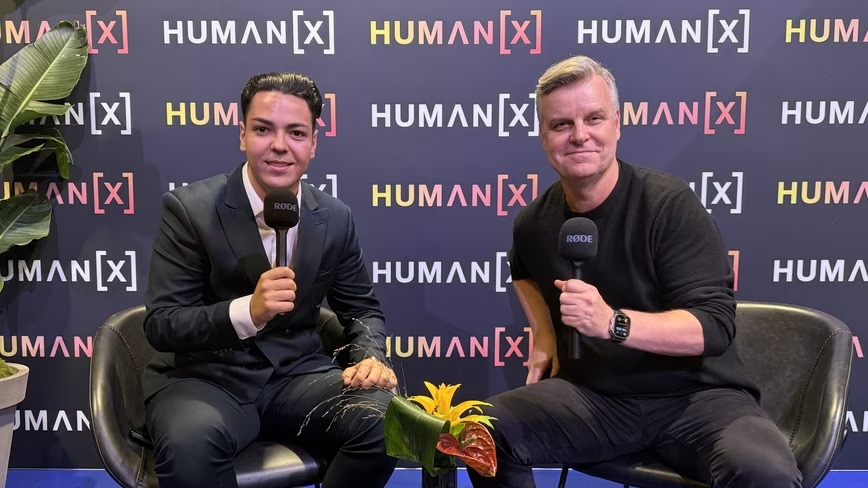
Eggemeier made the case against seats on stage at HumanX in Amsterdam on 23 September [14]. Two different pricing changes sit under that case. The per-resolution fee on AI agents is the one producing revenue, by his account [2]. The seatless model bills every resolution, whether a person or an agent closed the case, and it is still in a test [4]. More than 80,000 companies use Zendesk [8], so the roughly 100 in that test are at most about one customer in 800 [15].
Zendesk's usage figures need the same separation. The more-than-50% share of tickets that AI solves or assists folds in self-service and copilots [6]. Under the agent fee, the billable event is a case an AI agent resolves [2], so the agent-only share is the figure a buyer can budget against. The 80% to 90% automation rates come from his best customers [7]. The interview does not split the $400m by product or give the agent-only share of tickets.
For a support lead deciding whether to opt in, two numbers settle most of it. One is the share of tickets an AI agent closes with no human involved. The other is whether ticket volume rose or held flat over the past year. A high agent share with flat volume fits the seatless model best, because the bill follows work the agent already does. With a high share and rising volume, every new case adds to the charge, so a cap belongs in the contract. Where the agent share is low and volume is flat, seats stay predictable and the agent fee bills only what the agent closes [2]. The hard quadrant is a low share with rising volume. There the seatless model charges per resolution for cases staff still close by hand [4], and the seat contract needs a side-by-side price before anyone signs.
What to watch
- The price per resolution and any volume cap Zendesk attaches when the seatless model reaches customers who opt in.
- A split of the $400m between per-resolution agent fees and other AI products, to show how much of it is actually outcome-priced.
- How Zendesk contracts count a resolution when a customer's personal agent, such as Muse, is the one on the other end.
Clarity's read
What the record supports and how the coverage leans. The claims behind it follow.
Reality
- Evidence35
- Adoption50
- Hype gap+20
- Incentives70
- Confidence40
Claim ledger
Ranked by verification strength, evidence, and original report placement.
- [1]
Zendesk will end the year with about $400m of AI revenue, up from about zero two years ago, chief executive Tom Eggemeier told TNW.
- [2]
Most of Zendesk's AI revenue comes from AI agents that customers pay for only when they resolve a case.
- [3]
Zendesk began charging for automated resolutions in August 2024.
- [4]
Zendesk has tested a model with about 100 customers that drops seats and charges for every resolution, by a human or an AI agent.
- [5]
Eggemeier said Zendesk will roll out the seatless model shortly to customers who want it.
- [6]
AI solves or assists more than 50% of Zendesk tickets, Eggemeier said; the count includes self-service, AI agents and copilots, and AI agents alone handle less than that.
- [7]
Eggemeier said his best customers reach automation rates of 80% to 90%, with higher satisfaction than with people.
- [9]
Eggemeier said Meta's Muse, a personal assistant, cut about $2,000 a year from his family's internet and TV package and about $1,000 a year from its mobile plan.
- [10]
Muse did about 95% of the work; Eggemeier made one phone call himself and is not yet in the early test in which Muse makes calls.
- [11]
"I saved over the last five days $3,105," Eggemeier said of Meta's Muse.
- [12]
Eggemeier expects personal AI agents talking to company agents to make up more than half of interactions within two years.
- [13]
Eggemeier called that prospect a little scary, said people should always be able to reach a human, and said Zendesk tells customers to offer that option.
- [14]
Eggemeier made the case against seats on stage at HumanX in Amsterdam on 23 September, the day he spoke to TNW.
- [15]
The roughly 100 customers in the seatless test are at most about one in 800 of Zendesk's more than 80,000 customer companies.
Sources
1 independent publisher whose own reporting we read for this story.
- thenextweb.comZendesk CEO Tom Eggemeier says Meta’s Muse saved him $3,105 in five days
1 article · October 8, 2026
Topics and entities
Follow any of these and your For You feed starts watching them — no settings page required.
Topics
- Personal AI AssistantsFollow
- Seat-based SaaS pricingFollow
- AI customer service agentsFollow
- Outcome-Based PricingFollow