ProductNot yet confirmed elsewhere1 publisher2 min readPublished
Xanadu is moving its photon detectors onto GlobalFoundries' 300mm line in New York
Xanadu will move its photon-counting detectors and silicon nitride photonics onto GlobalFoundries' 300mm line in Malta, New York, under a multi-year deal. Its scaling case now depends on how chips from a commercial fab perform.
The Product Desk
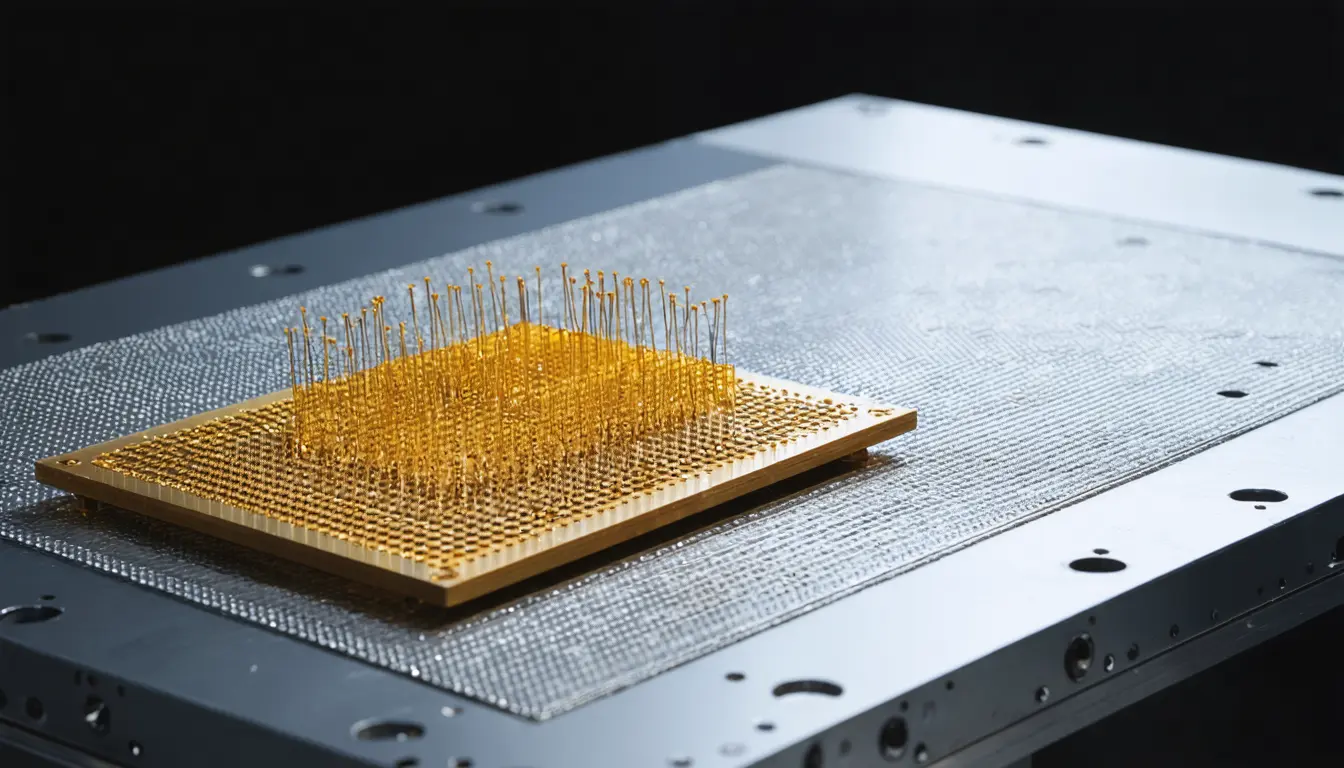
What happened
- Xanadu says adopting the detectors will "dramatically increase" the speed of its systems and "considerably reduce" the chip overhead needed for utility-scale machines.
- Beyond the detector work, the two companies say they will explore building higher-performance quantum modules for photonic systems.
- In February 2025, Xanadu announced it had built a prototype of what it called the world's first universal photonic quantum computer.
- Shares of Xanadu began trading on Nasdaq and the Toronto Stock Exchange in March 2026 after a SPAC merger with Crane Harbor Acquisition Corp.
Compiled by The Product DeskSomething wrong?How this is made
Why it matters
- capability Xanadu's detector and silicon nitride parts can now be built in an industrial-grade production environment, a prerequisite for making them in volume.
- constraint The speed and overhead gains Xanadu expects from its detectors now depend on GF's process reproducing Xanadu's ultra-low-loss results at 300mm.
- exposure Delays or weak results from the Malta transfer will now reach Xanadu's public shareholders as well as its customers and government funders.
The first users of photonic parts from GlobalFoundries' Malta line will be Xanadu's own engineers. According to DCD, the partnership will be the manufacturing foundation for Xanadu's forthcoming fault-tolerant demonstrators [16]. The same announcement mentions hardware for future quantum data centers [16]. A data center operator reading that phrase is several steps behind a Xanadu engineering team that first has to get its existing technology running on another company's production line [5].
The first stage is a transfer job. The initial work moves components of Xanadu's existing silicon nitride platform and its superconducting nanowire single-photon detectors to GF's 300mm line in Malta [3], with the stated aim of reaching an industrial-grade production environment [5]. The deal pairs Xanadu's ultra-low-loss photonic design and process development with GF's photonics manufacturing experience [2].
The detectors are the technically interesting half. An SNSPD reports how many photons arrived in a single pulse of light, and DCD calls the technology the most reliable photon number resolving option [4]. The report does not include financial terms, volumes, a schedule, or any measurement from parts made on the GF line [14].
"Transitioning quantum computing technology to a high-volume manufacturing line is fundamental to delivering quantum computing at scale," said Christian Weedbrook, Xanadu's founder and chief executive [7]. Nicholas Sergeant, GF's vice president of quantum technology solutions, said the partnership "creates a path to industrialize the critical components needed to accelerate the deployment of fault-tolerant systems and enable future quantum computing architectures" [9].
Xanadu was founded in 2016 [10]. In January 2023 it took CA$40 million from the Canadian government's Strategic Innovation Fund to build and commercialize fault-tolerant photonic quantum computers [11]. Weedbrook said the GF deal "demonstrates our focus on execution" [8].
If you are an operator deciding whether photonic hardware belongs on a roadmap, two questions sort the claims. The first is where a component is made: in a vendor's own development process, or on a commercial production line. The second is whether the vendor has published measured performance for parts made there. A lab part with published numbers is a prototype you can reason about. A fab part without numbers is a plan, and this announcement puts Xanadu's detectors and silicon nitride in that square [5][14]. Budget belongs with the fourth square: fab-made parts with published loss and detector figures.
I would treat Malta as a plan and wait for those figures before committing time or money. The tradeoff is less lead time to build in-house expertise if the numbers come back strong. For most operators that is a cheap risk, because the first output is going into Xanadu's own demonstrators [16].
What to watch
- Published loss and detector performance figures for silicon nitride and SNSPD parts made on GF's Malta line.
- A schedule, or first results, for Xanadu's fault-tolerant demonstrators built with Malta-made components.
- Financial terms or volume commitments for the deal, for example in Xanadu's filings as a listed company.
Clarity's read
What the record supports and how the coverage leans. The claims behind it follow.
Reality
- Evidence30
- Adoption20
- Hype gap+35
- Incentives70
- Confidence35
Claim ledger
Ranked by verification strength, evidence, and original report placement.
- [1]
Xanadu has partnered with GlobalFoundries in a multi-year collaboration to accelerate the development and manufacturing of advanced photonic components.
- [2]
The collaboration combines Xanadu's expertise in ultra-low-loss photonic design and process development with GF's experience in photonics manufacturing.
- [3]
Using GF's 300mm production line in Malta, New York, the partners will develop components including ultra-low-loss silicon nitride photonics and Superconducting Nanowire Single-Photon Detectors (SNSPDs), the companies said.
- [4]
SNSPDs are described as the most reliable photon number resolving technology: optical sensors that determine the number of photons in a single light pulse.
- [5]
The collaboration will initially focus on Xanadu's SNSPDs and ultra-low-loss SiN platform, transferring components of Xanadu's existing technology to GF's 300mm manufacturing line to scale up to an industrial-grade production environment.
- [6]
The companies said they will also explore ways to further develop high-performance quantum modules for photonic quantum computing systems.
- [7]
"Transitioning quantum computing technology to a high-volume manufacturing line is fundamental to delivering quantum computing at scale," said Dr. Christian Weedbrook, founder and CEO of Xanadu.
- [8]
"This partnership demonstrates our focus on execution and seeks to provide the reliable, precision-manufactured infrastructure necessary to transition quantum technology from the research environment to commercial-scale data centers." - Christian Weedbrook
- [9]
"By combining Xanadu's advanced photonic computing technology with GF's 300mm manufacturing expertise, this partnership creates a path to industrialize the critical components needed to accelerate the deployment of fault-tolerant systems and enable future quantum computing architectures." - Nicholas Sergeant, VP of quantum technology solutions at GF
- [11]
In January 2023, Xanadu raised CA$40 million from the Canadian government's Strategic Innovation Fund to build and commercialize photonic-based, fault-tolerant quantum computers.
- [12]
In February 2025, Xanadu announced it had built a prototype of the world's first universal photonic quantum computer.
- [13]
In March 2026, Xanadu started trading on the Nasdaq and Toronto Stock Exchange after going public via a SPAC merger with Crane Harbor Acquisition Corp.
- [14]
DCD's report of the announcement does not include financial terms, production volumes, a schedule, or performance measurements for parts made on GF's line.
- [15]
Xanadu said that by adopting SNSPDs it expects to "dramatically increase" the speed of its quantum computing systems and "considerably reduce" the chip overheads needed to deliver utility-scale quantum computers.
- [16]
The partnership will serve as a manufacturing foundation for Xanadu's forthcoming fault-tolerant demonstrators and will help support its ambition to provide hardware architecture for future quantum data centers.
Sources
1 independent publisher whose own reporting we read for this story.
- datacenterdynamics.comQuantum firm Xanadu partners with GlobalFoundries for photonic component development
1 article · October 7, 2026
Topics and entities
Follow any of these and your For You feed starts watching them — no settings page required.
Topics
- Semiconductor foundry manufacturingFollow
- Photonic Quantum ComputingFollow
- Silicon PhotonicsFollow