Wild savanna elephants check who is watching before they gesture, a study of about 840 gestures finds
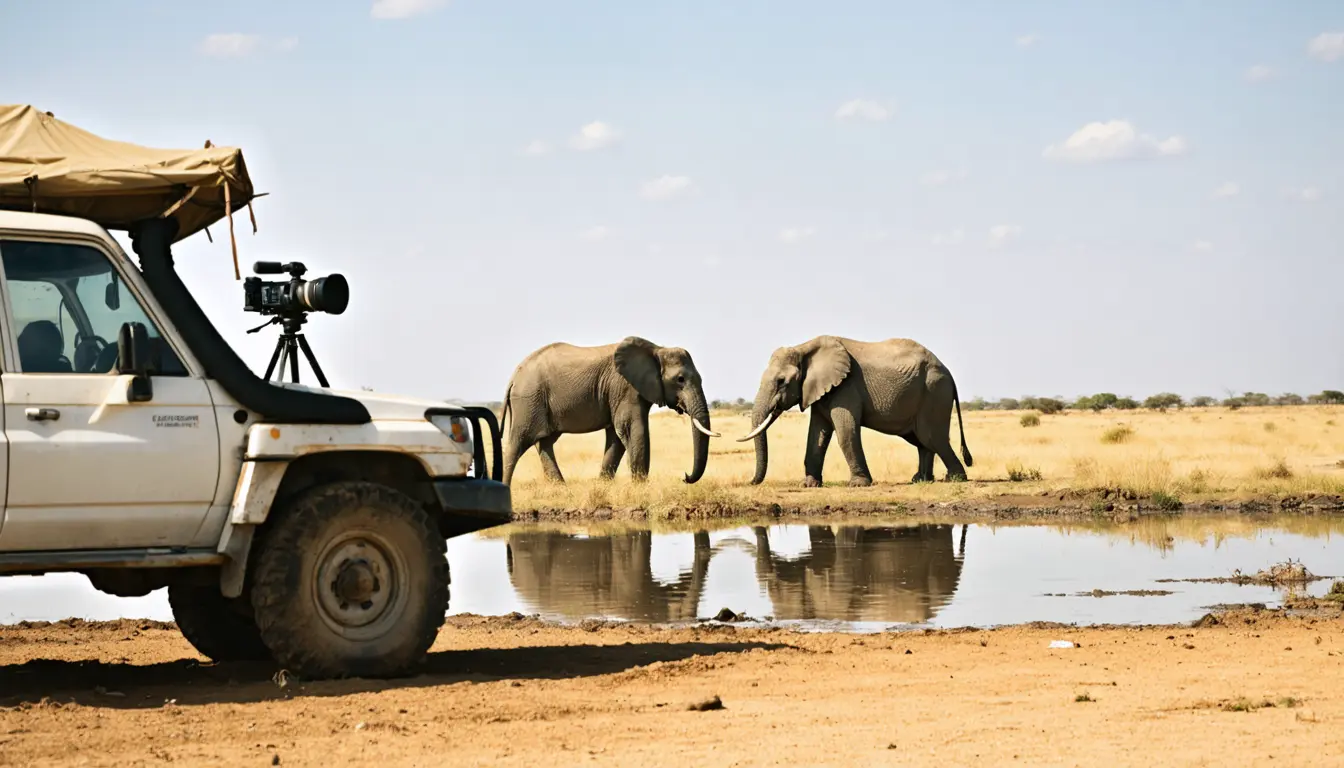
Wild African savanna elephants gesture intentionally, finds an Animal Cognition study that logged about 840 gestures in two South African parks. Its behavioural tests of intent put elephants, a lineage evolutionarily distant from primates, beside the apes in research on how gesture evolved.
The Scientist · Science desk
What happened
- Before and during a gesture, the elephants looked to see whether the recipient was paying attention, and changed the type of gesture to suit what it could see.
- When the recipient did not respond as the gesturer apparently wanted, the elephant waited and then gestured again.
- The team identified more than 40 gesture types built from 32 actions, used mainly to make another elephant move away or stop what it was doing.
- Of the 33 gesture types recorded in successful exchanges, 21 were used for both of those requests.
Why it matters
- precedent Theories of how gesture evolved now have to account for a lineage evolutionarily distant from the primates, a point in favour of explanations tied to intelligence and social life.
- constraint For most gesture types, an observer cannot tell from form alone whether an elephant wants another to move away or to stop, so reading them will depend on context and other signal channels.
- constraint The intent finding covers competitive encounters only, so any claim about elephant gesture in other parts of social life waits on the further research the team calls for.
Every test of intent in the study is something an observer can see. Attention checks and repeated signals [3][4] separate a gesture aimed at one animal from a display that would go off with or without an audience. Vesta Eleuteri of the University of Vienna, the lead author, said the gestures themselves are easy to notice. "They may fling their trunk or spread their ears wide, and you intuitively understand that 'they mean business.' But until now, we didn't know whether wild elephants were using these gestures to communicate intentionally," she said [9].
For a first systematic study [1], the sample is modest. More than 90 hours of observation during competitive encounters in Addo Elephant National Park and Marakele National Park yielded around 840 gestures [2]. That is at most about nine an hour [12]. The phys.org account does not say how many individual elephants produced them. That count would show whether the repertoire belongs to many animals or to a handful of especially combative ones.
The authors read the dual-use count as flexibility: elephants do not tie a gesture to a single goal [6]. Only 12 of the 33 gesture types seen in successful exchanges were used for one goal alone [13]. Angela Stoeger, the senior author, a University of Vienna professor who mainly studies elephant vocal communication, wants the field to widen the channels it records. "These findings underscore why studying multiple modalities is essential. In the future, studying the interplay of acoustic, visual, tactile and seismic signals, together with context, will finally reveal their messages," she said [10].
The comparison with apes comes from Eleuteri. "Such extensive, flexible gestural repertoires have previously been shown in apes and a few other primates. Finding the same in elephants is particularly exciting because elephants are so evolutionarily distant from primates. It suggests that sophisticated gestural communication may have evolved convergently in species that share advanced intelligence and complex social lives," she said [8].
In my view, the intent result is the firm part of this paper, and the convergence argument is a hypothesis it makes more plausible. That argument pairs sophisticated gesture with intelligence and complex social life across a small number of lineages [8]. Elephants add a distant case to the pattern. A pattern across species cannot show that one trait produces the other.
The team also compared its two South African populations with the ElephantVoices database, built from observations in Kenya and Mozambique [7]. "The populations shared the same gesture types, suggesting that elephants may share a common gestural 'vocabulary' across populations," Eleuteri said [14].
Elephants are losing habitat, and the loss brings them into conflict with people [16]. Lucy Bates of the University of Portsmouth, a co-author, said: "This work is important because humans and elephants increasingly come into contact with each other, as human populations expand in elephant range states" [15].
What to watch
- The number of individual elephants behind the roughly 840 gestures, and whether a few animals supply most of them.
- Multimodal studies of the kind Stoeger describes, testing whether sound, touch or seismic signals tell apart the 21 gesture types that carry both requests.
- Observations of further populations against the ElephantVoices records, to test whether the shared gesture vocabulary holds across the species' range.
Clarity's read
What the record supports and how the coverage leans. The claims behind it follow.
Reality
- Evidence62
- Adoption
- Insufficient
- Hype gap+18
- Incentives35
- Confidence64
Claim ledger
Ranked by verification strength, evidence, and original report placement.
- [1]
The study, published in Animal Cognition, is the first systematic investigation of intentional gestural communication in wild African savanna elephants.
- [2]
Researchers observed elephants in competitive contexts in Addo Elephant National Park and Marakele National Park in South Africa, carrying out more than 90 hours of observation and recording around 840 individual instances of gestures.
- [3]
Elephants visually checked whether another elephant was paying attention to them before and during gesturing, and adapted their gesture modality according to the recipient's visual attention.
- [4]
Elephants waited for a response and produced further gestures when the recipient did not respond in a way that satisfied their apparent goal.
- [5]
In competitive situations, wild elephants intentionally use more than 40 different gesture types made up of 32 gesture actions to achieve two main goals: asking recipients to 'move away' or 'stop what they're doing'.
- [6]
Of the 33 gesture types recorded in successful communications, 21 (64%) were used for both meanings, suggesting elephants do not rigidly use gestures with a single goal but communicate flexibly.
- [7]
The study compared gestures used by two South African populations, and the researchers compared their findings with the ElephantVoices database, based on observations from populations in Kenya and Mozambique.
- [8]
Vesta Eleuteri of the University of Vienna, lead author, said: "Such extensive, flexible gestural repertoires have previously been shown in apes and a few other primates. Finding the same in elephants is particularly exciting because elephants are so evolutionarily distant from primates. It suggests that sophisticated gestural communication may have evolved convergently in species that share advanced intelligence and complex social lives."
- [9]
"They may fling their trunk or spread their ears wide, and you intuitively understand that 'they mean business.' But until now, we didn't know whether wild elephants were using these gestures to communicate intentionally."
- [10]
Angela Stoeger, a professor at the University of Vienna and senior author who mainly studies vocal communication in elephants, said: "These findings underscore why studying multiple modalities is essential. In the future, studying the interplay of acoustic, visual, tactile and seismic signals, together with context, will finally reveal their messages."
- [11]
The researchers say the findings provide a foundation for understanding intentional gestural communication in wild elephants and highlight the need for further research into how elephants use gestures in other contexts.
- [12]
The observation effort produced at most about nine gestures per hour of observation.
- [13]
Of the 33 gesture types seen in successful communications, 12 were used for only one of the two goals.
- [14]
"The populations shared the same gesture types, suggesting that elephants may share a common gestural 'vocabulary' across populations."
- [15]
Lucy Bates of the University of Portsmouth, co-author, said: "This work is important because humans and elephants increasingly come into contact with each other, as human populations expand in elephant range states."
- [16]
Elephants face several conservation challenges, including habitat loss leading to conflict with humans.
Sources
2 independent publishers whose own reporting we read for this story.
Topics and entities
Follow any of these and your For You feed starts watching them — no settings page required.
Entities
- University of ViennaFollow
- University of St AndrewsFollow
- Addo Elephant National ParkFollow
- Animal CognitionFollow
- Lucy BatesFollow
- Vesta EleuteriFollow
- Angela StoegerFollow
- Elephant VoicesFollow
- Marakele National ParkFollow
- University of PortsmouthFollow
- African savanna elephantFollow