Science1 publisher2 min readPublished
Semmelweis researchers want depression and sleep checked before rheumatoid arthritis drugs are escalated
Semmelweis researchers say depression, poor sleep, obesity and smoking may sustain symptoms in the 6-28% of rheumatoid arthritis cases that resist treatment. They want doctors to look for those causes before escalating drugs when inflammation markers improve but pain and fatigue persist.
The Scientist · Science desk
What happened
- The team set out its argument, and a model to help doctors find the causes of persistent symptoms earlier, in Nature Reviews Rheumatology and The Lancet Rheumatology.
- The researchers say they have seen the approach improve outcomes in difficult-to-treat patients and, in many cases, strengthen the doctor-patient relationship.
- The group's earlier papers defining difficult-to-treat disease have been cited more than a thousand times, and the definition is now used worldwide, including for other diseases.
Compiled by The ScientistSomething wrong?How this is made
Why it matters
- decision Clinics running treat-to-target would add a screening step for mood, sleep and weight at the visit where they would otherwise raise a dose or switch drugs.
- cost If inflammation is no longer what drives the pain, a new anti-inflammatory drug changes the prescription and leaves the cause untreated; the team says finding the other drivers could spare patients such changes.
- constraint Until screen-first and escalate-first care are compared head to head in patients, a clinic cannot put a number on the escalations the check would spare.
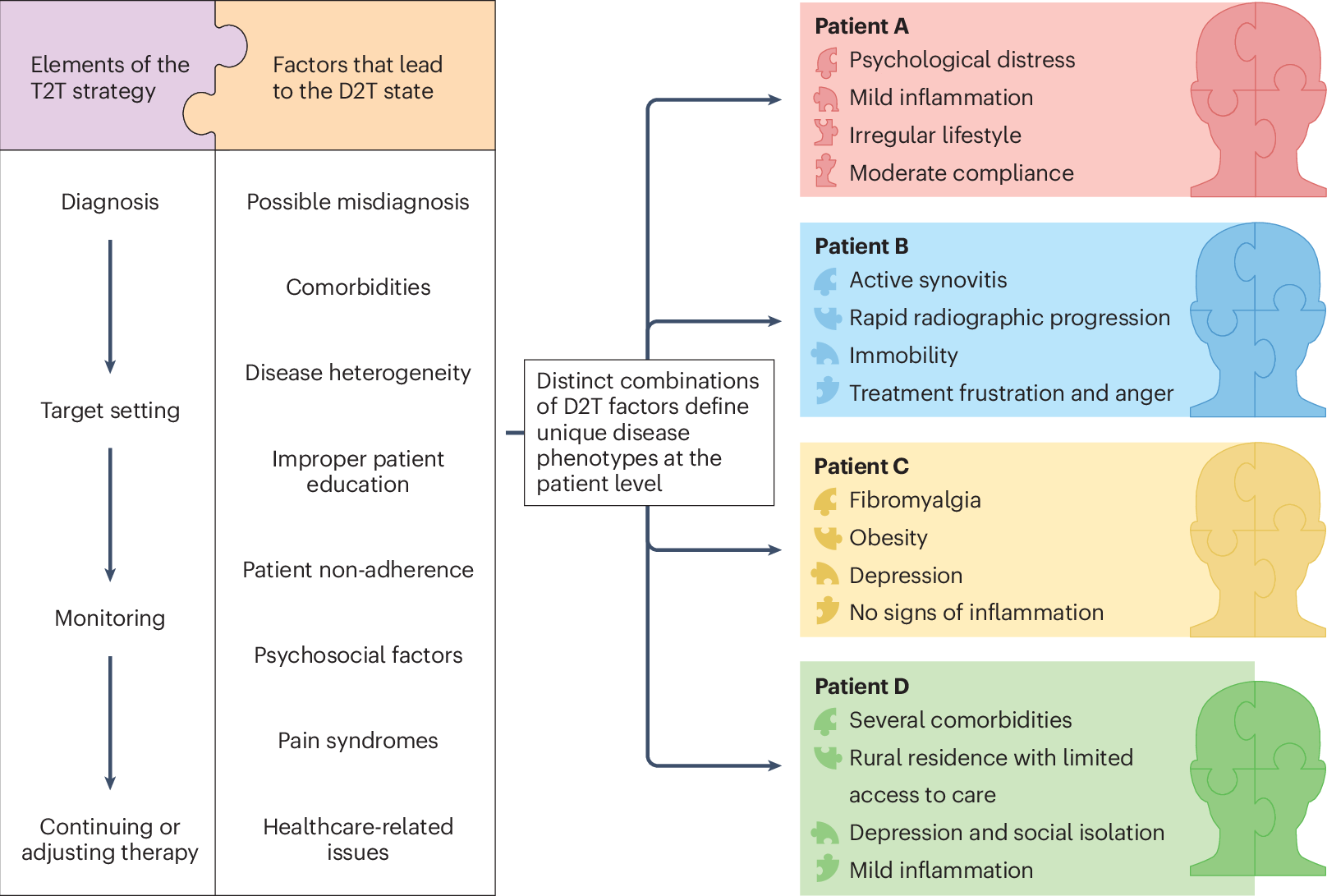
Treat-to-target, the widely used approach in rheumatoid arthritis, runs on feedback. Doctors track measurable indicators of disease activity. If inflammation has not come down enough, they raise the dose or switch to another drug [6]. According to materials from Semmelweis University [14], the team wants that same monitoring to work as an early warning. If the markers improve but the symptoms stay, the researchers argue, the pain or fatigue may not be caused solely, or perhaps at all, by ongoing inflammation [7].
The team explains persistent symptoms as a cycle. Pain and depression can reduce physical activity, contribute to weight gain and worsen sleep and mood. Those changes can then intensify pain [5]. The authors phrase the causal claim carefully: the other conditions may do more than occur alongside the disease, and may help keep symptoms active [16]. The thing this doesn't tell you is which condition came first in a given patient, or whether treating it will bring the pain down.
The clinical instruction comes from Dr. György Nagy, head of the Department of Rheumatology and Immunology at Semmelweis. "When target values improve but the patient still suffers from pain and fatigue, it is worth taking a step back. In such cases, instead of automatically prescribing more medication, doctors should look for what is maintaining the symptoms - whether it is chronic pain syndrome, depression, sleep disorders, or obesity," he said [8]. Smoking is on the team's broader list of possible drivers but not on his [1].
The difficult-to-treat estimate [3] covers a wide range. Its upper bound is about 4.7 times its lower [1]. The release does not explain that spread, or say how many difficult-to-treat patients have improved markers alongside lingering pain and fatigue. That second group is the one the early-warning model is built for [7].
I think the screen-first order makes sense on the team's reasoning alone, with one condition. The markers have to be good enough that "inflammation is controlled" is actually true for the patient being examined. If they are not, a screen for depression delays treatment for joints that are still inflamed.
Next, the team plans to look for patterns across patients through projects that use artificial intelligence [12]. "With AI-based pattern recognition, we could identify subgroups among patients, and with the help of these data we could create more effective, almost personalized treatment strategies for them," said Dr. Lilla Gunkl-Tóth, a PhD student at Semmelweis and first author of the publications [13].
What to watch
- A prospective study comparing screen-first with escalate-first care in patients whose inflammation markers have improved but whose pain persists, reporting outcomes and the number of drug changes avoided.
- Whether rheumatology guideline bodies add the early-warning step to their treat-to-target recommendations.
- Results from the team's AI subgrouping projects, in particular whether the subgroups predict who improves when depression or sleep is treated instead of the drug being changed.