Science1 publisher2 min readPublished
Oldest known eukaryote fossils turn up only in oxygenated Australian mud
Researchers found more than 12,000 early eukaryote fossils in ancient Australian drill cores, only in rocks laid down where oxygen was present. Oxygen-free rocks still preserved simpler microbes, so the pattern points to where these cells lived, though it cannot show why they first arose.
The Scientist · Science desk
What happened
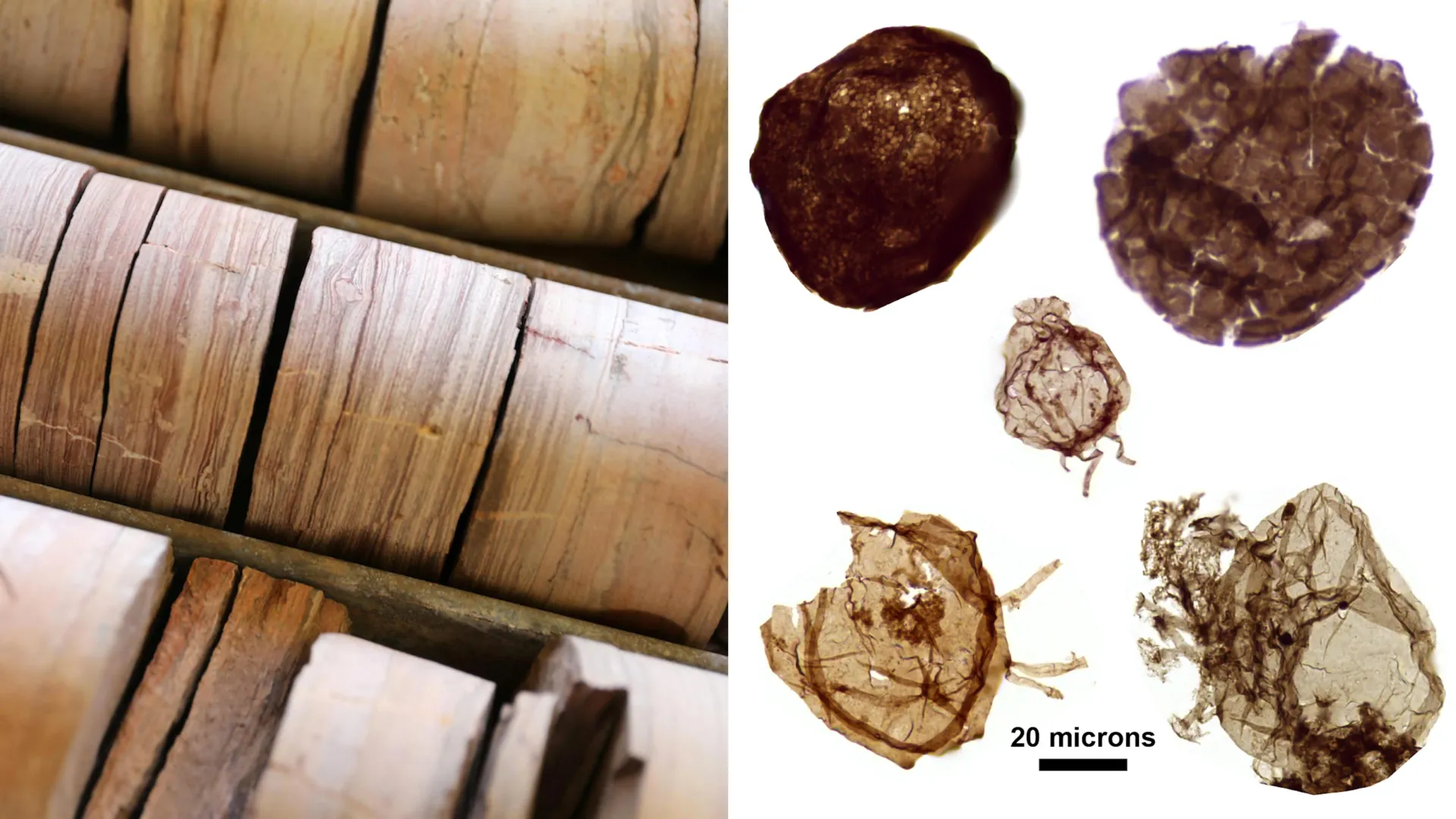
- The oldest of the Northern Territory fossils date to 1.75 billion years ago, the oldest eukaryote fossils currently known anywhere.
- The mudstone cores were drilled decades ago by mineral exploration companies and are stored in trays at the Northern Territory Geological Survey in Darwin.
- The team dissolved crushed core samples, identified fossils in the organic residue under a microscope, and studied the mudstones to reconstruct each depositional setting.
Compiled by The ScientistSomething wrong?How this is made
Why it matters
- contradiction Proposals that the first eukaryotes were anaerobes, built on living oxygen-free eukaryotes and on evidence that anoxic seas dominated, now have to explain why the oldest known fossils avoid anoxic rock.
- constraint A co-occurrence in one basin can support oxygen dependence in early eukaryote ecology, but on its own it cannot settle whether oxygen was a precondition for the lineage to form.
- capability Exploration cores drilled for minerals and left in government stores can yield thousands of billion-year-old microfossils, so existing core libraries become a search ground for early-life work.
The result rests on a negative sample, because the oxygen-free settings in the study still preserved simpler microbes [3]. Without that, an obvious objection would stand: anoxic mud might simply destroy delicate cells, and the eukaryotes' absence there would say nothing about where they lived. Rock that kept prokaryotes but no eukaryotes is much closer to a habitat signal.
The finding also lands in an open argument. Nearly all living eukaryotes use oxygen, because aerobic respiration supplies the energy complex cells need [9]. In recent years, though, researchers have found eukaryotes that thrive without it [10]. The geological record also increasingly suggests oxygen was much scarcer when eukaryotes were first evolving, with oxygen-free marine habitats the norm [11]. If anoxic water was the default, it is a pointed result that early eukaryotes stayed in oxygenated water across settings as different as coastal mudflats and the open sea [2].
The authors explain why they went to rocks and not genomes. Genetic studies of living microbes can say a lot about eukaryote ancestry, but they wrote that "only the fossil record can tell us about long-extinct lineages" [15]. The account is their own, published in The Conversation about their Nature paper [14][4]. The authors did not report how oxygen levels were read from the mudstones, how many samples came from anoxic settings, or how the more than 12,000 fossils [1] split across environments.
The fossils cannot show whether oxygen was needed for eukaryotes to arise at all. Gene-based work traces the last common ancestor of living eukaryotes to a union of at least an archaeon and a bacterium [12]. Fossils as old as 1.75 billion years [7] record where early eukaryotes lived once they existed, and say nothing directly about the conditions under which the lineage formed. An association in one ancient inland sea [6] fits oxygen being a requirement. It fits equally well with eukaryotes that had already become oxygen users living where the oxygen was.
The summary's wording is that the findings "strengthen the idea" that oxygen mattered to the emergence of complex life [13], and that is about as far as the evidence reaches. I think the pattern is good evidence that these early eukaryotes depended on oxygen, provided the oxygen reconstructions in the paper hold up. On the question of origins, it is evidence from one sea that covered much of northern Australia more than 1.5 billion years ago [6].
What to watch
- Whether other groups reanalysing the Nature paper's oxygen reconstructions and per-setting sample counts reach the same eukaryote-oxygen split.
- Whether eukaryote fossils of similar age from other basins show the same restriction to oxygenated settings, or turn up in anoxic mud.
- Whether older rocks yield eukaryote fossils that push the record closer to the archaeon-bacterium merger.