Science1 publisher2 min readPublished
Doshisha chemists use bulrush's own gases to load copper into a dye-removing carbon
Doshisha University chemists used one heating step to turn waste bulrush into a copper-laced carbon that took up as much as 62 mg of dye per gram. The lab results support a low-cost dye adsorbent for textile wastewater, though no test on real effluent has been reported.
The Scientist · Science desk
What happened
- The composite, called ZVCu@BAC, had a surface area of 984.5 m2/g, with needle-like copper nanoparticles spread evenly through the carbon and no clumping.
- Besides the cationic dye methylene blue, it removed the anionic dyes methyl orange and sunset yellow, with maximum capacities of 56.37 and 35.76 mg/g.
- After six regeneration cycles with a 0.1 M KOH/acetone wash, it still removed 90.6% of methylene blue and 88.0% of methyl orange.
Compiled by The ScientistSomething wrong?How this is made
Why it matters
- constraint A plant designer cannot size a treatment bed from capacities measured one dye at a time, and simultaneous mixed-dye removal appears in the report only as something to explore.
- cost The operator would pay for the KOH/acetone wash on every regeneration and for handling the dye it strips off, and the published estimate covers production only.
- decision The capacities in the report are for the copper composite alone, so a producer weighing the added copper nitrate cannot yet tell how much extra uptake it buys over plain bulrush carbon.
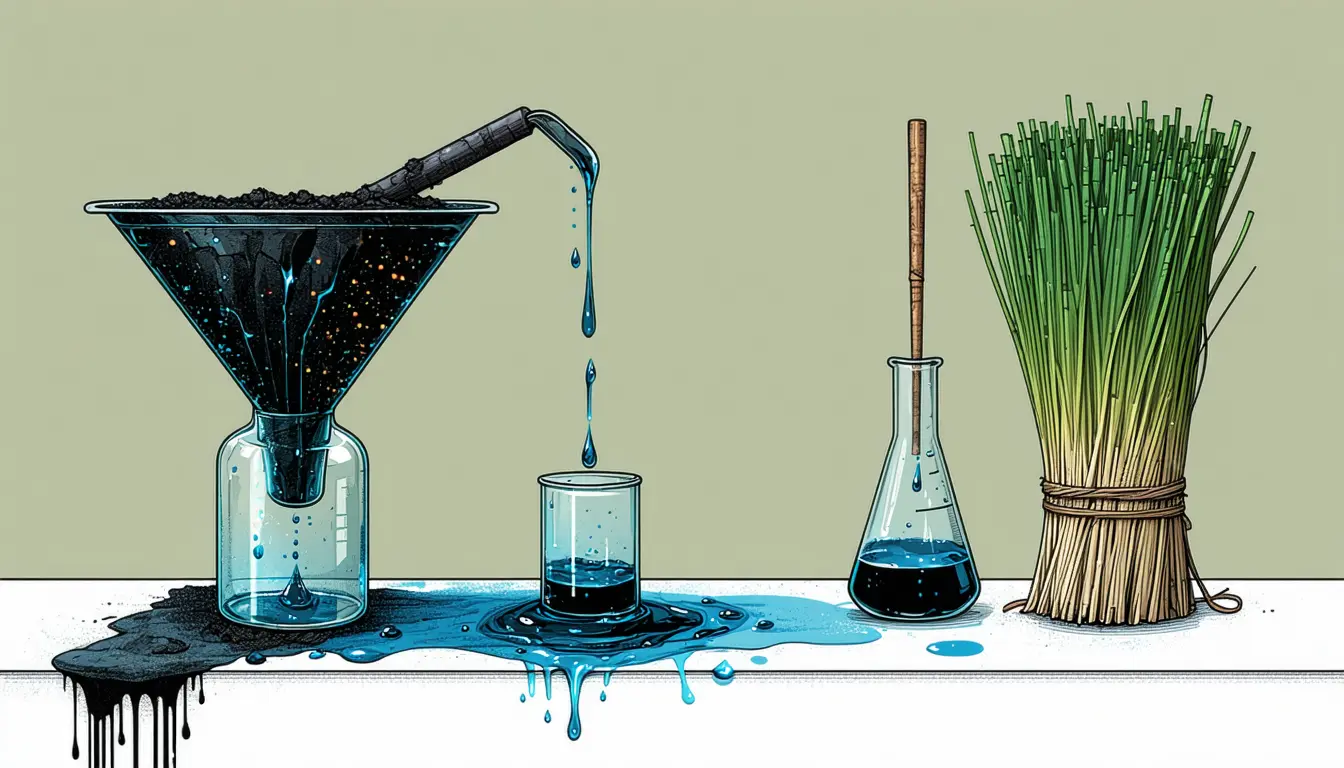
Bulrush brings its own reducing agent. The team heated the plant waste with copper(II) nitrate trihydrate and potassium hydroxide [5]. As the biomass broke down it gave off carbon monoxide and hydrogen, and those gases reduced the copper to metallic nanoparticles inside the carbon as it formed [6]. According to a phys.org report on the study, some metal-modification methods need a separate chemical reductant for that step [4]. Here the reduction happens in the same furnace run, with no second reagent added [6].
The dye tests were batch experiments [8]. The authors call the surface amphoteric, with a point of zero charge near pH 9.0 [9]. Uptake was uneven: sunset yellow's Langmuir maximum is about 57% of methylene blue's [1]. The equilibrium data fit the Langmuir isotherm best, and the team takes its pseudo-second-order kinetics as a sign that chemisorption largely controls the rate [10]. They credit four binding routes: electrostatic attraction, pi-pi stacking, pore filling and coordinate bonds to the metallic copper [11]. In their thermodynamic analysis, adsorption was spontaneous and released heat [10].
At 1,800 yen a kilogram [13], a kilogram loaded to methylene blue's Langmuir maximum holds about 62 g of dye. That puts the adsorbent at roughly 29 yen per gram of methylene blue on first use [2]. For sunset yellow the same division gives about 50 yen a gram [3]. Both are best cases. They come from fitted maximum capacities, before any regeneration spreads the cost over later cycles. The comparison a buyer would make is with commercial activated carbon, which the report describes only as costly to produce and regenerate [4].
Asif Ali, the Ph.D. student who developed the method with professors Michiaki Matsumoto and Yoshiro Tahara, framed the problem as one of discharge [2]. "An alarming 20% of toxic, recalcitrant textile wastewater is discharged untreated, causing severe damage to aquatic life and human health. So far, no single wastewater treatment method is universally suitable," he said [3]. The 20% is Ali's figure, given as motivation. The experiments measure something narrower: how much of each dye a gram of composite takes up [8][9].
Matsumoto put the weight on the feedstock. "Our study findings present the opportunity to advance a circular economy: valorizing invasive, zero-cost bullrush weed biomass into a functional carbon framework through an eco-friendly, single-step co-pyrolysis route," he said [15]. In my view the chemistry is the stronger half of the paper for now, and the wastewater framing the weaker. The zero-cost label applies to the raw weed. The report does not say how much bulrush a production run would consume or where it would be gathered [15].
What to watch
- Results on real textile effluent or mixed-dye solutions, which would show whether the single-dye capacities hold when dyes compete for the same surface.
- Column or pilot-scale runs, which would show whether batch capacities carry over to flow-through treatment and what each regeneration cycle costs.