Science1 publisher3 min readPublished
Engineered mice that should have died led a Montana State geneticist to a backup cysteine route
Montana State geneticist Ed Schmidt spent nine years finding the backup route that lets mammalian cells free cysteine when their main supply systems fail. Whether tumours use it to resist treatment is, for now, a possibility the university raises.
The Scientist · Science desk
What happened
- Montana State University geneticist Ed Schmidt reports in Nature Chemical Biology that mammalian cells have a second way to get cysteine from cystine.
- The first clue came in 2014, when engineered mice lacking any known way to convert cystine into cysteine survived conditions expected to kill them.
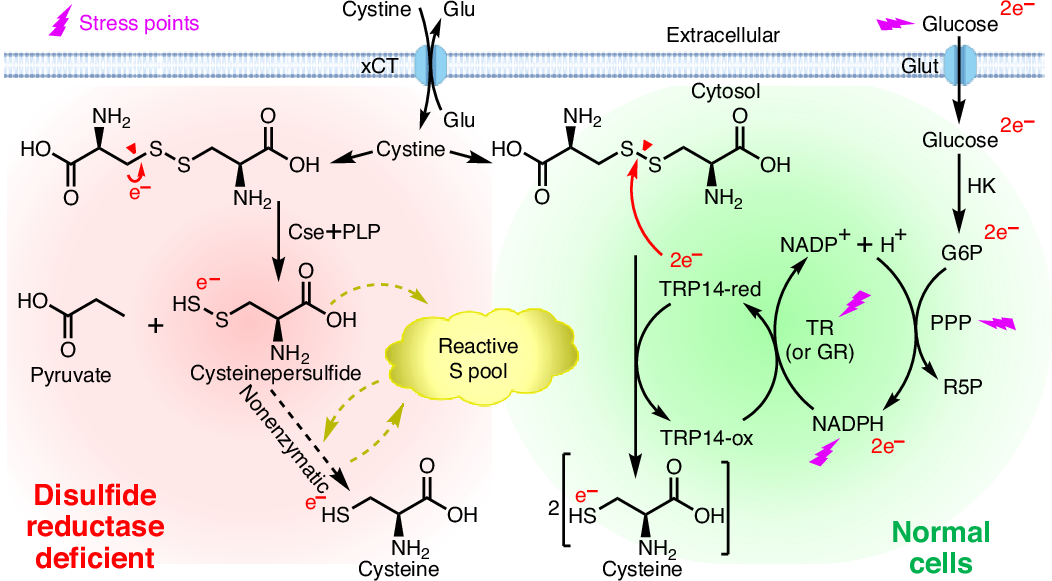
- When the usual disulfide reductase systems are unavailable, the backup route breaks an adjacent carbon-sulfur bond within cystine and ultimately frees cysteine.
- Schmidt said the system may have evolved as a defense against electrophilic toxins, which organisms make as chemical weapons against predators and competitors.
Compiled by The ScientistSomething wrong?How this is made
Why it matters
- constraint Any treatment that tries to starve cells of cysteine by disabling their disulfide reductases now has to account for a known escape route.
- decision Before the route can be treated as a cancer target, someone has to show that tumour cells depend on it under treatment; the university offers that link only as a possibility.
- capability A named bond gives chemists a specific reaction to measure and try to inhibit, where before there was only a survival nobody could explain.
"All cells need a constant supply of an amino acid called cysteine in order to stay alive," Schmidt said. "Yet cysteine is not available outside of the cells." [10] The textbook answer was that cells make it by breaking apart cystine, its oxidized form, with a disulfide reductase system. At least one working version of that system was assumed to be essential for life [9].
The mice that overturned the rule came out of an experiment built to test it. Schmidt had already engineered mice whose liver cells lacked one or the other of the two main disulfide reductases [4]. A single knockout that survives only shows that the remaining enzyme can cover for the missing one. The strict test of the claim that at least one is essential is an animal missing every known route, and according to the release that is what the 2014 colony lacked [3]. "Some of the physiological responses we were seeing in the livers of each of those mouse lines suggested to me that the belief that no cell could live without having at least one of these two reductases might not be correct," he said. "I wanted to test this." [5]
"This was supposed to be impossible," Schmidt said of the surviving mice. "No living organism or cell had ever been found that could live without having a functioning disulfide reductase system." [6]
A surviving mouse shows that cysteine reached its cells by some route, but not which one. Identifying it took seven more years [7]. Peter Nagy's group at the Hungarian National Institute of Oncology in Budapest supplied the analytical capabilities that showed how cells lacking a working reductase system still got cysteine from cystine [7].
The thing this doesn't tell you is the effect size. The release does not say how much cysteine the backup route supplies compared with the reductase systems in an ordinary cell. Schmidt describes it as a stand-in: "we have discovered a previously unknown system in mammalian cells that can take over when the main systems fail," he said [14].
The university states the cancer case conditionally. It says the same survival route "may help cancer cells resist treatment," and that shutting it down could make tumours easier to kill [12]. The living animals in the account are mice, and the route itself was pinned down by chemistry on cystine [3][8]. To become a drug target, it would need tumour cells that depend on it during treatment, and a way to block it that healthy tissue can tolerate.
I think the biology is the strong half. A mouse that lives where the accepted rule says it should die is a clean result, and this one came from a design aimed directly at that rule [3][4]. By the university's own wording, the cancer half is still a possibility [12].
What to watch
- Tumour studies showing that cancer cells switch to the carbon-sulfur route during treatment, or that blocking it makes them easier to kill.
- Measurements of how much cysteine the backup supplies compared with the disulfide reductase systems, and in which tissues it operates.
- Evidence that the route works in human cells, beyond the engineered mice where it was found.