Science1 publisher2 min readPublished
Predatory wasps move into Bornean ant-plant stems far more often in oil palm plantations
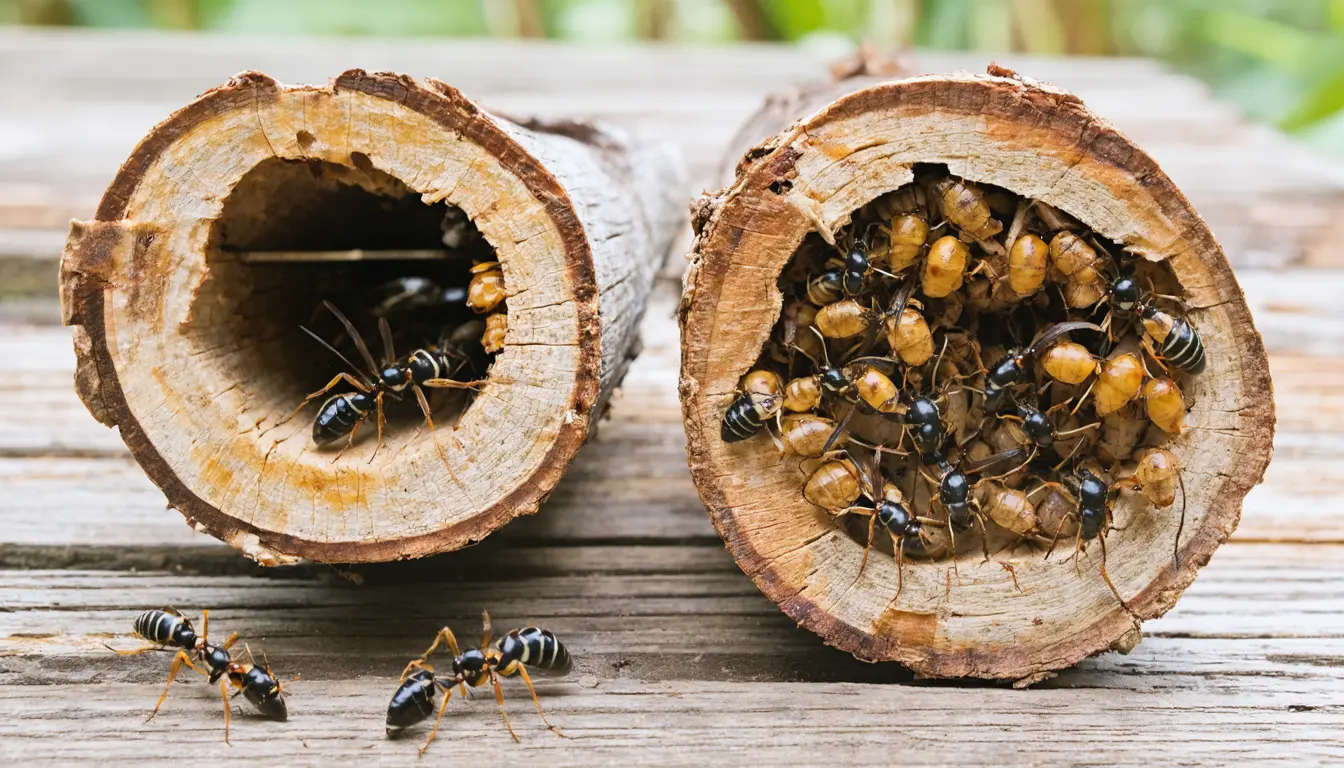
Predatory wasps are nesting in the stems Macaranga trees have grown for ants for at least 10 million years, most often in Borneo's oil palm plantations. Trees with wasps had smaller ant colonies, but nobody has yet tested whether the wasps are evicting the ants.
The Scientist · Science desk
Drafted by a language model from the sources cited here and checked against its claim ledger before publication. How we use AISend a correction
What happened
- Macaranga pearsonii gives ants hollow stem chambers and nutritious food bodies, and in return the ants attack leaf-eating insects such as caterpillars.
- The team dissected young Macaranga pearsonii trees from logged forest and from oil palm plantations in Malaysian Borneo to see what was living inside the stems.
- The researchers do not yet know whether the wasp species is native to Borneo or was introduced there.
- The work, by a team including Queen Mary University of London, Kew and the Czech Academy of Sciences' Biology Center, was published in PeerJ.
Compiled by The ScientistSomething wrong?How this is made
Why it matters
- constraint Both sampled habitats were already disturbed. The survey can tie heavier disturbance to more wasps, but it cannot show the partnership breaking down compared with intact forest.
- exposure Macaranga trees are among the first to colonise cleared land. If the wasps do weaken their ant defence, the cost lands on regrowth across logged and plantation landscapes.
- decision If the wasp is introduced, managers face an invasion to control. If it is native, disturbance is letting a local predator into the partnership, and that calls for a different response.
Opening the stems is what exposed the wasps. "While surveying these ant-plants, I noticed that many stems had been hollowed out in an unusual way. When we opened them, they were full of flies being eaten alive by wasp larvae. Adult wasps hunt and paralyze the flies, then store them inside the plant's cavities as food for their young," Lestina, the study's lead author, said [5].
People have altered both habitats in the survey [4][6]. Wasps were much more likely to turn up in plantation trees than in logged-forest trees [6], so the comparison runs from disturbed land to more heavily disturbed land. The release summarizing the paper does not mention unlogged forest or repeat surveys. It also does not give how many trees were dissected, what share held wasps in each habitat, or any measure of leaf damage [11]. The release says wasps are "increasingly" occupying the stems [1], but the design it describes has no time series and could not measure a trend.
The ant colonies are harder to interpret. Trees with wasps consistently held much smaller colonies [7]. Two explanations fit. Wasps could be pushing the ants out, or they could be moving into stems where a colony was already small or failing for some other reason. The authors say experiments would be needed to confirm displacement [8].
The forest-recovery argument depends on that answer. Macaranga species are often among the first plants to establish on cleared or damaged ground [12]. "If the plants lose their ant defenders and become less healthy, it could hinder forest recovery following disturbance," said co-author Kalsum M. Yusah [13]. Both conditions in that sentence are still open, and the authors themselves say the first one is unconfirmed [8].
Yusah placed the result in a wider pattern. "Human activities are transforming habitats worldwide, and this kind of shift in species interactions is exactly what we expect to see," Yusah said [10]. I think the field observation is sound. The link to disturbed habitat is credible, but only as strong as a survey of two habitats allows. A broken 10-million-year partnership [3] and slower regrowth are hypotheses that still need the experiments.
"When mutualistic benefits break down, it can drive long-term evolutionary change," said Fayle, the senior author, at Queen Mary University of London [14]. "If these structures become less valuable to the plants because wasps exploit them, the plants may stop investing in them," Fayle said [15].
What to watch
- Ant-removal or wasp-exclusion experiments on Macaranga pearsonii that test whether the wasps actually displace ant colonies.
- Surveys of the same tree species in unlogged forest, giving a baseline for the logged-forest versus plantation comparison.
- Taxonomic work that settles whether the wasp is native to Borneo or introduced.