Science1 publisher2 min readPublished
Temperature and rainfall track pollination specialization more closely than latitude does
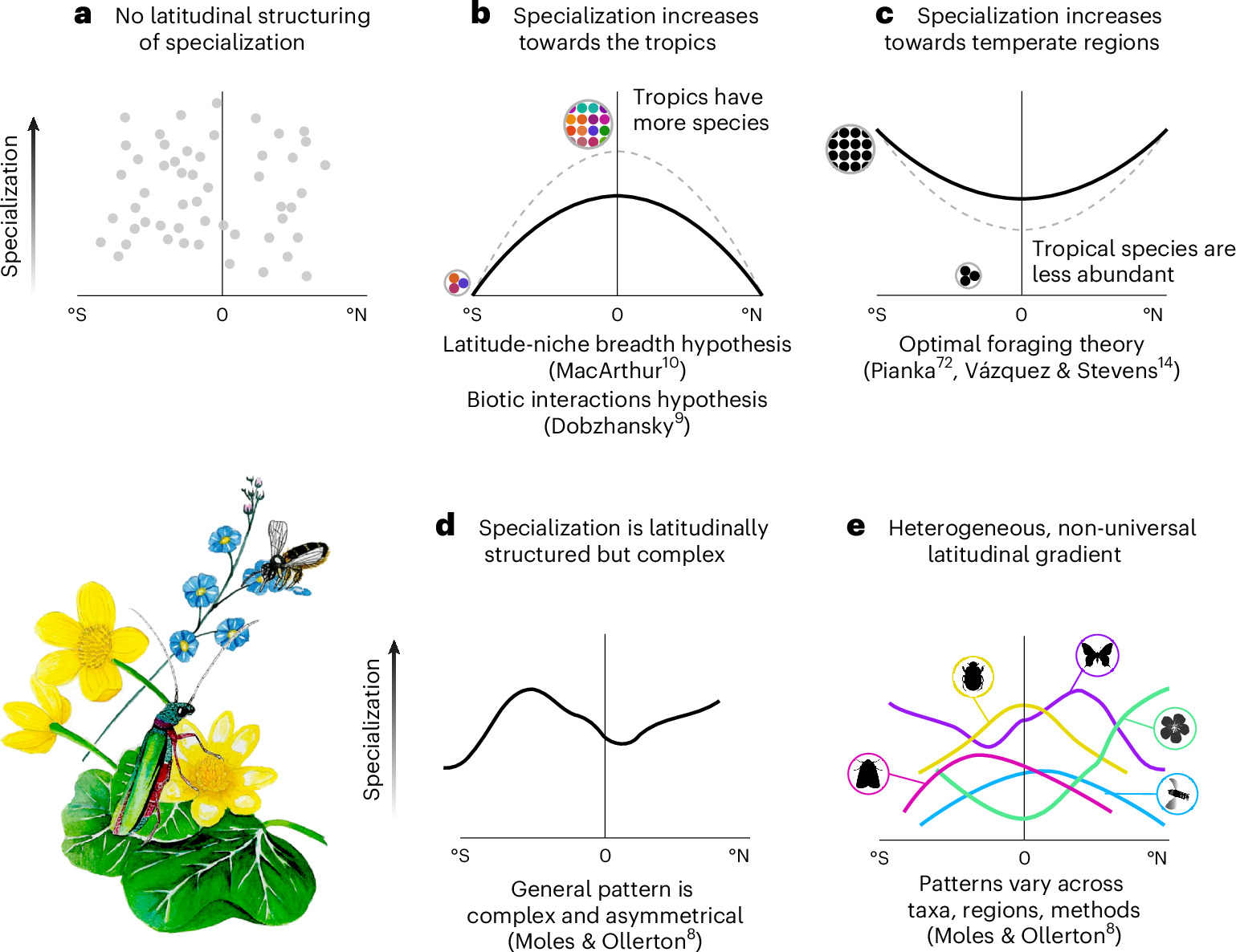
Charles University-led researchers pooled 3,415 plant-pollinator networks and found climate explains specialization better than latitude does. The result challenges the classic expectation that pollination grows more specialized toward the tropics.
The Scientist · Science desk
What happened
- The pooled data hold more than 110,000 links among 5,343 pollinator and 6,126 plant species, covering every major land biome including tropical forest, Mediterranean shrubland and subarctic tundra.
- Specialized partnerships were not more common in the tropics, and specialization often peaked near the northern boundary between the tropics and subtropics.
- Each group of plants and pollinators followed its own pattern, and the effects of climate differed greatly from one pollinator group to another.
- The study, published in Nature Ecology & Evolution, drew together 142 researchers from 32 countries on six continents.
Compiled by The ScientistSomething wrong?How this is made
Why it matters
- exposure Crops tied to specialist pollinators carry the most exposure if warming moves flowering dates or pollinator activity, because a specialist has fewer partners to fall back on.
- decision Ranking pollination systems by climate vulnerability has to be done one pollinator group at a time, since a single pole-to-equator curve would misplace groups that respond differently.
- constraint A cross-site comparison cannot say how one network will change as its own climate warms; that forecast needs repeated surveys of the same places over years.
The tropical expectation had a sensible basis. Tropical communities hold more interacting plant and animal species, so many ecologists assumed specialist pairings would be commoner there. The idea had gone largely untested because suitable data did not exist [8].
Lead author Sailee Sakhalkar, who recently completed her doctorate at Charles University, described what a specialist gives up [15]. "Specialization can be understood as an evolutionary bargain. A close match can make feeding and pollination very efficient, but it also increases dependence. If one partner disappears or becomes active at a different time, a specialist has fewer alternatives," she said [10].
The study is a synthesis. A network here is a set of links between plant and pollinator species, and the team pooled them from 162 studies, about 21 networks per study [2][1]. Spread across all 3,415, the links average a little over 32 per network [3][2]. "No single team could study pollination on this scale," Sakhalkar said [11].
Robert Tropek, head of the Insect Community Ecology Research Group, jointly led the work at Charles University and the Biology Centre of the Czech Academy of Sciences [15][1]. He argued that latitude was never the variable organisms respond to. "We tend to draw geographic patterns in pollination as lines running from the poles to the equator, but plants and pollinators do not experience latitude itself. They experience heat, cold, rain and changing seasons, each in their own way," he said [12].
Tropek's point is about proxies, and the climate result fits it [6]. It is still a correlation across sites. The thing this doesn't tell you is how wide the margin between the climate and latitude models was. The public summary does not report the specialization index, the effect sizes, or how the analysis handled differences in sampling effort among the 162 studies [2]. I think the descriptive result about the tropics is on firm ground, since it rests on thousands of networks [5]. How much temperature and rainfall add over latitude is a figure that has to come from the paper's own tables.
The split among pollinator groups is the part with consequences for climate forecasting. Rising temperatures and altered rainfall can change where species live, when plants flower and when pollinators are active [13]. "A bee, hoverfly, moth and hummingbird differ substantially in their bodies, behavior and ways of using flowers. Their relationships with plants may therefore respond very differently to changes in temperature and rainfall," Sakhalkar said [14].
What to watch
- The paper's effect sizes and specialization index, showing how much more of the variation temperature and rainfall explain than latitude.
- Repeat surveys of the same networks across years that test whether local specialization shifts as temperature and rainfall change.
- Group-level breakdowns for the pollinators that crops with specialist relationships depend on.